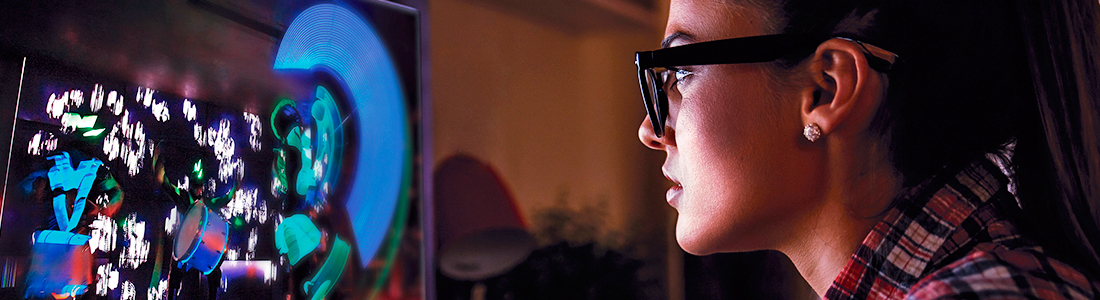
In a world that revolves around technology, technological arts in digital environments have emerged as the new forms of artistic expression that inspire new generations. These disciplines, which emerge from the interaction of electronic technologies with art, are not only becoming increasingly relevant as digital media expands but, unlike other artistic revolutions, they present themselves as a career path with great potential and also as an area of academic study.
Just like memes and GIFs, other forms of digital art include 3D-printed sculptures, video mapping, works by video jockeys, virtual reality, and interactive installations, among others.
The development of these projects requires expertise across many disciplines and the collaborative efforts of professionals in computer science, technology, design, and communication. Furthermore, their application extends beyond the realm of pure artistic expression; they are also valued in the creative and cultural industries, the entertainment industry, advertising, contemporary museology, and communication.
The Evolution of the Avant-Garde
 Digital art does not emerge as a counterpoint to traditional fine arts. The fundamentals are the same, but in this case, it represents an evolution that builds on the work of the 20th-century avant-garde and makes use of modern technology.
“This is nothing new, since all artists have, at one time or another, worked with the technology of their day; oil painting, for example, was the technology of its time during Leonardo da Vinci’s era. But in the 21st century, it is the so-called ‘new technologies’ that are being put to use in the service of art, and for the first time, they allow us to break down reality to convert it into data and create multimedia products,” said Fabián Barros, who holds a Master’s degree in Digital Arts from Pompeu Fabra University in Barcelona, is a professor of Multimedia and Digital Arts in the School of Communication and Design, a creative director in advertising, a multimedia artist, and the academic director of the new bachelor’s degree program.
On that basis, digital art began to take shape in the 1950s, when the first computers appeared; it then experienced its first boom in the 1990s and reached a second peak 10 years ago, in the 21st century, with the development and widespread adoption of smartphones.
Although it could be said that its roots lie in photography and the avant-garde art movements of the 20th century (Dadaism, Expressionism, Cubism, Surrealism, among others), digital art emerged with the advent of new technologies.
The earliest experiments in digital art emerged when the first—and enormous—computers arrived at universities in the 1950s. There, some experts began experimenting with inputting data to produce visual results. They used, for example, the then-novel ASCII code, a numerical language that allows computers to understand and process commands. However, some experts used this code as an artistic tool, creating drawings from numbers and letters—a technique that has been compared to pointillism. This artistic technique is rarely used today, but there are programmes ASCII Art Studio that allow users to experiment with that old tool.
 It wasn’t until the advent of the Internet that digital art took its first major leap forward. “In the 1990s, an artistic movement known as NetArt emerged, which used the Internet as its medium, just as the canvas had been used before,” Barros explained. It was also driven by the romantic idea—which had its roots in the avant-garde—that art is for everyone and that anyone can make that art their own.
Among the leading figures of pioneering NetArt is Jodi, an Internet art duo consisting of Dutch artist Joan Heemskerk and Belgian artist Dirk Paesmans, who created artworks on and for the then-emerging World Wide Web. Some of their works can be viewed at the intriguing address wwwwwwwww.jodi.org, and especially in its source code, which is puzzling at first glance but invites you to learn more about the duo’s concept and history.
Now in the 21st century, with the advent of social media, NetArt has been given a new lease on life and is expanding. This is true of memes, which are seen as a quintessential form of NetArt and serve as a means of conveying information in a condensed form.
Barros, who describes himself as a “passionate advocate of memetics”—the formal study of memes—explained that memes stem from the theory of British biologist Richard Dawkins, who published *The Selfish Gene* in 1976. In that book, the author draws a parallel between the gene, as the smallest unit of biological information transmission, and the meme, as the smallest unit of cultural information transmission from one individual to another.
The rise of social media as a means of communication created a breeding ground for memes, which today include not only traditional images with short captions, but also GIFs, text, videos, and other forms of content that spread virally across the internet. That is their essential characteristic.
From software to hardware applied to art
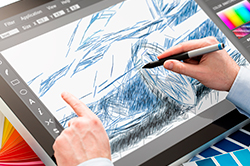 Alongside technological advancements, digital art continued to evolve and began to move beyond software, extending into machines and hardware. This gave rise to new forms of digital art, such as interactive installations. These forms of expression use sensors to capture the movements of users, actors, or dancers and transform them into visual, auditory, and even olfactory representations, with the aim of creating immersive, multisensory experiences.
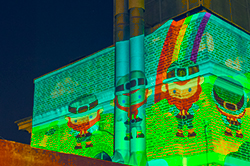
Another branch of digital art is video mapping, a technique for projecting images onto existing surfaces, ranging from a wall to an entire cathedral. These projections—created using powerful equipment with high-quality image processing capabilities—feature animations accompanied by sound, creating an audiovisual spectacle designed either to tell a story or simply to produce a temporary work of art.
Similarly, VJ-s emerged in the electronic music clubs of the 1980s and are dedicated to mixing video clips in time with the music played by a DJ or by themselves. Although in their early days they used primitive equipment such as VHS players and old projectors, technological advancements have expanded their creative possibilities through digital formats that allow them to manipulate images and explore new narratives using ultra-fast computers, synthesizers, and high-definition projectors.
A labor market that is constantly growing
In all these fields of digital art, the creation of works does not stem from a single artist, but rather requires input from various disciplines and talents, ranging from screenwriters, audiovisual technicians, software engineers, sound engineers, musicians, visual artists, electricians, and communicators. “It’s a vast world, and the possibilities are still evolving,” Barros said.
In fact, one distinctive feature of digital art today is that it is not confined to the realm of fine art, but has gradually found its place in the job market.
In the field of video mapping, for example, there is corporate mapping, which is used by companies and advertising agencies to showcase brands or products. The backdrop for these creative campaigns can be buildings or other urban settings that provide high visibility for the presentation.
The same is true of VJs—who are hired as stars at electronic music clubs but also work in advertising, at public events, and on TV shows—or of those who create digital installations, who may work at cultural centers, museums, and theater companies to develop multisensory exhibitions.
Similarly, those who create 3D sculptures—another discipline within digital art—can apply their expertise to education and the preservation of cultural heritage, for example, by creating 3D records of heritage works to make them accessible to people who cannot visit them in person, among other uses.
“There will be more and more opportunities for digital artists in the traditional market,” Barros said.
A new career
 With an eye toward these opportunities in the job market, Universidad ORT Uruguay a degree program that combines its strong track record in digital technologies, its pioneering role in design, and its expertise in the field of communication—particularly in the audiovisual sector.
Drawing on knowledge from these three areas, the curriculum is structured around concentric layers of learning that become increasingly in-depth each year throughout the four-year bachelor’s degree program.
"In the first year, students will be introduced to drawing, painting, the fundamentals of design, form, color, and photography, to begin understanding how these tools work in the digital arts," explains Barros.
In their second year, students will begin studying moving images, video art, experimental animation, NetArt, and sound art. In their third year, they will explore the performing arts in digital environments, video manipulation, the world of video jockeys, robotics, and interactive installations; and in their fourth year, they will analyze trends such as virtual reality and artificial intelligence, among other fields that are still in their infancy.
For students, Barros says, it will be “a journey of exploration” that will introduce them to various disciplines and help them find their preferred field and a place in the workforce.