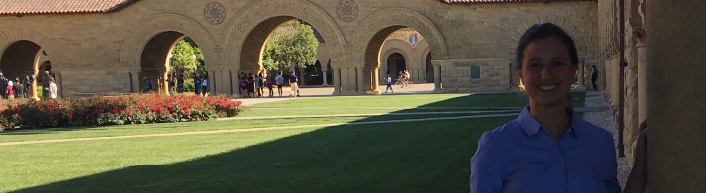
Architecture, civil engineering, and a dream. These three things led Cynthia Brosque to Stanford University, where she began a master’s program a few weeks ago.
Although she is an architect, in an era when educational paths are neither linear nor rigid, she decided to change career paths and pursue a degree in civil engineering. That is precisely why she came to Stanford University after being awarded the Outstanding Fellowship, a full scholarship offered by the university.
Cynthia has always been interested in structural analysis and design. During her studies, she worked at a construction company and an architecture firm, and that experience gave her a comprehensive, holistic view of architectural projects. That’s why, upon graduating, she knew immediately what she wanted to do.
“The opportunity to pursue a master’s and a doctorate in civil engineering arose because it was the field where I felt most at home professionally. I saw myself deepening my knowledge to focus my efforts on research in this field, where there is so much to be done,” she said from her new home in Palo Alto, California.
He then weighed his options and made up his mind. “I went to the ORT International Office, where I found support in the form of various scholarships and options depending on the type of program I wanted to apply to. From the start, Stanford stood out as the strongest choice because of the program’s focus, which is based on close collaboration with other departments within the university,” he explained.
Throughout the application process, the young architect highlighted the support she received from Prof. Daniel Chamlian, an architect with whom she also worked; Dr. Laura Moya, an architect and research professor at the School of Architecture; and Fernanda Pucciano, the school’s graduate coordinator.
With these contributions, Cynthia submitted her application to Stanford University, highlighting her interest in integrating a deeper understanding of structural engineering and sustainability into her architectural training, as well as in fostering interdisciplinary collaboration. She was ultimately awarded the scholarship, which will allow her to complete a one-and-a-half-year master’s program and also gives her the opportunity to continue on toward a Ph.D.
In her case, she will work as a research assistant alongside the professor and president of the Center for Integrated Facilities in Engineering (CIFE), a multidisciplinary center that specializes in developing technologies, tools, and methods to improve the architecture, engineering, and construction (AEC) industry.
According to its website, its mission is to be the world’s leading academic research center in these three disciplines and to support developments and practices aimed at planning, designing, and building sustainable projects.
With that in mind, Cynthia chose the Master’s in Civil and Environmental Engineering, which stands out for its combination of numerous research opportunities with a wide range of courses covering everything from structural design and analysis, construction theory, project management and leadership, to sustainability. The program also has software and computational methods for modeling and calculating project performance using various models and platforms.
As an architect, this master’s degree allows you to join a group that seeks to integrate design in order to prevent fragmentation among the three disciplines (AEC), a problem that often affects the quality of the project and its costs over the life of a building.
In this regard, CIFE conducts research aimed at driving innovation in the fields of design and civil engineering, ranging from how to develop more sustainable building designs by combining structural and non-structural elements to how to utilize more efficient and easily maintainable infrastructure.
Stanford’s international reach also ensures that these solutions do not remain merely on paper but are tested in different parts of the world, for example, through the support of the Global Project Center, which collaborates with universities in various countries.
At Stanford, the Department of Civil and Environmental Engineering is a cornerstone of the institution, having existed since the university’s founding in 1891. Today, 126 years later, Cynthia Brosque is embarking on a new career path there.