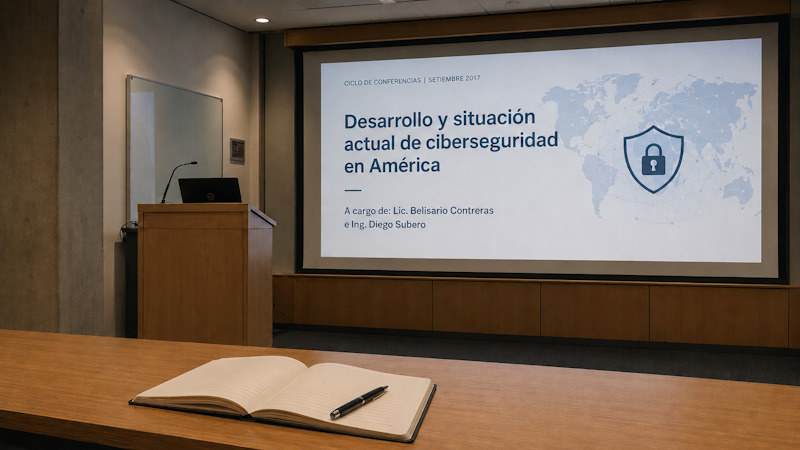
Mr. Contreras began his talk by stating that data is more valuable than oil and that, for this reason, cybersecurity strategies are necessary in both the public and private sectors. He also emphasized that “incidents are increasing year after year and are becoming increasingly sophisticated.”
No government in Latin America is secure, and if just one link in the chain fails, significant assets could be lost.
He pointed out that no one can be excluded from cybersecurity policies; otherwise, they are ineffective. “We must keep in mind that employees are the weakest link, but they are also the first line of defense.”
He recommended not blocking attackers right away, but rather waiting to see what they’re after and what they’re doing in order to figure out how to defend against them.
He also provided a brief overview of the different types of cyberattacks, highlighting phishing as the most common method and BEC (Business Email Compromise) attacks as the most successful.
BEC scams work by tricking an employee with access to financial accounts into making a transfer to an account they believe belongs to a customer or supplier, but the money ends up in the criminal organization’s bank account.
We must assume that the attacker is intelligent and will bypass all preventive measures.
According to Mr. Contreras , there are still many challenges to be addressed in Latin America and the Caribbean; for example, 30 of the region’s 32 countries lack national “ programmes ” to raise awareness about cybersecurity, 26 countries have not implemented national strategies, and 20 lack national command and control centers.
At the conclusion of the conference, Mr. Contreras stated that it is necessary to adopt a legal framework that enables the investigation and prosecution of cybercrime but, above all, protects citizens.