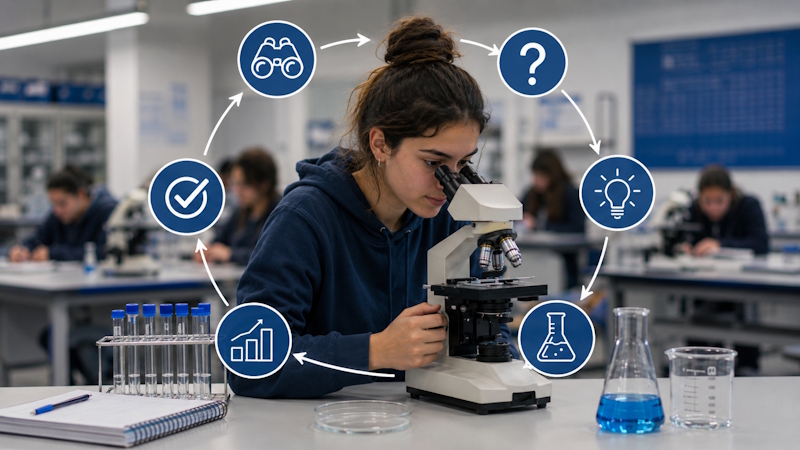
Each stage of the scientific method plays a role in the research process. From formulating a hypothesis to designing an experiment and analyzing the results, all of these steps are part of a procedure that allows us to draw evidence-based conclusions.
Understanding how the scientific method works is one of the first steps toward developing critical thinking skills and learning to solve problems logically.
Although it is often associated with major discoveries made in laboratories by professional researchers, this method is also used in education and in many everyday situations.
For students, learning how to ask questions and formulate hypotheses helps them better understand how scientific knowledge is constructed.
What Is the Scientific Method?
The scientific method is an organized set of practices and forms of reasoning that allows us to investigate phenomena, formulate explanations, and evaluate whether those explanations are consistent with the available evidence.
It is used to move from an initial observation or question to well-founded conclusions that can be reviewed and verified by others.
The techniques of the scientific method may vary depending on the discipline, the problem, and the type of information available.
Research in biology, for example, may require laboratory experiments, while a study in astronomy may rely primarily on observations and measurements.
In general terms, the scientific method is characterized by:
- Based on researchable questions: Scientific research seeks to answer specific questions about phenomena that can be observed, measured, or analyzed.
- be based on evidence: explanations do not depend solely on opinions, but must be verified against data obtained through observations, experiments, or other research methods.
- Combining observation and reasoning: Science involves both gathering data and learning to interpret information, identify patterns, and develop explanations.
- Facilitate communication: Procedures and findings must be presented clearly so that others can review, discuss, or attempt to replicate the research.
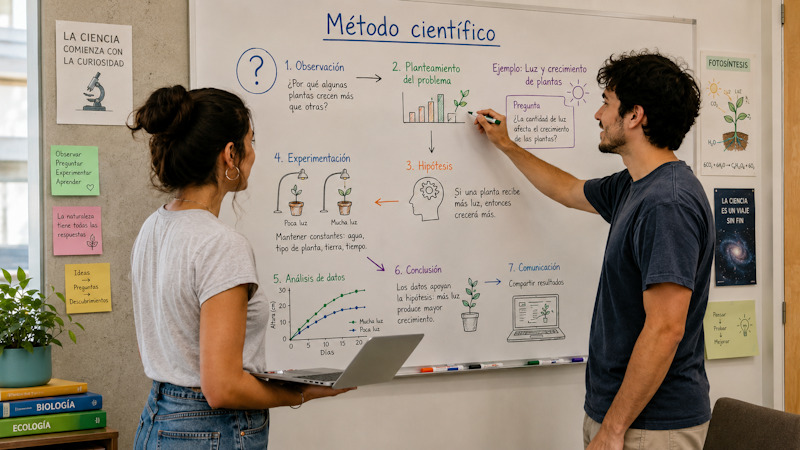
According to the Stanford Encyclopedia of Philosophy, the scientific method is not the final result of research, but rather the set of methods used to arrive at that result. In other words, the predictions and knowledge obtained are the products of science, while the method encompasses the tools and forms of reasoning used to produce them.
Applying this method does not guarantee a specific answer, nor does it completely eliminate errors. Its purpose is to provide a systematic and critical approach to generating knowledge based on evidence.
Is your future in science?
Discover the perfect major for you
What are the steps of the scientific method?
The scientific method follows a sequence of steps that allow researchers to investigate a phenomenon in an orderly manner and draw evidence-based conclusions.
According to an article on the Science Buddies website, not all areas of science can apply these steps in exactly the same way. Depending on the type of research, some steps may be repeated or adjusted, but the process usually begins with a question about something that has been observed and ends with the communication of the results.
1. Make an observation
Every scientific observation begins with identifying a situation that sparks curiosity. Instead of accepting what happens without questioning it, the facts are analyzed to identify what is worth investigating.
-
It allows us to identify phenomena that require an explanation.
-
It is based on observable facts, not on assumptions.
-
It marks the beginning of the scientific method and the research process.
Before asking questions or formulating hypotheses, it is important to observe the situation objectively and record what is happening. For example, a student observes that a plant near a window grows faster than another plant located in a spot with less light.
2. Formulate a research question
Once the observation has been made, the next step is to define precisely what you want to study. A well-formulated question guides the rest of the process and makes it easier to obtain results.
A good research question should:
- Be clear and specific
-
can be answered through observations or experiments
-
Avoid overly general or ambiguous statements
-
define the topic to be researched

Continuing with the example of a plant that grows faster near a window, an example of a research question might be: How does the number of hours of daily light affect a plant's growth?
3. Conduct a background check
At this stage, preliminary research is conducted to determine what information is available on the topic—for example, on photosynthesis and the light requirements of plants.
Reviewing reliable studies and materials helps you understand the context of the research and identify key concepts.
Information can be obtained from specialized books, scientific articles, university publications, or other up-to-date academic materials.
Reviewing the background of a research study also helps build a solid theoretical framework and formulate a more well-founded hypothesis.
4. Formulate a hypothesis
A scientific hypothesis is a provisional answer to a research question that proposes a possible explanation for the phenomenon under study.
A hypothesis should not be based solely on opinions or beliefs.
A good hypothesis must be based on data, be clear and specific, and be directly related to the research question.
A common way to write this is by using a cause-and-effect relationship, for example: if X happens, then Y will happen. For example: if a plant receives more hours of light per day, then it will grow more because it will be able to photosynthesize more effectively.
5. Design and conduct the experiment
The scientific experiment is the stage in which the evidence needed to test the hypothesis is gathered.
To obtain reliable results, the procedure must be carefully planned, ensuring that the conditions of the study are consistent and that only the factor being evaluated is altered.
In any experimental design, it is important to identify:
- independent variable: the factor that is deliberately altered
- dependent variable: the outcome or effect being measured
- controlled variables: the conditions that remain constant throughout the experiment
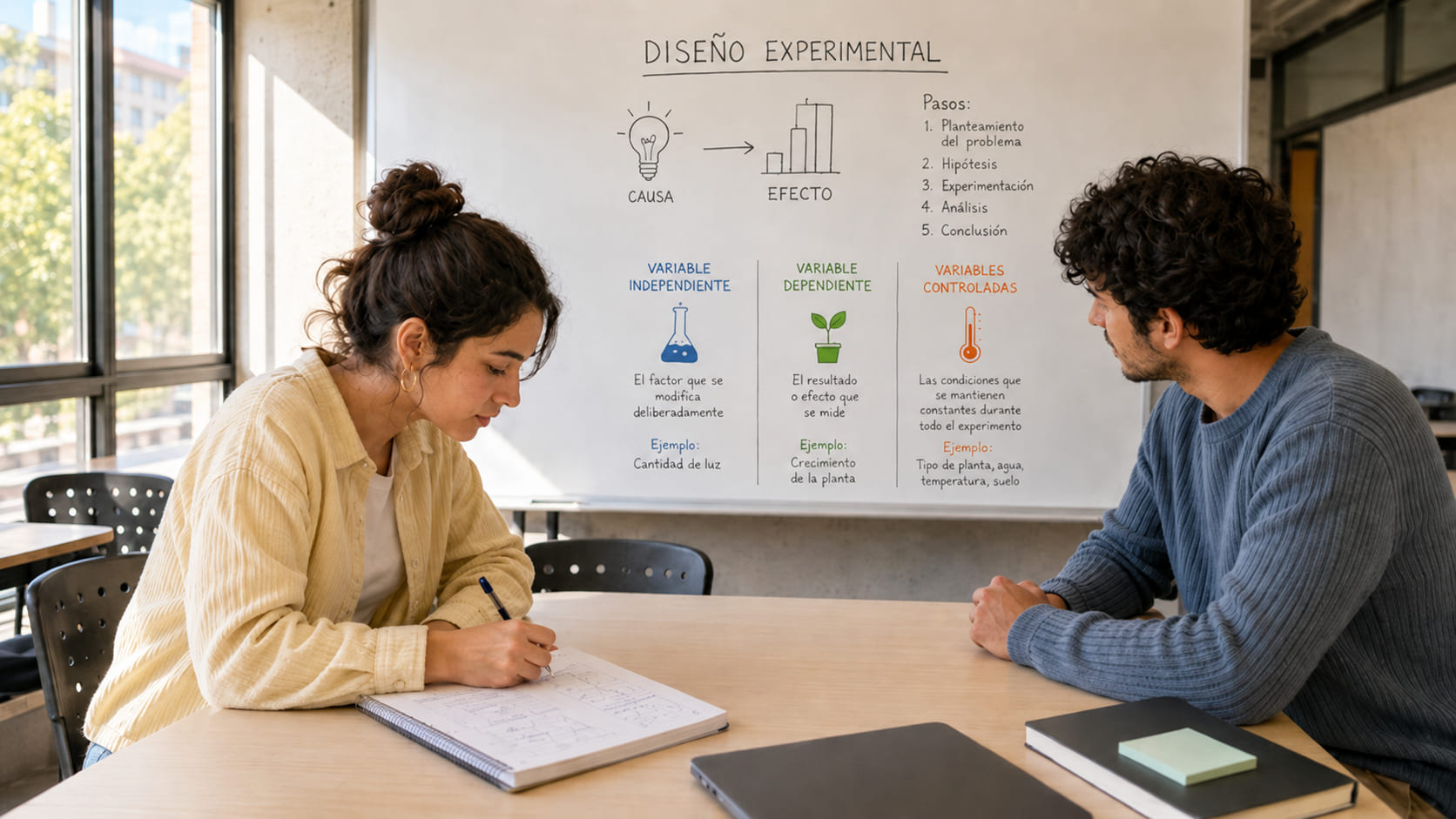
Continuing with the topic of photosynthesis, a clear example would be to place several plants under the same conditions, varying only the number of hours of light each one receives.
6. Record the results and draw conclusions
Once the experiment is complete, all the data collected must be organized to facilitate its interpretation. Data recording allows you to compare measurements, identify patterns, and detect possible differences among the results obtained.
The analysis of results involves interpreting that information objectively and assessing whether there is sufficient evidence to answer the research question.
Data can be recorded using tables of results, photographs, graphs, and notes.
Once the research data has been collected and interpreted, conclusions are drawn from it, bringing the scientific method to a close.
A good conclusion should:
-
answer the question posed at the beginning
-
be based on the evidence obtained
-
explain whether the hypothesis was supported by the results
-
identify potential limitations and areas for improvement for future research
For example, after analyzing the measurements, it was concluded that the plants with the greatest exposure to light grew more than the others, which supports the proposed hypothesis.
In addition to summarizing the most relevant findings, a well-crafted conclusion can serve as a starting point for new research or for further exploration of unresolved issues.
What happens if the hypothesis is not confirmed?
A hypothesis does not have to be confirmed for a study to be valid. Its purpose is to propose an explanation that can be tested and compared with the results obtained.
According to the Understanding Science project at the University of California, Berkeley, science neither proves nor disproves ideas absolutely. It accepts or rejects them provisionally based on the available evidence, so a conclusion may be revised if new findings emerge.
When the data do not support the hypothesis, this does not necessarily mean that the experiment has failed.
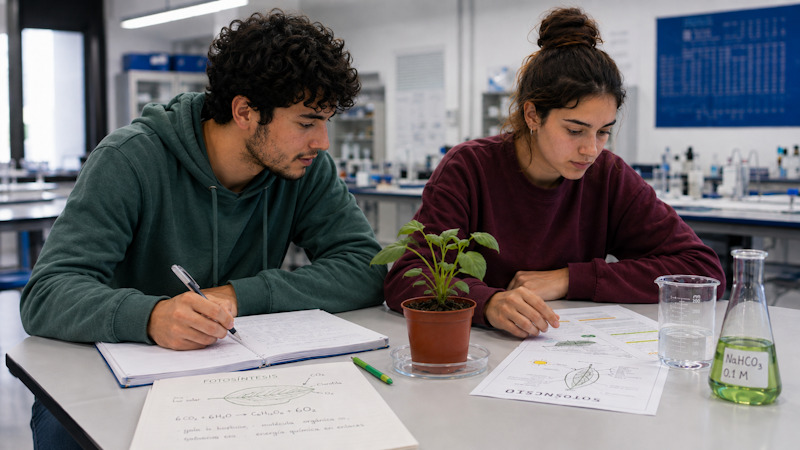
The difference between what is expected and what is observed also provides information and can help us better understand the phenomenon under study.
For example, a student hypothesizes that a plant will grow more the more light it receives, but the results show a different reality. The student must analyze what might have happened.
In this case, it is possible that the temperature was different or that some condition was not stable.
In these cases, it is necessary to review various aspects of the research.
-
accept what the data show and not force them to fit the initial hypothesis
-
review the experimental design and verify whether the variables were controlled properly
-
consider other explanations or factors that had not been taken into account
-
conduct several tests to determine whether the results hold true or whether they were influenced by a one-time error
Based on the evidence gathered, it may be necessary to adjust the initial explanation, test a new idea, or even explore other lines of research. In the case of plants, for example, one could investigate whether there is an optimal amount of light or whether the effect varies by species.
A hypothesis that is not confirmed should not be dismissed or considered useless.
The goal of the scientific method is not to prove that the initial idea was correct, but to discover which explanation best fits the available evidence.
- You may also be interested in:“Science-Backed StudyTechniques”
The knowledge gained through the scientific method is extremely valuable during the school years, when students begin to develop skills such as observation, critical thinking, and the ability to answer questions in a well-reasoned manner.
Beyond the experiments conducted in class, this approach can be applied to everyday situations in which it is necessary to test an idea or interpret data.
Is your future in science?
Discover the perfect major for you