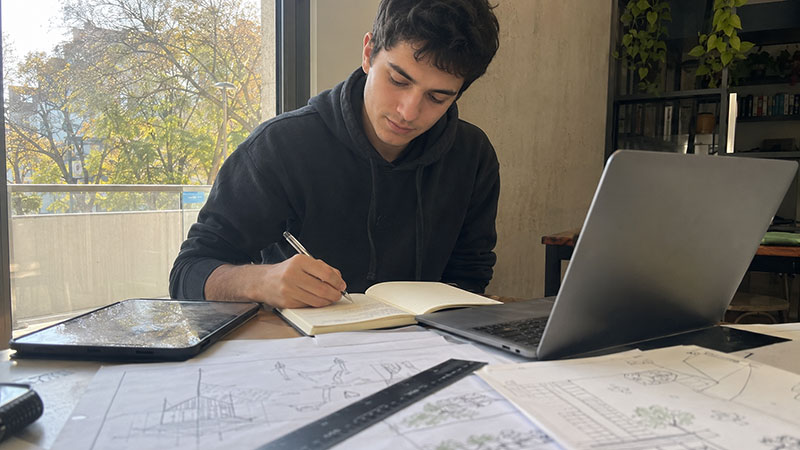
A technical degree is a higher education program focused on applied training in a specific professional field. Its main feature is not only that it takes less time to complete than a traditional university degree, but also that it focuses on a defined set of knowledge, skills, and tools related to a specific field of practice.
In UNESCO’s international classification, short-cycle tertiary education corresponds to ISCED level 5 and is generally designed to provide practical, occupation-oriented professional skills. This definition appears in *Short-cycle tertiary education*, published by the UNESCO Institute for Statistics.
This definition helps clear up a common misunderstanding. A technical program is neither a short course nor a one-off training session. It is a structured degree program with admission requirements, a curriculum, a graduate profile, and a degree.
In Uruguay, the Ministry of Education and Culture publishes a list of authorized private higher education institutions, as well as the accredited programs offered by private and public institutions, and distinguishes between universities, university institutes, and non-university higher education institutions.

This framing is important because it shows that the term “technical degree” is part of the higher education system and not separate from it.
That is why, when asked what a technical degree is, the most accurate answer is not simply “a short degree program,” even though that is often the case.
The most accurate answer is that it is a specialized higher education program designed to prepare students for a specific professional field, with a close connection between conceptual foundations and practical application. This combination explains why technical programs tend to attract students who are looking to enter a specific field early on without having to cover, from the outset, the full breadth of a broader discipline.
Are you thinking about pursuing a technical degree?
Learn about all the options available at ORT
Why a vocational program is not the same as a college degree
The difference between a technical program and a university degree is not simply a matter of the number of years. Duration matters, but what really matters is the scope of the education.
An undergraduate degree program typically provides a broader education within a discipline: it explores theoretical foundations in greater depth, incorporates more comprehensive methodological frameworks, and, depending on the field, offers more opportunities for research, disciplinary analysis, management, or further specialization.

According to UNESCO’s classification, this level corresponds to the university degree or equivalent, which is classified as ISCED 6. This category is defined as“Bachelor’s or equivalent level” by the UNESCO Institute for Statistics.
Simply put, vocational training tends to focus on questions such as“what skills does a person need to perform well in this field,”whereas a university degree program takes a broader approach, addressing questions such as “what are the underlying principles of this discipline,” “what theoretical frameworks underpin it,” and “how is knowledge analyzed or produced within it.”
This isn't about one option automatically being better than the other. These are two different approaches with different purposes.
This difference is reflected in the curriculum design. In vocational programs, there is typically a more limited selection of content and specialization begins earlier. In longer university degree programs, on the other hand, the curriculum is generally more comprehensive, both in terms of the number of subject areas covered and the level of conceptual depth in each.
The shorter duration of a technical degree program is not a mere detail: it reflects a deliberate curricular choice to focus on specific areas.
What's changing in the learning experience
For a high school student, the difference isn't just in the final degree. It's also evident in the way students learn. In a technical program, it's common to have workshops, labs, projects, case studies, and hands-on experience with professional tools from the very beginning of the program.

This type of structure fosters a more direct understanding of the purpose of each course and how it relates to specific problems. Undergraduate degree programs, on the other hand, typically devote more time to disciplinary depth, the discussion of different approaches, methodological training, and the development of a broader conceptual foundation.
This can be particularly valuable for those who want a broader education before specializing, or for those who envision future paths that include research, teaching, administration, or graduate studies. This difference in experience does not mean that one option is necessarily better than the other; it simply means that they cater to different expectations.
Are you thinking about pursuing a technical degree?
Learn about all the options available at ORT
What are the benefits of a technical degree?
The main advantage of a technical degree is its focus. By concentrating the program on a specific field, it allows students to develop a clear professional profile in less time, with a clear link between course content and practical experience. For many young people who are still figuring out their interests, this feature alleviates the feeling that they are entering a program that is too broad or abstract.
Another advantage is its applied focus. The international definition of short-cycle tertiary education itself emphasizes professional knowledge, skills, and competencies.

In the case of Uruguay, moreover, several public and private programs demonstrate this combination of specialized theory, practical tools, and problem-solving. This makes vocational training a good option for those who value learning by doing and want to make progress from the outset in a well-defined field of interest.
It may also be a good option for those who want to enter the workforce relatively early or prefer to start with a program focused on a specific field before deciding whether to pursue longer-term studies.
One example is the Associate Degree in Business Administration offered by the School of Economics and Business Administration at the University of the Republic, which is designed to prepare students for mid-level management roles and can be combined with other academic pathways.
What not to expect from a technical degree
To fully understand what a technical degree is, one must also recognize its limitations. Since it is a more focused program, it generally does not offer the same breadth of disciplines as a comprehensive university degree.

This can result in less emphasis on certain theoretical foundations, a narrower range of approaches, or a more limited methodological training than that offered by some bachelor’s or engineering programs.
Specificity does not render technical expertise “insufficient”; it simply defines its purpose.
Therefore, the decision should not be framed as a simplistic choice between a “better” option and a “worse” one. The most useful question is which of the two best suits the student’s educational journey and goals.
Those seeking a broader foundation, more time for disciplinary exploration, and a path with greater academic scope will likely find a better fit in a bachelor’s degree program. Those seeking applied, specialized, and more focused higher education may find a technical degree to be a better entry point.
Are you thinking about pursuing a technical degree?
Learn about all the options available at ORT
Examples of technical terms to help you better understand the concept
These examples help illustrate that technical expertise is not limited to a single sector.
At ORT, this type of training is offered in a wide variety of fields:
- at the School of Business and Social Sciences, offering programs such as Associate Degree in Business Management and Administration and Associate Degree in Tourism and Hospitality Management;
- at the School of Architecture, offering programs in Interior Design and Landscape Architecture;
- at the School of Communication, offering programs such as Public Relations and Event Planning Technician and Advertising and Digital Communication Analyst;
- in the School of Design, with Graphic Design and Digital Design; and
- at the School of Engineering, as a Server and Application Administrator and IT Infrastructure Analyst.
Taken together, these options show that a technical degree program can focus on management, communication, project work, design, or technology, but they all share a common feature: applied higher education, with a professional profile established from the early stages.

The public system also offers other technical and technological higher education pathways with similar names. UTU’s range of tertiary education programs confirms that higher education in Uruguay is not organized along a single track, but rather in various formats with different levels of scope, duration, and specialization.
That diversity is important because it helps dispel the notion that all higher education must necessarily take the form of a long university degree program.
How to Tell If a Technical Degree Is a Good Choice
For someone who is finishing high school, the best question isn’t “what’s best overall,” but “what kind of education do I need right now?”
A technical degree program is often a good choice when there is a clear interest in a specific field of application, when learning through projects and hands-on tools is valued, and when building a specific professional profile within a shorter timeframe is appealing.

A university degree may be a better fit for those seeking a broader disciplinary foundation, more time to explore subfields within the discipline, and a more comprehensive conceptual education.
In either case, the key is not to focus on the name of the program, but rather to examine its curriculum, duration, graduate profile, and the types of problems it teaches students to solve. Students make better choices when they understand the educational model behind the degree.
In short, a technical degree is a higher education program focused on applied training in a specific field.
It differs from a university degree program in that its scope is typically more focused, its curriculum prioritizes more specific professional skills, and it tends to lead to specialization at an earlier stage.
In Uruguay, this distinction is significant: understanding it helps students make better choices among programs that are part of the same higher education system but follow different educational approaches.
Are you thinking about pursuing a technical degree?
Learn about all the options available at ORT