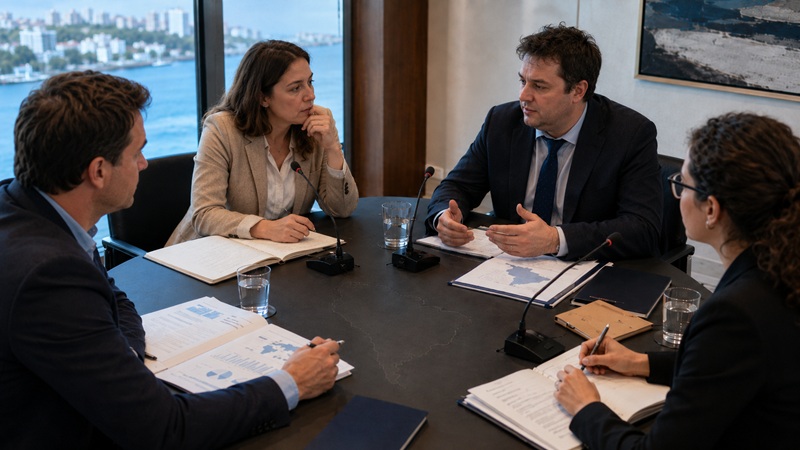
A panel discussion that examines, through three real-life examples from Uruguay, how communication becomes a tool of power for negotiating, influencing, and shaping the public agenda.
-
Date: Aug. 4, 2026
Time: 7:00 p.m.
Location: School of Communication - Auditorium - 1185 Uruguay Ave.
Live stream: Zoom
How does a multinational corporation negotiate with the government? How does an international organization influence a country’s public agenda? And how is all of this viewed from the other side of the desk—within the government itself?
A panel featuring three key figures involved in these dynamics in Uruguay, moderated by Dr. Raúl Oxandabarat, who teaches the course “Public Affairs, Reputation, and Crisis Management,” offering three complementary perspectives on how relationships between organizations and institutions of power are managed today.
The event, which will be an open class offered as part of the Master’s in Communication and Marketing Management and the Master’s in Creativity, Innovation, and Communication, will seek to compare real-world experiences in lobbying, institutional negotiation, and public agenda-setting, building bridges between the course’s theory and the day-to-day practice of those working in each of these three areas, in order to translate classroom theory into concrete experience.
They exhibit
-
Moderator: Dr. Raúl Oxandabarat
He holds a Ph.D. in Law and Social Sciences from the University of the Republic and a certificate in University Teaching from Universidad ORT Uruguay. He currently serves as spokesperson for the Supreme Court of Justice. He is an undergraduate and graduate instructor in the School of Communication, where he teaches Public Affairs and Crisis Communication, Lobbying and Public Affairs, and Rhetoric and Persuasion.
-
Ma. Verónica Gené
Corporate Affairs Manager at Coca-Cola FEMSA Uruguay. She has a Bachelor’s degree in Political Science from the University of Buenos Aires (2002–2006), has Diploma in Institutional Communication from Austral University (2009), and a graduate degree in Corporate Affairs—with a focus on corporate communication, public affairs, and business management—from the Pontifical Catholic University of Argentina (2016). Her educational background combines political science with applied corporate communication, and in her current role, she leads the management of institutional relationships, government relations, and the company’s public affairs agenda in Uruguay.
-
Mag. José Peralta
Communications and Advocacy Advisor at the United Nations Country Office in Uruguay, where he develops and implements the UN System’s national communications strategies and promotes its work in the country. He holds a bachelor’s degree in Communication Sciences, completed a graduate program in Digital Journalism at the University of Toronto, and is currently working on his thesis for a master’s degree in Design, Management, and Project Leadership—with a specialization in International Cooperation Projects—at UNEATLANTICO. With nearly 20 years of experience in journalism and communication, he served as a journalist and Online Coordinator for the weekly magazine *Búsqueda* for 14 years, and worked as Regional Editor for the Americas at IFEX, the global organization for freedom of expression. He has also taught at various universities in Uruguay and throughout the region.
-
Javier, M.A. Benech
Ministry of Foreign Affairs. Director of Communications for the Ministry of Foreign Affairs (Foreign Office) of Uruguay. In this role, he oversees institutional communications for the agency responsible for the country’s foreign policy, including official communications during crises or emergencies involving Uruguayan citizens abroad. His experience provides the panel with a perspective from within the government itself: how institutional communications and relations with the public are managed from a government department with high media and diplomatic exposure.
He worked for more than 15 years at some of the country’s most influential media outlets: the weekly magazine *Búsqueda*, Radio Sarandí, and Channel 10.
For more than 10 years, he served as director of communications for the Public Prosecutor’s Office, where he faced the challenge of communicating the new adversarial criminal procedure that took effect in 2017, acting as the office’s spokesperson.
Event Registration
- Free admission
- Advance registration is required
- Registration Form