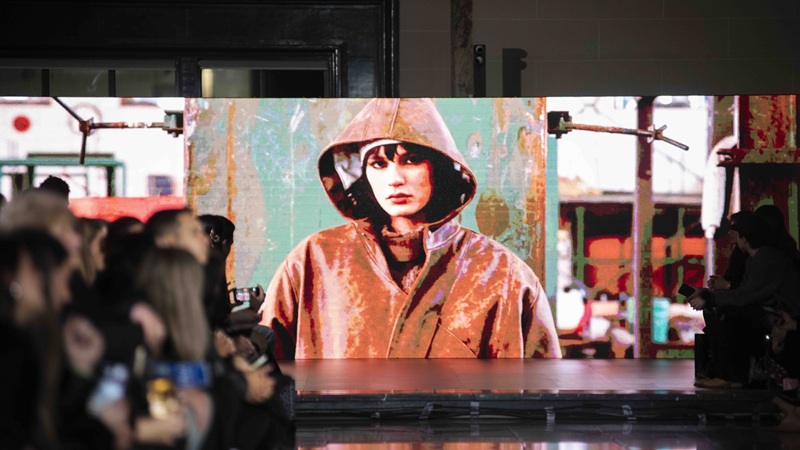
Organized and put together by the students, the fashion show’s theme focused on“the uncertainty surrounding who we are as Uruguayan women, and it transforms that search for identity into a call to be seen and heard as creative individuals,” as described in an academic paper by the students.
With this in mind, seven collections were presented:Ataraxia, Huella, #GARRA, Quiebre, Ser a través del otro, Entre, and Rastro. Each one represented an aspect of Uruguayan culture.
The fashion show was attended by officials and staff from the School of Fashion and Design ( Universidad ORT Uruguay ) and the School of Design, as well as family members and friends of the students. The event also drew influencers and content creators connected to the Uruguayan fashion scene.
The fashion show was covered by various media outlets, including Canal 12, El País, InfoStyle, Portada Punta, Caras y Caretas, and Galería, among others.
The event was attended by Magdalena Vilaró and Ana Darracq, the professors in charge of the course, and D. Ind. and T. M. Mariana Muzi, the program’s academic coordinator. Also participating as guests were Brazilian stylist and ORT visiting professor Lucius Vilar and Brazilian professor Carol García.
09UY Collections
#GARRA
By: María Victoria Britos, Paula Di Lorenzi, Camila Echeverría, and Federica García.
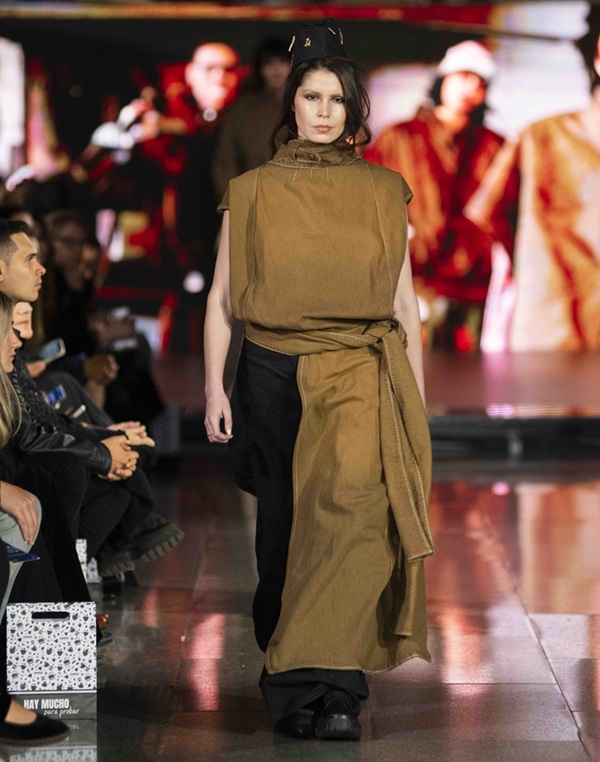
The first collection to hit the runway was #GARRA, which drew on the Uruguayan concept of the “Garra Charrúa” to reflect on the challenges of being a young creative in Uruguay. As explained by Camila Echeverría, one of the collection’s designers:
The collection draws inspiration from its philosophy of pressing forward despite the circumstances, as a symbol of perseverance, effort, and resilience, but also of the exhaustion, frustration, and uncertainty that young creatives are experiencing.
The tension between moving forward and remaining stagnantwas reflected in every piece of the #GARRA collection through the use of stiff fabrics such as denim, tailored cotton, and leather to represent the strength evident in the structure of the tops.
The designers also used industrial dyeing with localized washes to symbolize wear and tear, while their use of softer fabrics, such as Valencia knit, evoked the artist's sensibility.
"The collection sought to reflect the marks left by that journey and to highlight the value of creative work, which is often overlooked or undervalued," Camila explained.
For the project, the designers collaborated with the artists from Sitio Kiosko, an independent design project focused on urban apparel, who contributed through airbrushing, accessories, and a standout piece in the collection.
The collection featured a palette of neutral and earthy tones, such as muted browns and olive greens, which evoked effort, strength, and perseverance, while the bold colors of the prints represented artistic expression.
The urban garments were characterized by loose silhouettes, layers, and utilitarian details, incorporating the number three as a design element inspired by the three claws. The knots, meanwhile, evoked the arteries of the heart as the source of the passion for creation.
Footprint
By: Sofía Carrara, Guillermina Fuentes, Mia Lale, and Candela Mármol.
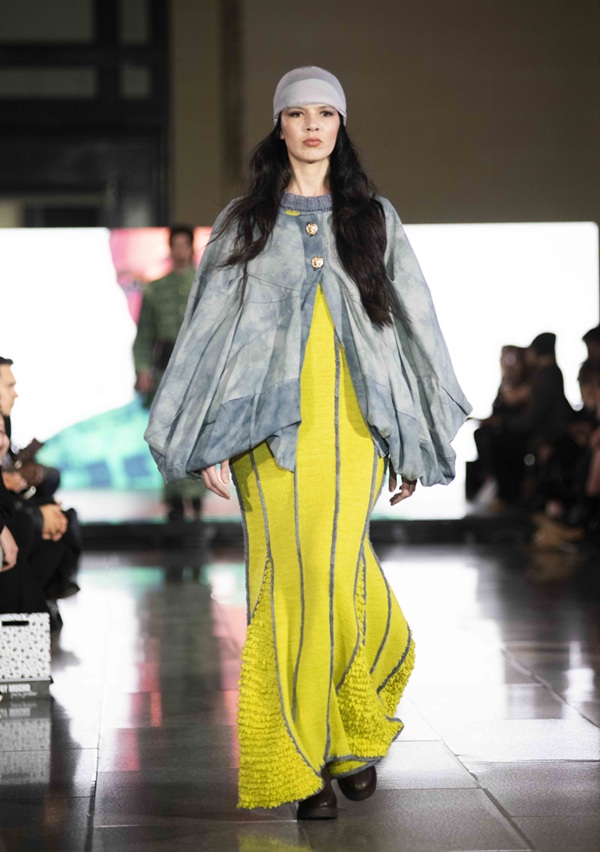
For 09UY’s second clothing collection to be showcased on the runway, Huella took as its starting point the construction of identity through the legacies passed down across generations.
Customs, ways of speaking, flavors, and other elements of daily life were incorporated and transformed over time. In the designers’ words,“We don’t inherit a complete identity; we inherit fragments.”
Building on this idea, the project explored how these legacies continued to be present in everyday life.
The materials were selected to complement this concept. The denim was treated using bleaching and tie-dye techniques to create a worn-in look and traces of wear. Micro-tulle was used to incorporate sheer elements, while wool and leather added texture and structure.
Another standout feature was the gold buttons, sourced from Italy, which were chosen for their connection to history and heritage. Because each one was unique, they represented the diversity of elements that made up an identity.
The collection was rounded out with a palette of neutral tones combined with pops of color, which lent it a contemporary look. The garments incorporated volumes and design elements intended to protect and cover the body, while the repeating patterns found in some pieces referenced the passing down of elements from one generation to the next.
Ataraxia
By:Victoria Magnou, Lucía Puñales, Lara Vignale, Belén Pintos, and Manuela Chiapparro.
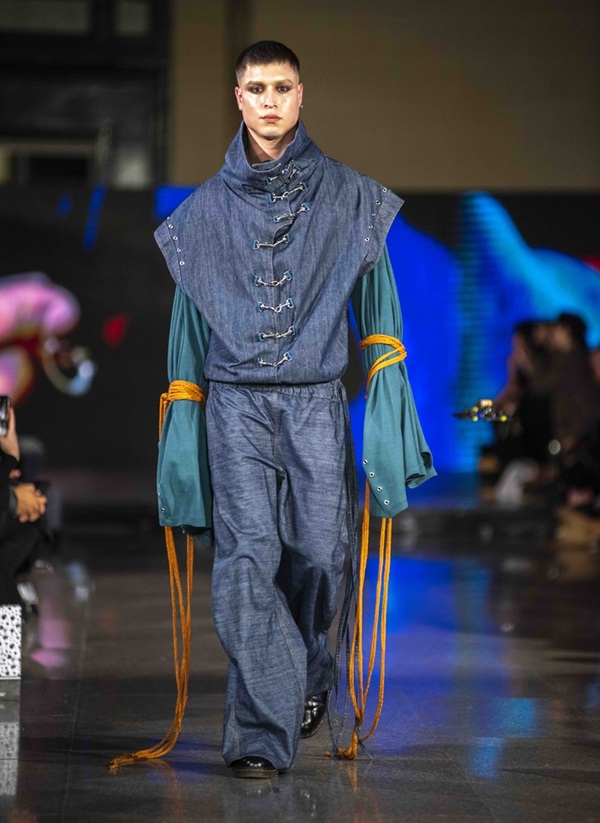
The third presentation at the Fashion Show, *Ataraxia*, explored the process of identity transformation experienced by young people who move from the interior of the country to Montevideo to study.
The proposal stemmed from a phenomenon that has been little explored within Uruguayan culture: the upheaval involved in leaving behind a support network and facing an urban environment characterized by anonymity, speed, and disconnection.
As the designers explained: “He’s no longer the same young man who used to study in the countryside, nor is he just another kid from the capital. He’s managed to adapt and move seamlessly between both worlds.”
Thus, the collection views identity as a process of adaptation and reconstruction, in which the individual integrates what they leave behind with the new experiences they encounter in the city.
The concept unfolds in two phases. The first, called“Apathy,”represents the initial difficulty in adapting to the new environment and the need to protect oneself from a city perceived as colder and more individualistic.
The second,“Ataraxia,”refers to the moment when the individual achieves a new balance and manages to inhabit both worlds without fully belonging to either. This transition is reflected in a shift from voluminous, enveloping garments to lighter, more dynamic silhouettes.
The collection combines high-quality, natural materials —such as the cotton found in denim, knitwear, and yarns—with urban-inspired elements, such as metal hardware, fasteners, eyelets, and carabiners.
In this way, the designers established a dialogue between an individual’s origins and the new environment in which they live.
The color palette followed this logic of contrast and transition: beige, gray, and brown tones—associated with the urban landscape—predominated, accompanied by accents of light blue and terracotta linked to nature.
In the garments, this duality was expressed through large volumes and enveloping structures, made primarily of heavy denim and brim, representing the need for protection during the period of apathy.
In contrast, the lighter dresses and garments, made of linen and shirting denim, incorporate movement and fluidity to represent the openness and adaptability achieved during the stage of ataraxia.
Break
By: Antonella Pita, Helena Previtali, Victoria Semino, and Belén Sobral.
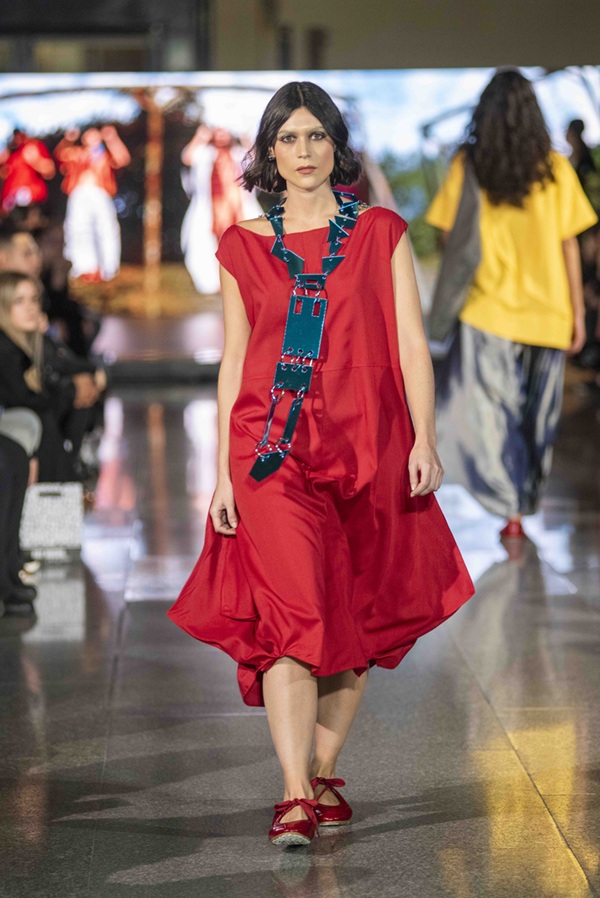
Later, the Quiebre collection was featured on the runway at the Museo del Gaucho y la Moneda to break away from the traditional, understated, and reserved way of expressing our Uruguayan identity.
"It proposes stepping away from expectations and making room for freer forms of expression, where boldness, audacity, and the absurd have a place," explained Belén Sobral, a student and the designer of the collection.
To convey this idea, the Quiebre quartet used fabrics typically associated with classic and formal styles, but combined them in an unconventional way, pairing gabardine and plain poplin with shimmering, iridescent, and sheer fabrics.
This contrast, in turn, was also evident in the combination of neutral and muted colors with vibrant, saturated colors—such as shades of gray paired with yellow, red, fuchsia, and sky blue.
The intention was to show how the ordinary and understated can take on a new hue, becoming more intense, vibrant, and expressive.
The garments were based on shirting elements that were reimagined, adapted, and reworked. Tailoring details such as pockets, buttonholes, and tailored pockets were also incorporated, moved to the exterior of the garments as a way to reinterpret classic and formal elements, creating the contrast and rupture that Quiebre proposes.
To Be Through the Other
By: Juliana Hincapié, Avril Xaubet, Andreina Naveda, Chiara Stefanoli, and Valentina Marmo.
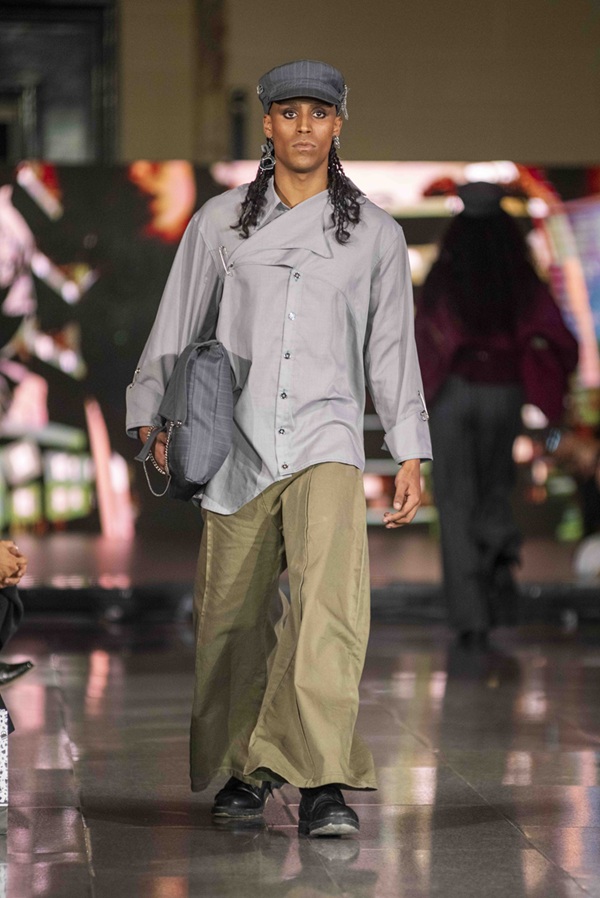
"Quiebre" was followed by "Ser a través del otro," a project that explored the construction of identity through the eyes of others, using social judgments and expectations as a starting point for the creative process.
In the Uruguayan context, the collection challenged the tendency to label and homogenize people, and presented individual expression as a way to transform the factors that shape identity.
The initiative was aimed at creative young people who saw clothing as a tool for communicating and expressing their identity.
The collection combined materials associated with work and functionality —such as denim, tailored fabrics, gabardine, poplin, and rib—with knits and various techniques that altered their original appearance.
Visible stitches, pleats, hooks, clips, chains, embroidery, and removable elements were incorporated into the garments to represent the marks that the environment leaves on each individual.
The loose silhouettes and hourglass shape reinforced the concept of an identity that, though initially shaped by social pressures, managed to expand as it found spaces for personal expression.
Accessories were also part of this collection, featuring handbags, belts, necklaces, brooches, and berets that incorporated chains, charms, acrylics, yarn, and hooks.
The looks combined garments inspired by workwear with more delicate fabrics and accessories, creating contrasts between structured elements and details associated with individual expression.
Among
By: Agustina Bolumburú, Sofía Castelló, Lucía Barbieri, and Sabrina Machado.
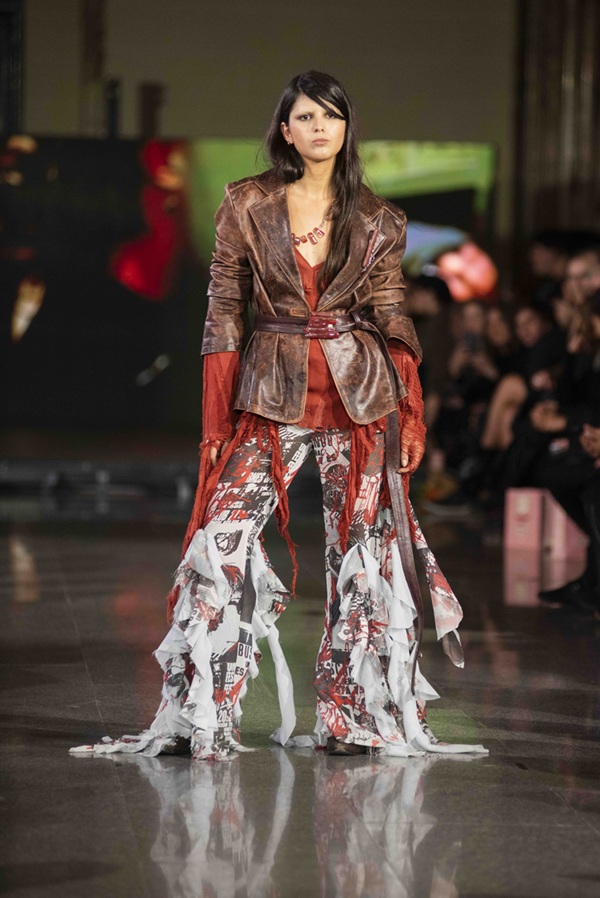
The "Entre" collection was based on the concept of the same name, which represented the tension between silence and the need to express oneself.
The collection was inspired by Uruguayan rock music and the Uruguayan identity, which the designers describe as “nostalgic and emotional”; through their garments, they seek to “show that in-between state between what is kept hidden and what ultimately becomes visible.”
The materials chosen to convey the concept were lightweight, sheer fabrics, frayed fabrics, cloths, and leather accents. The mix of soft and structured materials creates contrast and depth, striking a balance between a light world and a bold one.
The collection's color palette combined grayish blues, beige, and brown with burgundy, violet, red, blue, and black. The neutral tones evoke the landscape, concrete, and a sense of calm, while also drawing on aspects of Uruguayan culture.
"The intention was to reflect the contrast between calm, silence, and the energy of rock as a form of personal expression," said Sabrina Machado.
Among the designs featured were loose-fitting dresses and pants, deconstructed tops, and glass accessories, belts, and reworked pieces.
The form-fitting silhouettes—which emphasized the waist, shoulders, hands, and legs—along with the uneven hemlines and layered details, reinforced the idea of a complex and ever-changing identity that oscillates between concealment and revelation, in keeping with the collection’s overall concept.
Trail
By: Clara Amarelle, Valentina Cadimar, Ana Gremminger, and Julieta Itman.
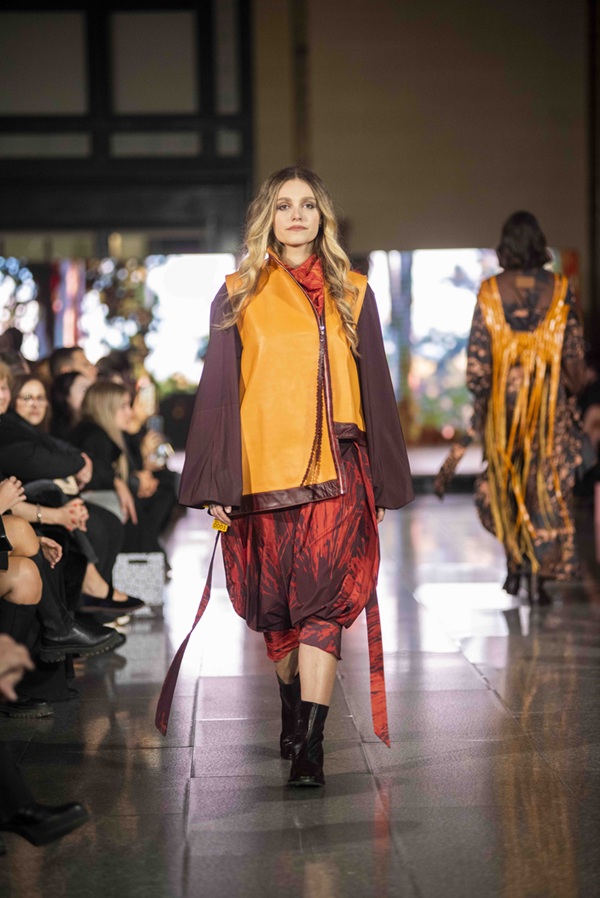
The latest collection at the Fashion Show was “Rastro,” a collection that sought to celebrate Uruguay’s productive roots and highlight the countryside as a fundamental part of the national identity, from a different perspective and moving beyond stereotypes.
“The collection aims to bring attention to an industry that often remains invisible to city dwellers, despite being one of the country’s main economic and cultural drivers,” explained Valentina Cadimar, adding:
The aim is to raise awareness among urban audiences about a reality that is often taken for granted, showing that today’s agricultural sector is a highly technologically advanced and innovative field that enjoys enormous international recognition.
The proposal thus invited us to rethink the relationship between the city and the countryside, understanding them as two worlds that are not opposites, but rather complementary.
Natural materials such as cotton, leather, and wool were used to create the garments, representing a direct connection to the earth and offering the quality and authenticity characteristic of Uruguayan production.
However, the goal was not to use them in a traditional way, but rather to reinterpret them through contemporary processes. To that end, the collection incorporated laser-cut and engraved leather, prints developed on cotton fabrics, and various techniques that combine the elegance of the materials with modern technologies.
This combination reflects the collection's central concept: a field that retains its essence but is constantly evolving through innovation.
Rastro’s color palette sought to represent the diversity of the rural landscape. Thus, it featured the earth tones and greens characteristic of the countryside, as well as colors that often go unnoticed within that landscape, such as vivid yellows, oranges, reds, and burgundy.
The students also worked with prints: for the outer surfaces of the garments, they designed three-color prints based on photographs of the region, while for the inner surfaces they used two-tone prints with figurative images.
While one usually views the countryside in its horizontal expanse, Rastro takes a step back and uses satellite images as a starting point, images that reveal the diversity of patterns traced on the land by rural production itself.
The garments were developed with a strong conceptual foundation, but designed to be fully functional and marketable in an urban setting.
Thus, pants, shirts, and other utilitarian pieces inspired by workwear were designed, prioritizing functionality and durability. The intention was for these garments to blend naturally into the city, symbolizing the convergence of these two worlds.
The use of the clasp was also explored not only in terms of its function but also as a design element, reinterpreting it through interventions and new applications that give it a more contemporary and technical character.
These details, along with the metallic accents featured in the garments, reinforced the sense of innovation that runs throughout the entire collection.
After: The End of 09UY
To conclude the fashion show, the models returned to the runway accompanied by the young designers, who were greeted with applause from the audience.
Once the fashion show was over, the attendees enjoyed an after-party with food and live music.
Learn more about theBachelor of Science in Fashion Design at the