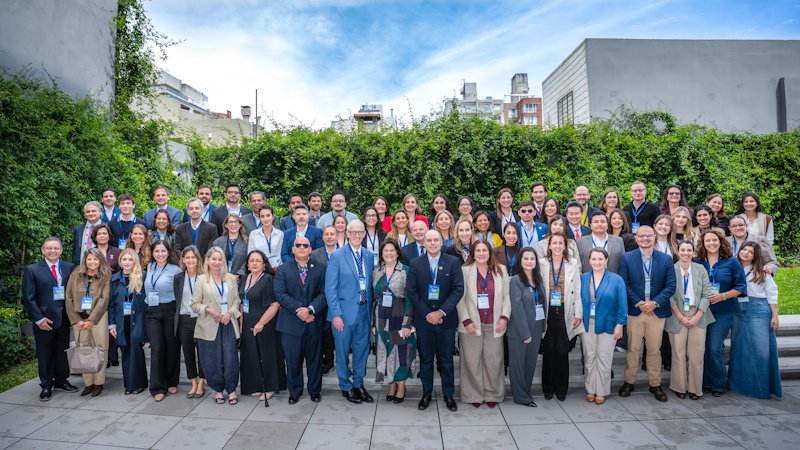
Over the course of two days, the Business School hosted more than 100 participants from 12 countries at the 15th PRME Latin America and the Caribbean 2026 Conference. Under the theme “Collaborate to Transform: Collective Values in Responsible Education, ” the event addressed challenges related to climate action, artificial intelligence in education, responsibility in value chains, equity, diversity, and responsible leadership.
The event, designated as being of ministerial interest by the Ministry of Education and Culture, took place within the framework of the Principles for Responsible Management Education (PRME), an initiative of the United Nations Global Compact that promotes the integration of sustainability, ethics, and social responsibility into the education of future leaders.

Academic exchange and cross-sector collaboration
The event brought together students, faculty, and administrators from more than 10 Latin American universities, along with representatives from the public and private sectors and international organizations, creating opportunities for dialogue among the academic community, public policy makers, and the business sector.
Participants included Bruno Gili, from the Uruguay Innova (U+I) program of the Office of the President; Mónica Gómez Erache, from the Ministry of the Environment; Herman Kamil, from the Ministry of Economy and Finance; Marcelo Barreiro, from the University of the Republic; and Stefano Pettinato, representative of the United Nations Programme t for Development (UNDP) in Uruguay. Representatives from Uruguay XXI, the Union of Uruguayan Exporters, the Uruguayan Chamber of Commerce and Services, UN Women, and Microsoft, among other organizations, also participated.
The diversity of participating institutions made it possible to bring together perspectives from academia, government, and the business sector on the challenges of sustainability and responsible education, and highlighted the importance of collaboration among these sectors.
Cooperation Among PRME Regional Chapters
For the first time, a PRME Head participated in a meeting of the initiative in Latin America and the Caribbean. Dr. David Steingard delivered the opening address, in which he highlighted the need to transform business and management education. He noted that the challenge lies not only in the disciplines being taught, but also in how that education can become a personal mission.
Another highlight of the meeting was the first-ever joint participation of the presidents of PRME Latin America and the Caribbean and PRME Brazil, who expressed their commitment to strengthening ties between the two chapters. This was complemented by the presence of representatives from PRME North America, which furthered the exchange among the initiative’s regional networks.
Day 1 of the Gathering

-
Opening of the 15th PRME Meeting
The opening ceremony was attended by Mariella de Aurrecoechea, MBA, dean of the School of Business and Social Sciences; Dr. Nicolás Gambetta, chair of the event, academic vice dean of the school, and director of the Business School; Victoria González, president of PRME Latin America and the Caribbean; and Dr. David Steingard, head of PRME.
During his welcoming remarks, Gambetta emphasized that this event reaffirms the Business School’s commitment to sustainability, a principle that runs through all of its academic programs. Similarly, Aurrecoechea noted that sustainability is integrated into ORT’s educational programs and highlighted the importance of these forums for fostering deeper reflection on these issues.
Victoria González emphasized leadership as a catalyst for opportunities for the growth and transformation of others. She described PRME as a community united by the conviction that education can help build a better world, and she highlighted the challenge of working collectively—even amid our differences—to turn values into decisions, decisions into actions, and actions into concrete changes in people’s lives.
During the opening ceremony, Iara Carabajal, a student in ORT’s School of Design, was also introduced. She designed the cover of the notebooks given to participants in collaboration with Repapel. For her design, she drew inspiration from the work of Uruguayan female illustrators.
-
Plenary Session 1 - From Individual Leadership to Collective Impact
During his presentation, Dr. David Steingard questioned whether business schools are training responsible leaders or preparing professionals to achieve conventional corporate success. He also invited the audience to reflect on the tensions between profitability, human well-being, and the sustainability of the planet, as well as on the ability of educational institutions to challenge the systems that generate inequality and environmental damage.
Starting with the question “Should business schools close?”, which he extended to the institutions participating in PRME, Steingard facilitated a group discussion on the role of these organizations and their ability to drive change. Some of the questions raised included whether these institutions have undergone real changes or have merely added courses and certifications on sustainability, and whether their hiring, promotion, and academic recognition systems effectively value social impact.
Finally, he emphasized that these challenges cannot be addressed by a single organization, not even by the United Nations. In that regard, he highlighted the need to collectively overcome the barriers that hinder the transformation of education and research in business and management, with the goal of promoting sustainability and social impact.
-
Plenary Session 2 - Collaborative Climate Action for Latin America - Post-COP30: From Belém to Montevideo
Moderated by Dr. Marcelo Barreiro, full professor in the Department of Atmospheric Sciences and Ocean Physics at the University of the Republic, this discussion brought together Dr. Mónica Gómez Erache, climate change advisor at the Ministry of the Environment; Dr. Herman Kamil, director of the Debt Management Unit at the Ministry of Economy and Finance; and Stefano Pettinato, Resident Representative of the United Nations Programme t for Development (UNDP) in Uruguay. Barreiro opened the discussion by noting that there is scientific consensus on human influence on climate change and cautioned about the need to strengthen adaptation measures.
One of the central themes was climate finance. Pettinato noted that, although the resources allocated to Latin America have doubled since 2020, they remain insufficient and would need to increase four- to eightfold to reach meaningful levels. He also warned about inequalities in their distribution, given that the funds do not always reach the places where they could have the greatest impact. For his part, Gómez Erache highlighted the existing monitoring systems in Uruguay and the development of financial instruments to facilitate access to international funds. He also emphasized the need to strengthen the resilience of coastal areas in the face of risks associated with climate change.
Kamil shared Uruguay’s experience in developing bonds linked to environmental indicators and highlighted the growing importance of climate change adaptation on the international financial agenda, which has traditionally focused more on emissions mitigation. In that context, he stated that “being creative means seeking new ideas; innovating means putting them into practice.” The discussion also addressed the challenges of international cooperation, the need to translate climate commitments into concrete policies, and the importance of incorporating a gender perspective into responses to climate change.
-
Plenary Session: Latest News
Orelia Villarreal Marker, Senior Director at the Thunderbird School of Global Management, presented recommendations for the development and implementation of the Sharing Information on Progress (SIP). During her presentation, she emphasized that the SIP should not be viewed as just another report or as a compliance exercise, but rather as a tool for institutional reflection, strategic alignment, continuous improvement, and transparency, which helps highlight the impact of the actions taken.
One of the main challenges, he said, is to construct a coherent narrative based on an institution’s various initiatives. In that regard, he recommended not generating new evidence to prepare the report, but rather identifying and documenting the evidence that already exists—even though it is often not systematically organized.
Meanwhile, Alexa Barco López, from in-sight/EAFIT, presented the regional report “Impactful Business Leadership,” based on a survey of 363 companies in seven countries, from which a sample of 137 organizations was selected. The study uses the Impact Business Leadership Index (ILEI), composed of 55 variables grouped into six pillars, to analyze how companies report their contribution to the generation of economic value and to the Sustainable Development Goals (SDGs).
Among the key findings, he highlighted that sustainability is a matter for senior management, that three out of every four companies have climate goals, and that the financial sector plays a prominent role. He also noted the role of companies as drivers of development and the importance of communicating progress on sustainability from both academic and business perspectives.
-
Plenary Session 3 - Due Diligence and Global Value Chains: Is Latin America Ready?
Moderated by the dean of the school, Mariella de Aurrecoechea, MBA, this plenary session featured Carmen Porteiro, president of the Uruguayan Exporters’ Union; Julio Lestido, president of the Uruguayan Chamber of Commerce and Services; Larissa Perdomo, Country Brand Manager at Uruguay XXI; Martín Dovat, CEO of Zonamerica; and Dr. Gustavo Yepez, Vice President of PRME Latin America and the Caribbean at the Externado University of Colombia.
During the discussion, Porteiro noted that sustainability requirements do not always stem from regulations, but also from buyers and the conditions for accessing certain markets. In that regard, he emphasized that sustainability entails costs that some companies have managed to share with their customers. Lestido cautioned that companies are not yet prepared to fully meet due diligence requirements in global value chains. He argued that trade agreements can open up opportunities, but that the results will depend on the actions taken by the companies themselves. Dovat addressed the role of free trade zones in Uruguay’s integration into the global economy and the joint efforts with Uruguay XXI to position the country as an international business hub. Meanwhile, Perdomo highlighted Uruguay’s favorable standing in terms of environmental, social, and governance (ESG) criteria, noting that, along with Chile, it ranks among the best-positioned countries in the region.
Day 2 of the Gathering

-
Plenary Session 4 - Artificial Intelligence and the Future of Responsible Education: Collaborating with Machines or with Each Other?
On this occasion, moderated by Marcel Mordezki, professor of Technology Management and Innovation at ORT, the following individuals exchanged views: Rodrigo Goñi, president of the Chamber of Representatives; Amílcar Perea, president of the Uruguayan Chamber of Information Technology; Elianne Elbaum, manager of Microsoft’s AI for Good Lab; Dr. Eva Guerra, from PRME Latin America and the Caribbean and EGADE; and Bruno Gili, executive director of the Uruguay Innova (U+I) program at the Office of the President of the Republic. Mordezki opened the discussion by addressing how the role of universities is changing in a context where students and faculty have immediate access to tools capable of providing knowledge and answers.
Among the main challenges, Guerra highlighted the need to revive fundamental educational practices—such as debate, reflection, questioning, and the Socratic method—to create dynamic learning experiences. Elbaum noted that artificial intelligence tools can increase productivity, but that making the most of them requires critical thinking and attention to how they are used. For his part, Perea argued that education should be geared toward new skills that enable students to approach problems from different perspectives and identify opportunities to create value. Gili emphasized that education remains people-centered and noted that assessment will be one of the critical aspects of this transformation.
From a public policy perspective, Goñi noted that artificial intelligence poses educational, political, economic, and social challenges that require collective responses. He emphasized the importance of collaboration among different stakeholders and of addressing this transformation as a matter of state policy, beginning with a better understanding of the phenomenon by those with legislative responsibilities.
-
Plenary Session 5 - Bridging Gaps Through Collaboration: Equity, Diversity, and Inclusive Leadership in Latin America and the Caribbean
The plenary session was moderated by Dr. Ximena Fernández, professor of Leadership at ORT, and featured the participation of Dr. Julianna Ramírez, a member of the PRME Latin America and the Caribbean Council at CENTRUM PUCP; Laura Raffo, MBA, director of Antel and professor of Business Planning at ORT; Magdalena Furtado, director of UN Women Uruguay; Fernanda Ariceta, member of the Board of Directors of the Global Compact Network Uruguay and CEO of Alva Creative House; and Ana Laura Trias, coordinator of the Uruguay Entrepreneur Network at the National Development Agency (ANDE).
During the discussion, Furtado noted that, while progress has been made toward gender equality, it is occurring at a slow pace, and structural inequalities persist in areas such as caregiving, economic autonomy, participation in decision-making, and violence against women. She emphasized that time is an economic resource and that training alone cannot close the gaps unless the unequal distribution of domestic and caregiving tasks is addressed. For her part, Raffo discussed the barriers that hinder women’s access to management positions—including the concentration of women in certain professional fields—and highlighted the importance of data and informal support networks.
From a regional perspective, Ramírez addressed gender inequalities in Peru, particularly those related to the distribution of household chores. Trias shared findings from a study on equity in the entrepreneurial sphere. Finally, Ariceta raised the need to examine power structures and organizational rules, rather than focusing efforts solely on helping women adapt to leadership roles that have historically been defined by different dynamics.
-
Plenary Session 6 - Collective Values for a Decade of Action: The Commitment of Business Schools in Latin America and the Caribbean
The final plenary session of the conference was moderated by Dr. Nicolás Gambetta, director of the ORT Business School. Participants included Dr. Andson Braga de Aguiar, editor-in-chief of the Revista de Contabilidade e Finanças at FEA-USP; Dr. Gleriani Torres, president of PRME Brazil at FIA Business School; Dr. Victoria González, president of PRME Latin America and the Caribbean at CETYS University; Dr. Christiane Molina, from EGADE; and Orelia Villarreal Marker, MBA, Senior Director at the Thunderbird School of Global Management.
The discussion was structured around three main themes: the challenges facing business schools, possible solutions from different countries, and the next steps for moving forward in the region.
Among the main challenges, Molina highlighted that average investment in science and technology in Latin America accounts for 0.6% of GDP and that research funding comes primarily from the public sector. In this regard, he emphasized the importance of strengthening collaboration between public and private universities to pool capabilities and address the problems faced by individuals and businesses. González, for his part, encouraged participants to consider the differences among countries in the region and noted that the challenges related to sustainability and social responsibility are not the same in every context. Torres addressed Brazil’s territorial and demographic diversity and the challenges this poses for internationalization and coordination among institutions.
Regarding the necessary actions, Villarreal Marker emphasized the importance of institutional reports going beyond the mere presentation of data and becoming strategic tools capable of coherently communicating progress to various stakeholders. Molina shared his institution’s experience with the creation of a dean’s office dedicated to applied research, while Braga de Aguiar pointed out the remaining challenges regarding academic incentives. The discussion highlighted the need to strengthen funding, institutional collaboration, and recognition mechanisms to advance the commitments of business schools in the region.
Parallel Sessions
40 academic papers on sustainability and responsible development
Academic presentations featured prominently on the agenda, with 40 papers presented across nine parallel sessions over the course of the two-day event. The research, experiences, and case studies presented were linked to the Sustainable Development Goals (SDGs).
These events fostered an exchange among researchers and faculty members from various institutions in the region regarding the integration of sustainability and social responsibility into management education.

Closing Ceremony and Awards Ceremony
The event concluded on Friday, October 23, with an awards ceremony, during which USD 2,000 was awarded in three categories: the Consuelo García de la Torre Award (USD 1,000), which recognizes the best academic paper or case study for its contribution to education for sustainable development and the PRME principles; the Business Case Study Award (USD 500), intended to recognize best practices and sustainability strategies with a positive impact on organizations and their environment; and the Student Project Award (USD 500), which honors projects developed by undergraduate or graduate students related to the challenges addressed at the conference.
Gala Dinner
