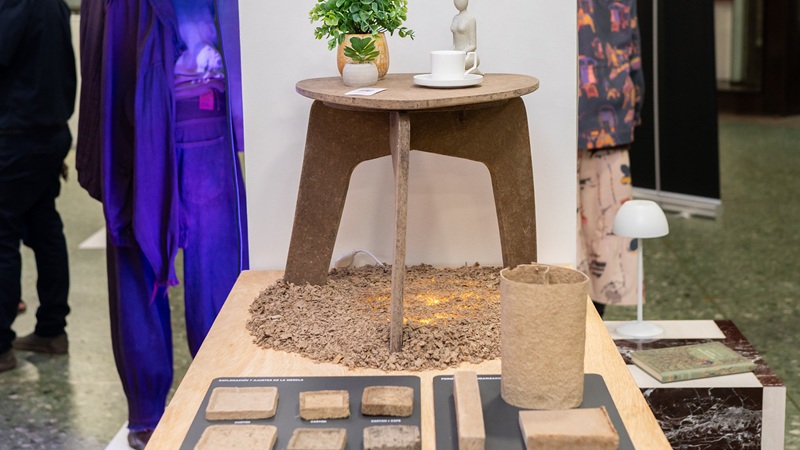
Developed as an integrative project, this work stems from a challenge posed by Rediseña, an initiative of the Montevideo Shopping Center, and explores new ways to add value to waste through material design processes.
From Waste to Material
The proposal involves creating a composite material made from recycled cardboard pulp sourced from the mall itself, a natural binder, and dry additives obtained from waste from the fruit industry.
The goal was to develop a fully biodegradable alternative that could be used as a raw material for new products.
During the project, Irrazabal designed both the material composition and the manufacturing process, which was based on a sequence involving waste preparation, aggregate processing, component integration, pressing, and drying of the parts. The system was designed to be artisanal, yet easily replicable and scalable.
As a result of the process, three production formats were produced: slabs, sheets, and bars, designed to meet different design needs.
Depending on the production method, the material can be cut with a saw or laser, drilled, moistened, screwed, nailed, glued, and painted, expanding its potential applications in the design of objects and prototypes.
The project is linked to SDG 9: Industry, Innovation, and Infrastructure of the United Nations Sustainable Development Goals, which promotes innovation and the development of more sustainable technologies and processes. In this case, experimenting with waste to create a new biomaterial offers an innovative alternative for product development and manufacturing.
In turn, the proposal is linked to SDG 12: Responsible Consumption and Production, as it seeks to recover value from cardboard and fruit industry waste by transforming it into a new raw material and extending its life cycle.
Designing New Possibilities
Beyond the creation of a new biomaterial, the proposal reflects on the role of design as a discipline capable of transforming waste into resources and opening up new opportunities for sustainable innovation.
This work highlights how industrial design can play a role from the earliest stages of materials development, integrating experimentation, the circular economy, and sustainability to expand the possibilities for creating future products.