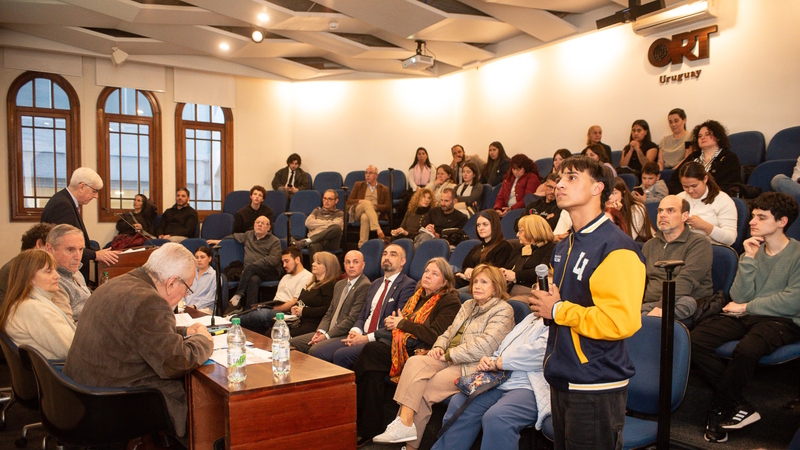
The theme of this year's 12th Nelly and Nahum Bergstein Knowledge Contest was "The Holocaust: One Hundred Years Since the Birth of Ana Vinocur," a Shoah survivor who settled in Uruguay and dedicated part of her life to sharing her testimony.
The final round took place on August 25 in the auditorium of the Pocitos Campus of the National Institute of Education ( Universidad ORT Uruguay). The contest, organized by the Bergstein family since 2015, is open to students from educational institutions across the country and has is supported by the Uruguayan Friends of the Hebrew University of Jerusalem, the Uruguayan Holocaust Memorial Center, the German School and High School, and the Universidad ORT Uruguay.
The contest aims to promote knowledge and reflection on the Shoah among young people through an educational program. The 2026 edition was dedicated to Ana Benkel de Vinocur, born in Łódź, Poland, in 1926, who survived the Łódź ghetto and the Auschwitz and Stutthof concentration camps. She arrived in Uruguay in 1947 and was a founding member and executive director of the Uruguayan Holocaust Memorial Center.
The three finalists
Álvaro Casanova, from PRE/U (Montevideo), took first place; Yiseleidy Chiappa, from UTU Young (Río Negro), took second place; and Brandon Faggiani, from Centros Educativos Impulso (Montevideo), took third place.
The jury was composed of writer Roberto Cyjon, an engineer; journalist Dr. Ramiro Rodríguez Villamil; and Prof. Silvia Facal, director of the Judaism Program at the Catholic University of Uruguay.
Memory and Education
Ana Vinocur undertook extensive work in Uruguay to preserve the memory of the Shoah, which included lectures and activities at educational institutions. She also published books recounting her experiences during the Nazi era.
The theme of this edition is linked to SDG 4: Quality Education, one of the Sustainable Development Goals adopted by the United Nations in 2015 to address global challenges by 2030, due to its emphasis on education and the transmission of knowledge related to human rights, remembrance, and the prevention of intolerance.