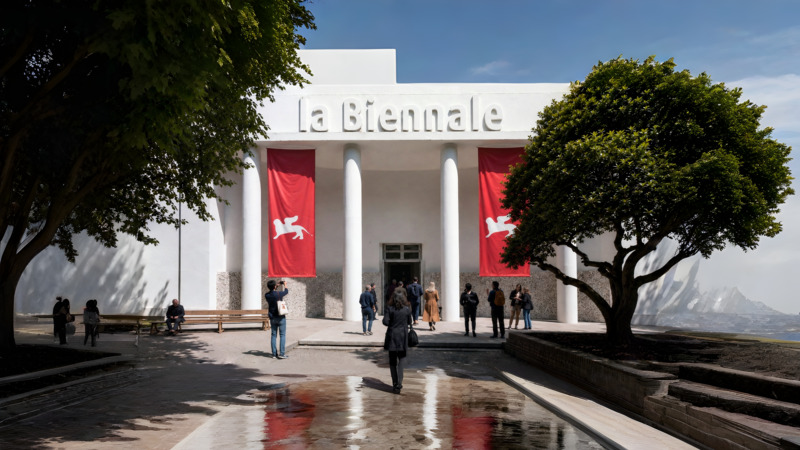
The National Directorate of Culture of the Ministry of Education and Culture (MEC), through the National Institute of Visual Arts (INAV), has launched the call for proposals to select the project that will officially represent Uruguay at the 20th International Architecture Exhibition of the Venice Biennale, which will take place from May 8 to November 21, 2027, in Venice, Italy.
The Uruguayan entry, * has *, with the support of the Faculty of Architecture at the Universidad ORT Uruguay, the School of Architecture, Design, and Urban Planning at the University of the Republic (Uruguay), the Architecture, Design, and Environment program at the Catholic University of Uruguay, the Viñoly Foundation, and the Uruguay Cultura Foundation.
Key Dates for the Call for Applications
The deadline for inquiries regarding the terms and conditions expires on September 30, 2026, at 1:00 p.m.. The application deadline is that same day at 5:00 p.m..
The 2027 Venice Architecture Biennale will take place from May 8 to November 21, 2027.
Who is eligible to participate?
The following are eligible to apply as principal architects: architects who are Uruguayan citizens—whether natural or legal—and are at least 18 years old, regardless of their place of residence.
Participating teams may include foreign members, whether or not they reside in Uruguay. Only one proposal is allowed per principal investigator and per participating team. In addition, each principal may submit only one proposal and may not be a member of any other, whether in the architecture, curatorial, or team categories.
The rules also set forth specific eligibility requirements that must be reviewed before completing the registration.
Resources for Selected Projects
The selected proposal will receive $450,000 allocated for the lead team’s fees, plus another $450,000 for transportation, lodging, per diem, and travel insurance related to the installation and opening, and up to $2,100,000 for the production and implementation of the exhibition project and the production and printing of the catalog.
View this post on Instagram
In addition, the authors of the proposals selected for second and third place will receive $220,000 each. These funds may be used, among other purposes specified in the rules, to cover their teams’ participation in the opening of the Venice Architecture Biennale, to conducting research related to the submitted proposals, or to public projects, initiatives, or events in Uruguay.
For the first time, the call for entries for the International Architecture Exhibition of La Biennale di Venezia includes financial support for the second- and third-place proposals, as well as specific funds allocated for fees and travel expenses for the team responsible for the selected proposal.
INAV will be responsible for on-site mediation throughout the exhibition period, organizing the opening, and implementing the communications, press, and social media plan. These services will be provided directly by the organization and should not be included in the budgets of the applying teams.
- We also recommend reading: “What Is the Venice Architecture Biennale and Why Is It So Important?”
What does the 2027 Venice Architecture Biennale have in store?
The artistic direction of the 20th International Architecture Exhibition will be led by Wang Shu and Lu Wenyu. The exhibition will be titled Do Architecture — For the Possibility of Coexistence Facing a Real Reality.
View this post on Instagram
In accordance with the terms of the call for entries for the Venice Architecture Biennale, the artistic direction invites reflection on architecture as a practice that is situated within and committed to contemporary social, cultural, and environmental realities. Among the issues raised are the relationships between territory and architecture, memory and innovation, building traditions and technological development, as well as the challenges arising from climate change, urbanization, and shifts in contemporary ways of life.
Within this framework, the Uruguayan call for proposals invites participants to develop proposals that engage critically with the themes proposed by the Biennial’s organizing committee and with the challenges these pose for architecture and the territory in Uruguay.
The call for entries is open to various media, languages, and disciplinary approaches related to architecture, provided they address the theme proposed by the organization and take into account the characteristics of the physical space of the Uruguay Pavilion.
- You might also be interested in reading: “Oteiza and the Sleeping Art at the Venice Biennale: Modern Void, Postmodern Remnants, and the City”
The Uruguayan Pavilion at the Venice Biennale
Uruguay is one of three Latin American countries—along with Brazil and Venezuela—that has its own pavilion at the Giardini della Biennale.
The Uruguay Pavilion is owned by the Uruguayan government, and its acquisition was authorized by Law No. 12,697, dated January 20, 1960.
Proposals must take into account the spatial characteristics of the Uruguay Pavilion. The technical documentation for the call for proposals includes floor plans, cross-sections, and elevations—information relevant to developing the exhibition proposal in relation to the space where it will be presented.
- You might also be interested in reading: “Uruguay Unveiled Its Pavilion at the 19th Venice Architecture Biennale”
What should the application include?
Registration requires identification documents for the account holder and team members, as well as a affidavit signed by the principal investigator, the applicable affidavits of co-authorship, and a letter of intent signed by the participants.
You must also attach a single PDF file, no larger than 20 MB, containing the proposal dossier. It must include:
- Project Title.
- Curatorial Proposal, with a maximum length of 3,000 words.
- Exhibition Proposal, developed in relation to the spatial characteristics of the Uruguay Pavilion.
- Representative image, along with visual and written information that help explain the proposal.
- Technical requirements, equipment, and resources required for its production, assembly, and operation.
- Work Schedule Work Schedule.
- Reference Budget detailed.
- Brief Team Profile.
If materials or audiovisual documentation are included to support the application, a public link must be provided, and the content must not exceed 10 minutes in length.
The sworn statement from the principal applicant includes a declaration that the applicant is the author of the project, that the project is not subject to the limitations and restrictions set forth in the guidelines, and that the information provided is accurate. The co-authors, for their part, declare their co-authorship and expressly authorize the principal applicant to submit the project.
How will the proposals be evaluated?
The process will begin with a preliminary hearing conducted by a Technical Commissioncomposed of the Department of International Relations and Cooperation and the National Institute of Visual Arts of the National Directorate of Culture.
The committee will analyze the budgetary, logistical, and operational feasibility of the proposals and will prepare a technical feasibility report that will serve as input for the jury’s evaluation and deliberation.
The jury will evaluate the conceptual, formal, and technical aspects of the submissions that meet the requirements set forth in the rules, while also taking into account the observations in the technical feasibility report and the relevance of each proposal in relation to the objectives of the call for proposals and its production context.
It will be composed of: Carlos Arcos, from the School of Architecture at the Universidad ORT Uruguay; Daniela Urrutia, from the Faculty of Architecture, Design, and Urban Planning (FADU) at the University of the Republic; Felipe Reyno, from the Department of Architecture, Design, and Environment at the Catholic University of Uruguay; Florencia Rodríguez; Román Viñoly, from the Viñoly Foundation; and Silvana Pissano.
As a result of the evaluation process, the jury will select a winning proposal and rank the second- and third-place entries. The winning proposal will be responsible for representing Uruguay at the 2027 Venice Architecture Biennale.
- You might also find it helpful to read: “‘53.86% Uruguay, Country of Water’: The Project That Represented the Country at the Venice Biennale”
How do I apply for the 2027 Venice Biennale?
Registration is done solely and exclusively through culturaenlinea.uy and the deadline is September 30, 2026, at 5:00 p.m..
The person submitting the proposal must register as a user or agent on the platform. Registration can be completed in stages and allows you to save your progress before submitting the final version.
Once you have completed the form and attached the required documentation, you must select “Submit Registration” to complete the process.
For questions regarding the rules, please contact us at convocatorias.cultura@mec.gub.uy. For questions about how the platform works, please contact culturaenlinea@mec.gub.uy.
The deadline for submitting inquiries is September 30, 2026, at 1:00 p.m..