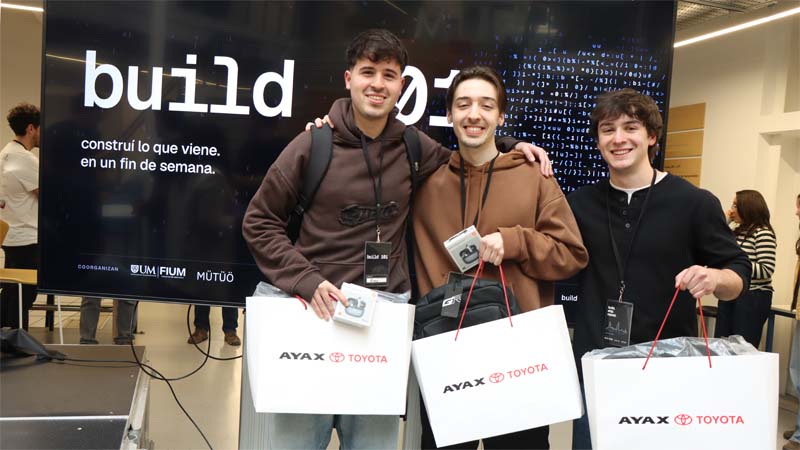
The students participated in the Guardián project, an Android app that uses artificial intelligence to detect potential phone scams in real time and alert the family members of those affected. The initiative is specifically designed to protect older adults, one of the groups that may be most vulnerable to this type of scam.
The competition was held on October 17 and 18, 2026, at the University of Montevideo.
A Solution to the Rise in Scams
The idea came about while the students were looking for an everyday problem that could be addressed using artificial intelligence. After evaluating various options, they began researching telephone scams in Uruguay and found statistics that led them to delve deeper into the topic.
Bruno said that one of the statistics that caught their attention the most was the increase in reports of fraud in the country. According to information from the Ministry of the Interior, the number rose from 1,333 in 2013 to 31,144 in 2024.
Although they initially had reservations about the proposal, the first tests of the system and the feedback from the mentors convinced them to continue with its development.
How does Guardián work?
Guardian analyzes phone calls in real time. As a call progresses, the system transcribes what is being said and uses an artificial intelligence model from Anthropic to identify potential signs of fraud.
The app assigns a risk level between 0 and 100, which is updated as it analyzes the various phrases in the conversation.
When the risk exceeds 40 points, it sends a notification to a previously designated family member. If it reaches 70 points, it displays a warning on the screen of the person receiving the call and also calls the family member to explain what is happening.
To improve their ability to identify potential scams, the students incorporated information from organizations such as the Ministry of the Interior, the media, and the prosecutor's office, including examples of the types of fraud used in Uruguay.
In this way, the system can recognize situations in which a person attempts to impersonate a family member or a financial institution, requests sensitive information, or pressures the person on the other end of the line to make an urgent decision.
A day to turn an idea into a prototype
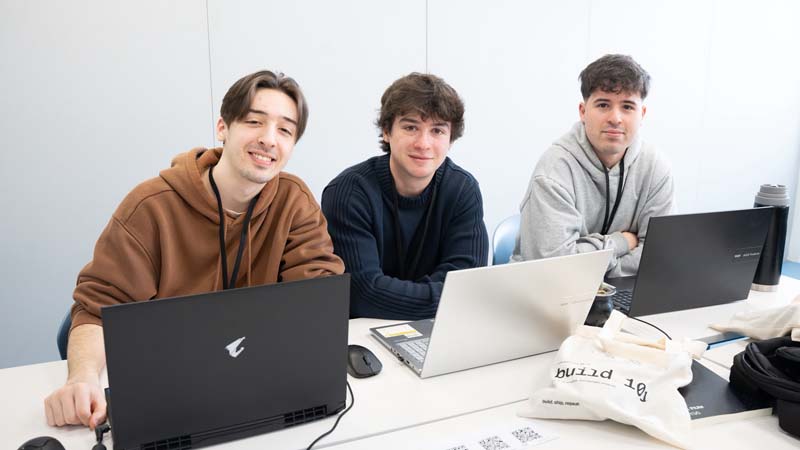
Build 101 was the first hackathon in which the three students participated. They learned about the call for entries through a post on LinkedIn and decided to apply right away.
During the development session, which lasted from 9:00 a.m. to 9:00 p.m., they worked hard to turn the idea into a working prototype.
Unlike a traditional academic project, they did not establish a rigid division of labor. Each team member took on new responsibilities as the project progressed.
They also took advantage of the artificial intelligence tools available during the competition to generate code, run tests, and make improvements to the application.
A live demonstration made all the difference
In addition to technological development, the pitch was a key factor in the outcome. The students prepared a four-minute presentation in which they combined an explanation of Guardián with a live demonstration of how it works.
Pedro played the role of an elderly person receiving a suspicious call, while Bruno played the role of the alleged scammer, who was posing as a bank representative. Matías played the role of the family member who was supposed to receive the alert.
During the conversation, the app identified risk signals and displayed a warning on the screen. At the same time, Matías received an automated call explaining the situation.
An additional screen allowed users to see how the risk level changed as the conversation progressed.
This demonstration allowed the jury to quickly understand both how Guardián works technically and how it could be useful in everyday situations.
The team passed an initial evaluation by four judges and then presented the project to the full jury and the audience. According to the students, the clarity of the pitch and the visual appeal of the demonstration were key factors in helping them stand out among the participants.
From the Classroom to a Technology Competition
When reflecting on the knowledge that enabled them to tackle the challenge, the students highlighted their familiarity with the technologies and, in particular, their ability to understand how the various components of a system are connected.
Their education in Systems Engineering enabled them to analyze the flow of information—from its input and processing to the generation of a response—and to use artificial intelligence tools to develop a solution.
The experience also allowed them to put into practice skills related to teamwork, problem-solving, and communicating ideas.
The project continues beyond the hackathon
Although Guardián began as a prototype developed in just over a day, its creators don't want the project to end with the award.
After the competition, they visited the Center for Innovation and Entrepreneurship (CIE) at the Universidad ORT Uruguay, where they began exploring ways to further develop the proposal and assess its potential as a startup.
Among its upcoming goals are analyzing funding opportunities and making the necessary improvements so that the app can be used in real-world situations.
The students acknowledge that there is still work to be done, both in terms of technological development and the validation of the tool.
Learn more about Systems Engineering