
Programming a virtual robot, designing instructions to solve problems using artificial intelligence, transforming waste into biomaterials, and analyzing DNA sequences are the opportunities that the Universidad ORT Uruguay School of Engineering Universidad ORT Uruguay to high school students in 2026.
The four contests are aimed at high school students in their 2nd or 3rd year of upper secondary education (EMS) and are designed to introduce them to different disciplines before they choose a college major.
Based on challenges inspired by real-life situations, participants will need to apply creativity, logical reasoning, information analysis, and the ability to develop solutions. In addition, teams will be eligible for scholarships covering 80% and 50% of the cost of university programs related to each field.
HackORT: Program Your Robot
In HackORT: Program Your Robot, participants must design an algorithm that allows a virtual robot to complete an obstacle course in the shortest time possible.
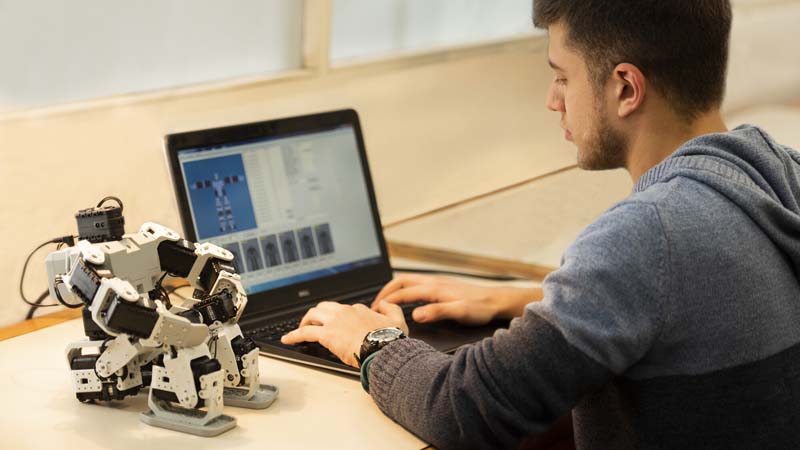
The challenge will take place in the Open Roberta Lab programming environment, a platform that allows users to experiment with programming and robotics concepts. Once the algorithms are submitted, they will be run to evaluate their effectiveness and the time each robot takes to complete the course.
The contest will include an introductory online workshop, during which participants will learn how the tool works and receive recommendations for developing their proposals.
Members of the winning team will receive an 80% scholarship, while those who place second will receive a 50% scholarship to study Telecommunications Engineering, Electronics Engineering, or Electrical Engineering.
Artificial Intelligence in Action
"Artificial Intelligence in Action" proposes exploring how instructions—known as prompts—can be designed to harness the potential of ChatGPT when addressing different problems.
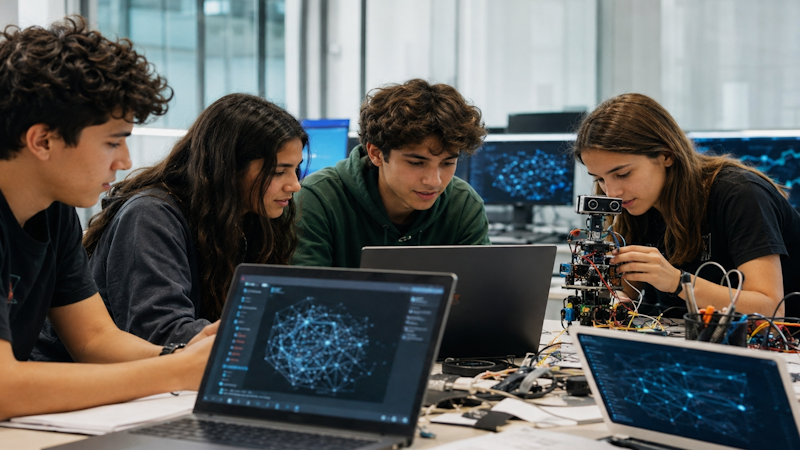
Teams must develop a solution for three scenarios: analyzing statements or news stories to detect potential errors and biases; solving math problems while explaining each step; and creating a story based on an image.
In addition to providing a specific prompt for each problem, participants must include examples of complete conversations that illustrate how the solution works and what value it can provide to the user.
The creativity and originality of the instructions, the clarity of the examples, and the ability to apply the suggestions in real-life situations will be some of the aspects considered during the evaluation.
The first prize consists of an 80% tuition scholarship, and the second prize consists of a 50% tuition scholarship to pursue a degree in Systems Engineering or a Bachelor's degree in Systems.
Innovate with Biotechnology: From Waste to Biomaterial
The “Innovate with Biotechnology: From Waste to Biomaterial” contest invites students to develop a biomaterial from waste, microorganisms, or byproducts derived from them.
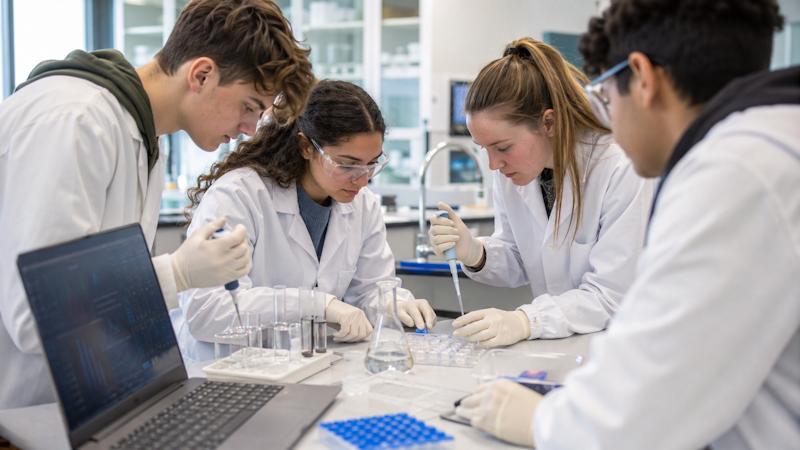
The proposal must be developed into a working prototype with a specific application. It could be, for example, protective packaging, a biodegradable flowerpot, an insulating panel, or an organizer for a classroom or laboratory.
The biomaterial must include, as its main component, at least one local waste product or byproduct, such as paper, cardboard, coffee grounds, used yerba mate, peels, plant fibers, or clean sawdust.
Teams must also conduct tests to evaluate the material’s mechanical strength, water resistance, and performance in real-world applications. In this way, the challenge combines experimentation, measurement of results, the circular economy, and the search for practical solutions.
The winning team will receive an 80% scholarship, and the runner-up will receive a 50% scholarship to study Biotechnology Engineering or the Bachelor's Degree in Biotechnology.
EXCELLENT Bioinformatics
In "EXCELent Bioinformatics," participants will use Excel to solve a problem related to molecular biology and biotechnology production.

The challenge is to analyze five DNA sequences and identify which one has the greatest functional similarity to a known protein from the bacterium Escherichia coli.
To arrive at an answer, teams must translate nucleotide sequences into amino acids, calculate various protein characteristics, and compare their results. The exercise simulates a real-world industrial scenario in which decisions must be made based on incomplete information before moving on to more complex and costly laboratory tests.
The submission must include an Excel spreadsheet that automates the analyses and a short video in which the participants explain their reasoning.
The team that finishes in first place will receive an 80% scholarship, and the team that finishes in second place will receive a 50% scholarship to pursue a bachelor's degree in bioinformatics.
An opportunity to learn by doing
Beyond the prizes, competitions offer an opportunity to learn how people work in different areas of engineering. The challenges encourage students to experiment, analyze information, formulate hypotheses, measure results, and communicate the decisions made during the process.
The introductory workshops will be held online and will be recorded so that participants can review them as they work on their projects.
For all four competitions, proposals may be submitted through September 18, 2026, and the results will be announced on October 16. Specific requirements, rules, and registration forms are available on each challenge’s webpage.