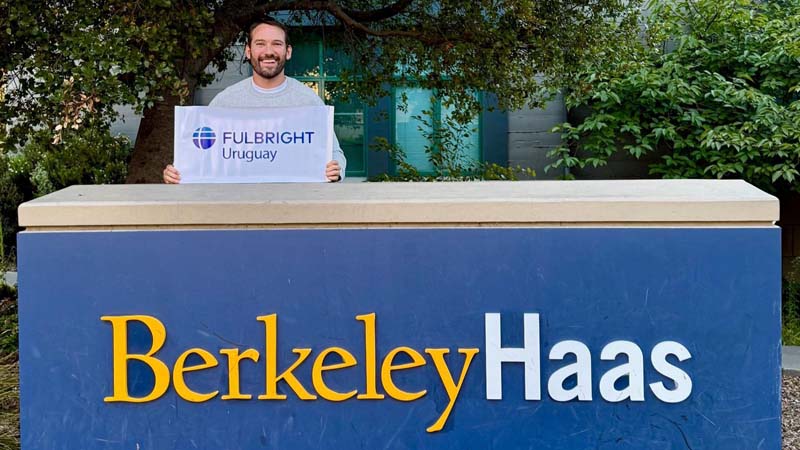
After several years working at a multinational company, Sebastián decided to change the course of his career and devote himself entirely to entrepreneurship.
His application included letters of recommendation from the dean of the School of Engineering, Eduardo Mangarelli, and from Enrique Topolansky, director of the Center for Innovation and Entrepreneurship (CIE) at Universidad ORT Uruguay. He was accepted at five universities and placed on the waitlist at three others, but his admission to Berkeley ultimately determined his path.
“My plan was to make the transition from working at a multinational company to entrepreneurship. I wanted to come to the United States and immerse myself fully in the entrepreneurial ecosystem,” Sebastián said.
Berkeley and Silicon Valley
He is currently pursuing an MBA at Berkeley Haas, one of the business schools considered among the most prestigious in the United States.
One of the most striking aspects is the diversity and backgrounds of his peers. Among them are former Navy SEALs, Olympic athletes, entrepreneurs who have sold companies for hundreds of millions of dollars, NASA professionals, members of the Forbes Under 30 list, and leaders from various industries.
“People are amazing. Every day you’re exposed to things that make your brain grow another centimeter,” Sebastián said.
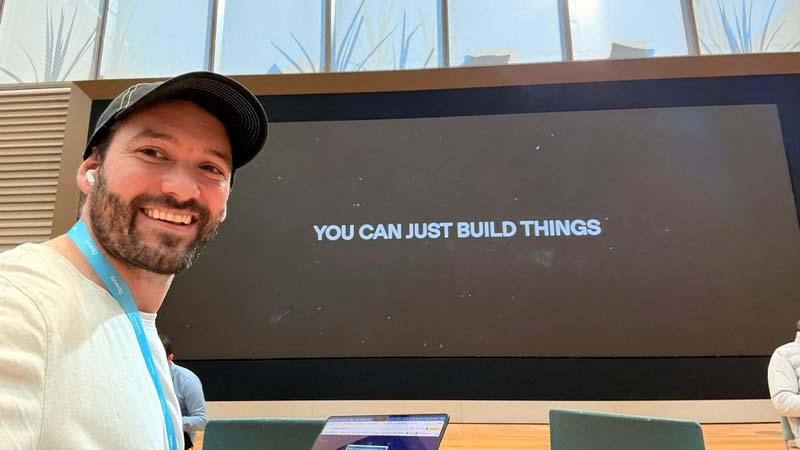
His academic experience also gave him access to some of the most important companies and leaders in the tech sector. He participated in a hackathon held at OpenAI’s headquarters, where he met Sam Altman, and attended events with leaders from companies such as Perplexity and Notion. He also visited organizations like Tesla and AngelList and took part in small-group meetings with key figures in the tech ecosystem.
It feels surreal to come here and meet people who are building some of the world's most important companies.
A Community Through Soccer
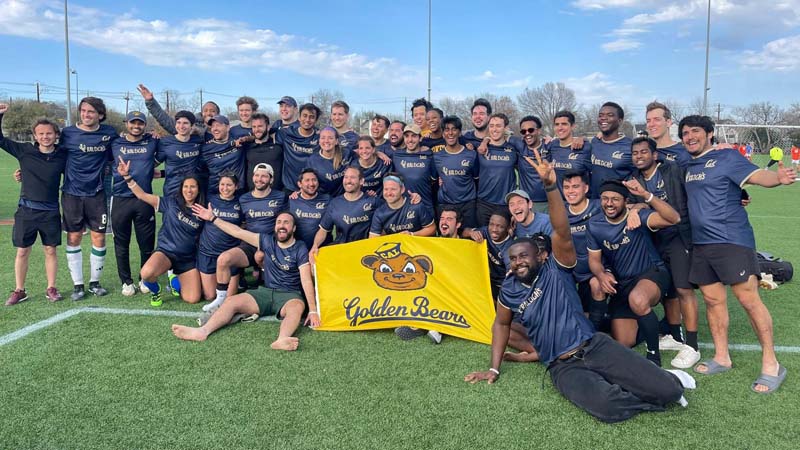
Outside the classroom, Sebastián took on the role of president of the MBA soccer club, an experience that allowed him to build connections among students from different countries.
“Soccer ended up becoming my identity during the MBA program. I had the opportunity to serve as the team’s president and build a community that brought international and American students together around a soccer ball,” he said.
The team participates in tournaments that bring together students from various universities across the United States, an experience that has also allowed them to develop leadership skills and strengthen the community at Berkeley.
Sebastián is living this experience in Berkeley with his wife, Sofía Gioscia—a graduate of the Bachelor’s program in Management and Administration at Universidad ORT Uruguay—and their son Tomás. The two met in German classes recommended by Professor Miriam Kemna before participating in an academic exchange program in Germany. Although they attended different universities, that was the beginning of a story that has now brought them together to share this new chapter in the United States.
Entrepreneurship from Berkeley
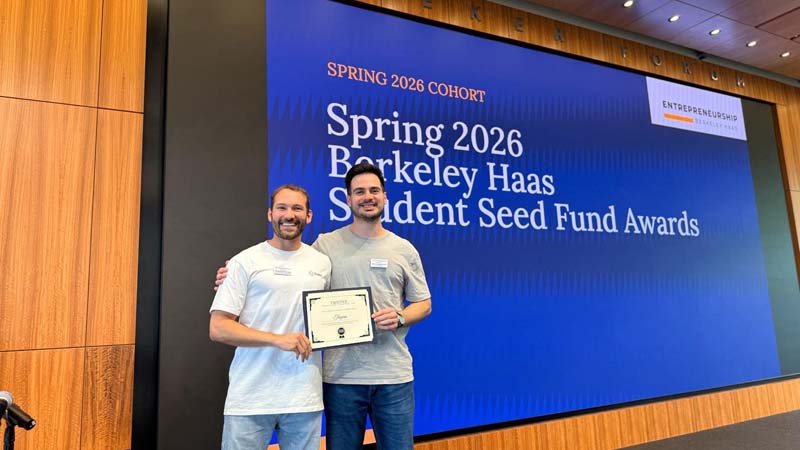
In addition to his MBA, Sebastián co-founded a startup with a classmate, Martin Delanghe. The project aims to reduce the energy costs faced by small and medium-sized businesses in California due to spikes in electricity consumption.
The proposal involves developing mobile batteries capable of supplying power during specific periods of high demand in order to reduce energy costs and optimize the use of the power grid.
In the long term, the vision is to move toward distributed energy models, where electric vehicles and energy storage systems can supply power where demand is highest.
The startup was accepted into SkyDeck, one of the incubators affiliated with the University of California, Berkeley. With an acceptance rate of about 0.5% among thousands of annual applications, it is one of the most competitive programmes in Silicon Valley. Startups that have gone through SkyDeck have collectively raised more than US$2.7 billion in funding.
“We’re now 100 percent focused on entrepreneurship. The plan is to keep growing and eventually secure a larger round of funding,” Sebastián explained.
The Challenge of Pulling Yourself Together
Sebastián acknowledges that one of the most challenging moments was the admissions process itself. “The hardest part is getting in. Once you’re accepted, it’s all downhill from there,” he said.
He also points out that Uruguayan culture often contrasts with the way Americans communicate their ambitions. While a more cautious attitude prevails in Uruguay, in Silicon Valley it is common to encounter people who think in terms of “moonshots”: projects with extremely ambitious goals, capable of transforming entire industries or solving problems that seem impossible.
Here, people say quite casually that they're going to revolutionize an industry or create a technology that will change the way we live. Often these ideas seem impossible, but it's precisely those people who end up achieving extraordinary things.
Spending time with people who think about those moonshots led him to reflect on imposter syndrome and the importance of allowing himself to think big.
“There are colleagues who come in with goals that seem unattainable. Maybe many of them don’t achieve them, but they all aim very high. That mindset—the courage to pursue enormous goals—is one of the most valuable lessons I’ve taken away from Silicon Valley.”
Return to contribute
Although his stay in the United States will last until he completes his MBA, which is scheduled for 2027, Sebastián plans to return to Uruguay. “I’m going to come back. I might stay a little longer to continue my academic studies, but the plan is to return,” he said.
His experience in Silicon Valley also allowed him to appreciate the role of entrepreneurial ecosystems and spaces that connect entrepreneurs, investors, and mentors.
If there aren't any places that bring together entrepreneurs, investors, and mentors, it's very difficult for new companies to emerge.
In that regard, he highlighted the role of initiatives such as the Center for Innovation and Entrepreneurship at Universidad ORT Uruguay noted that strengthening such spaces can contribute to the development of entrepreneurship and innovation in the country.
For Sebastián, the experience at Berkeley not only provides a first-rate academic education, but also the opportunity to understand how some of the world’s most dynamic innovation ecosystems work and to consider how those experiences can contribute to Uruguay’s development.
Learn more about Telecommunications Engineering