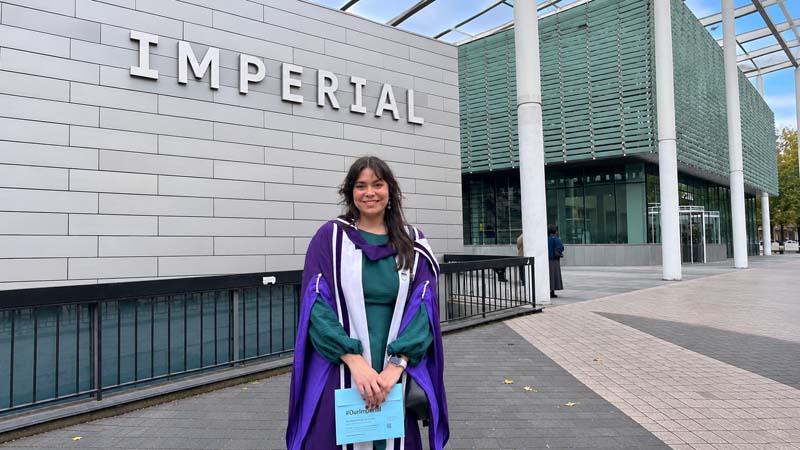
As Strategic Research Development Manager, Giuliana works to identify funding opportunities, connect researchers from different disciplines, and promote international collaborations that contribute to the development of scientific capacity in low- and middle-income countries.
Imperial is one of the most internationally recognized universities in science, engineering, and technology. According to the 2027 QS World University Rankings, it ranks second globally and first in Europe. Its work is characterized by a strong focus on research and scientific innovation.
Giuliana's career spans biotechnology research, vaccine development, scientific management, and international cooperation. After completing her graduate studies, she found a way to remain involved in science in a professional capacity she had not imagined when she began her career.
From Uruguay to London
His interest in biotechnology stemmed from the combination of two disciplines he was particularly fond of: chemistry and medicine. He was looking for an education that would allow him to understand biological processes, but also to apply that knowledge to solve specific problems.
What drew me to ORT was that blend of basic and applied science. I was interested in understanding how things work, but also in finding ways to use that knowledge to bring about change.
After graduating and while continuing to work at the Institut Pasteur in Montevideo, he began exploring opportunities to continue his education abroad.
In 2015, she received a Chevening scholarship from the British government, which enabled her to pursue a master’s degree in Applied Biosciences and Biotechnology. Theexperience not only broadened her scientific knowledge but also brought her into contact with students and researchers from different countries.
“Meeting people from so many different cultures was one of the most enriching experiences. You learn different ways of studying, working, and interacting with others. That also helps you develop a tremendous sense of empathy.”
After completing his master's degree, he returned to Uruguay, where he worked at Virbac Santa Elena, a company dedicated to the development and production of veterinary vaccines.
Some time later, he decided to return to academic research and contacted a professor he had met while studying in London. Through that connection, the opportunity arose to pursue a Ph.D. in Bioengineering, once again at Imperial.
More Accessible Vaccines
During her doctoral studies, Giuliana worked on a synthetic biology project aimed at developing more cost-effective and efficient vaccine production platforms, with the goal of facilitating their implementation in developing countries.
His research focused on genetically modifying yeast to produce virus-like particles (VLPs). These structures mimic components of viruses but do not contain their genetic material, so they can be used in the development of certain vaccines without causing the corresponding infection.
The work included research related to the human papillomavirus, chikungunya, and hepatitis E, as well as the production of a rabies virus protein.
One of the main challenges was to increase the amount of proteins or particles produced by the yeast and to find processes that could be scaled up to an industrial level.
The project was carried out in collaboration with a company in Bangladesh, which added a practical dimension to the research.
It wasn't just a matter of finding a solution that would work in a London laboratory. We also had to consider whether it could be implemented in Bangladesh, given the resources, reagents, and technologies available there.
This experience strengthened his interest in applied research and in scientific initiatives capable of addressing the specific needs of countries with fewer resources.
A New Way to Support Research
After completing her doctorate, Giuliana began to rethink her professional future. Although she enjoyed research, she realized she wanted to pursue a career that would allow her to work more directly with other people and coordinate scientific projects.
“I really enjoyed researching and solving problems, but I also realized that I enjoyed connecting people, learning about what they were working on, and finding opportunities for collaboration.”
That is how she discovered the field of strategic research management, an area she had not been familiar with until then. Her first experience in this field was at Imperial’s School of Natural Sciences, where she joined a team dedicated to supporting researchers in securing funding, establishing partnerships, and developing strategies to strengthen their projects.
After two and a half years in that position, in October 2026 he took on the role of Strategic Research Development Manager at the Global Development Lab, which is part of Imperial’s International Relations Office.
In his new position, he works with researchers from various schools and with institutions in countries across Africa and Asia, among other regions.
Its role is to identify opportunities for collaboration, support access to research funding, and contribute to the development of projects that address the needs of low- and middle-income countries.
It also participates in the analysis of issues related to gender equity, diversity, and the strengthening of local scientific capacity.
“What excites me most is being able to help these countries develop their own research capabilities, train professionals, and gain greater autonomy. They often have the knowledge and talent, but lack the necessary resources.”
Mentoring Programs for Latin American Women
In addition to her work at Imperial, Giuliana is co-director of Hace la Fuerza, a nonprofit organization she founded together with other Latin American professionals.
The initiative began in 2021, stemming from a shared reflection on the importance of networking and mentoring in professional development.
The organization runs a mentoring program for Latin American women who are nearing the end of their college studies or who have recently graduated and are the first in their families to attend college.
Participants receive guidance from Latin American professionals with experience in various fields. The sessions cover topics such as goal setting, professional skill development, and building confidence in one's own abilities.
The program has included participants from Uruguay, Argentina, Paraguay, Peru, Colombia, and Mexico.
For Giuliana, this initiative also provided an opportunity to reconnect with people who had been important to her during her formative years. “It was really nice to be able to involve people who had been there for me during my formative years and to create opportunities for other women who may not have those support networks.”
A Career with Many Paths
Looking back on her early years as a student, Giuliana admits that she never imagined the career path she would eventually take. Her experience led her to discover that a scientific education can open up opportunities in areas that go beyond experimental work.
“When I started studying biotechnology, I was interested in understanding how things worked and finding ways to apply that knowledge. Today, that same curiosity drives me to want to understand how universities work and how we can promote better research projects.”
For those just starting their studies, his main piece of advice is to stay curious and be open to exploring different career paths.
I think it's important not to limit yourself to just one path. Maybe today you're interested in one area, and later you'll discover another one you didn't even know existed. A background in biotechnology gives you tools you can apply in many different fields.
He also emphasized that pursuing an international career isn’t the only way to find professional opportunities. “Not everything has to be outside of Uruguay. The country has incredible potential, and not everything abroad is better. There are many opportunities, and the important thing is to figure out what you want to do.”
Learn more about Biotechnology Engineering