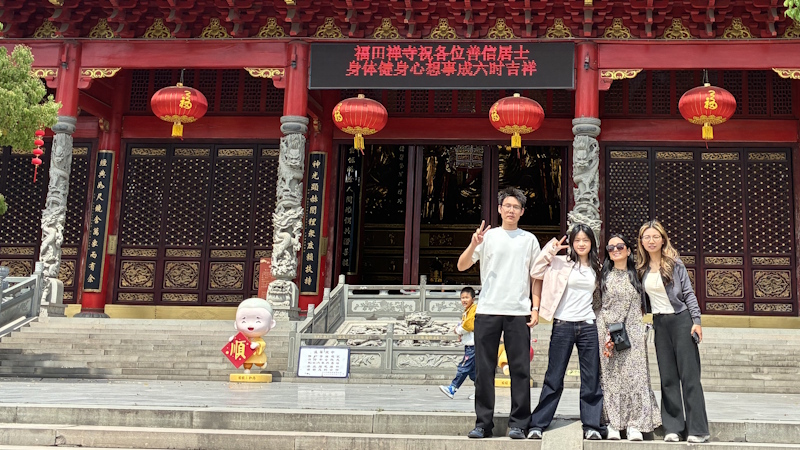
Beyond the differences in their journeys, the four experiences converge at a single point: an international exchange allows students to gain insights that are difficult to obtain solely in the classroom. Getting to know companies, building connections, interacting with people of other nationalities, and experiencing firsthand the differences between the East and the West enabled them to return to Uruguay with new tools and perspectives for their careers.
Fernanda Reyes, Emanuel Farfaro, Adrián Caffarelli, and Andrés Rojas share what they took away from their time in Shanghai.
Learning About Business from Another Culture
Fernanda Reyes, a Mexican who has lived in Uruguay for nearly 20 years, holds a bachelor’s degree in Fashion Design and currently works as a marketing manager. She arrived in China with prior experience working with Asian suppliers, but living in the country gave her a new perspective on business and cultural dynamics.
For Fernanda, one of the key lessons she learned was to understand that many of the differences aren't just about how business is conducted, but also about relationships, timing, and how trust is built.
Emanuel Farfaro Ruiz is of Argentine-Uruguayan descent, lives in Colonia del Sacramento, and is a software tech lead at Mercado Libre, where he works in the user accounts department. At the same time, he is developing his own technology project—an interest that also influenced his decision to travel to Asia and experience firsthand a market he had previously only observed from afar.
The experience allowed him to apply what he had learned in the MBA program to a different business ecosystem and gain exposure to companies, technologies, and business models that are part of a market with its own unique characteristics.
https://youtu.be/x_5jB5oSEnk?si=794t27JCbwwo_40u
Shanghai Inside and Outside the Classroom
For Adrián Caffarelli, an engineer and technology professional, the experience combined academic learning, cultural exchange, and the opportunity to get to know a different business environment.
The activities extended beyond the classroom. Visits to companies and interactions with professionals and students provided insight into how work is done, how decisions are made, and the role technology plays in various sectors.
Andrés Rojas, a systems engineer originally from Colombia who currently lives in Uruguay, also emphasized the value of getting to know the country beyond the academic experience. His stay allowed him to immerse himself in a different culture and broaden his perspective on how business is conducted in different contexts.
Among the lessons learned from the trip, he emphasized the importance of thinking globally without losing sight of local particularities.
https://www.youtube.com/watch?v=jLQO2MU3EiM
Training that keeps pace with changes in business
During their stay, the MBA students attended classes, visited companies, gained firsthand experience of the Chinese business ecosystem, and shared experiences with students of various nationalities. The trip also allowed them to observe cultural, professional, and academic differences between the East and the West.
The proposal is part of the dual-degree agreement that the Business School has with the Shanghai MBA Center - SHU MBA, which is affiliated with Shanghai University. The agreement allows students to supplement their education in China and earn an internationally recognized dual degree. Universidad ORT Uruguay is the first Uruguayan university to establish an MBA dual-degree agreement with a Chinese university and remains the only one in the country to offer this opportunity.
The international dimension of the MBA is integrated with training in managing organizations in a context shaped by innovation and technological transformation. Among its options, the program has offers a specialization in Business Analytics, which includes specific courses designed to build proficiency in artificial intelligence.
The experience in Shanghai thus adds an international perspective to a program that seeks to connect technology, strategy, and context, exposing students to other cultures, markets, and ways of doing business.