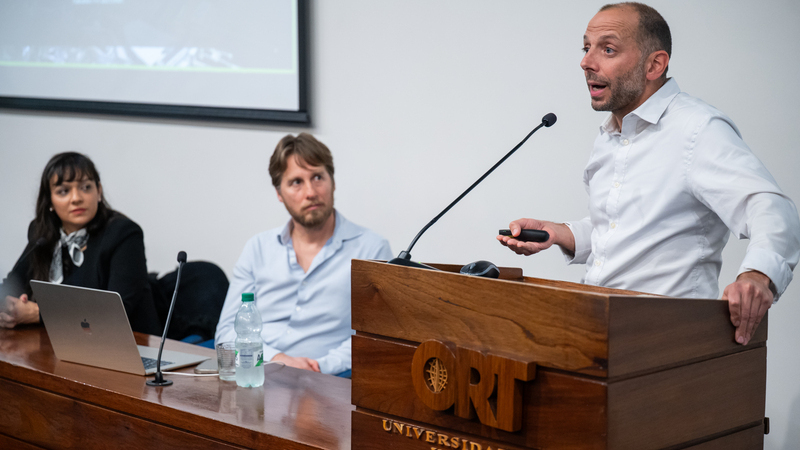
On October 7, ORT’s School of Architecture held a conference titled "Growing in Highly Competitive Markets". The event was organized by Architect Klaus Mill, academic coordinator of the Diploma of Specialization in Real Estate Business; and Dr. Michelle Fleitas, academic coordinator of the Real Estate Agent program at ORT.
Speaking to the audience, Diego Hodara—founder and CEO of Titanium Realty Group LLC—presented projects of various scales and recounted the decisions that led him to shift from investing in single-family homes to developing rental apartment buildings.
An architect with a degree from the University of the Republic (Uruguay), who has completed graduate studies in Business Administration and holds a Master of Science in Real Estate from New York University (United States), he also answered questions about credit, investments, and development opportunities in Uruguay.
From the First Homes to Real Estate Development in New York
Hodara's professional career in the United States began outside the realm of architecture. After seeking employment at design firms and construction companies, he landed a job at a firm that sold kitchen furniture, where he put his knowledge of drafting and construction to good use. Later, he joined the construction management team at a real estate development company.
At the same time, he began making his own investments. In 2006, he bought a house that he hoped to resell, but the real estate crisis derailed those plans. He had to rent it out, and, as he explained, the rent wasn’t enough to cover the loan and operating expenses. Month after month, he had to put money into it to maintain the property. Eventually, he sold the property at a loss.
The architect recalled a scene from that period: after work, he would take the train to the property to clear the snow himself. The lack of funds to hire someone for that service was one of the challenges he faced in managing his first housing projects.
During the 2008 crisis, he began offering construction services to third parties and partnering with investors to purchase other properties. That process led him to his first building, which had five-story building with 30 apartments. He described it as one of the most difficult transitions of his career: it meant shifting from working with single-family homes to a construction project that required additional partners, more capital, and bank financing.
In response to a question from the audience, he compared that initial leap with the subsequent growth: he had found it more difficult to move from single-family homes to a 30-unit building than to later expand his developments to 390 apartments. The difference lay in the track record needed to convince partners and banks.
His education in architecture and urban planning accompanied him throughout that journey, although his professional career focused on real estate management. The faculty had already discussed his experience at the meeting
- You might also be interested in reading: “A Uruguayan Developing in New York”
Journal Square: Public Transportation, Planning, and Land Use Opportunities
When explaining why he invested in Jersey City, Hodara focused on the emerging markets connected by public transportation (transit-oriented emerging markets). He had lived in that city and began exploring its streets on weekends, looking for plots of land and observing how the area might evolve.
Their interest focused on Journal Square, an area with rail connections to Manhattan via the PATH system and a regional transit hub. Its proximity to employment centers, along with the availability of parking lots and developable lots, was part of their analysis.
Hodara studied the zoning ordinances and the potential for densification planned for the area. He mentioned the plan Journal Square 2060 when explaining the expectations for urban transformation that he took into account before acquiring land. According to him, it was not a matter of choosing an isolated lot, but rather of anticipating what kind of neighborhood might take shape and what residential demand might accompany that process.
He linked that vision to the concept "live, work, and play": the possibility of living, working, and having access to shops, services, and recreational activities all within the same area. As an example familiar to the Uruguayan public, he recalled the changes he had observed since his childhood in the area where Montevideo Shopping was later built.
The analysis of the city also guided the choice of real estate project. Instead of relying on the presale of apartments, Hodara opted for buildings constructed for rental purposes, aimed at people looking for new homes with amenities and good connections to Manhattan. The property could be held within a corporation, generate rental income, and, depending on the circumstances, be refinanced or sold once it was leased.
In his presentation, he noted that Titanium Realty Group LLC completed approximately 1,000 units between 2020 and 2025, spread across seven or eight projects. According to his presentation, the growth of that portfolio was linked to a sustained acquisition and development strategy in Journal Square.
- You might also be interested in reading: “Real Estate Investments: What They Are and How to Get Started”
Cluster approach: gaining a deeper understanding of a single market
In addition to the choice of Jersey City, there was a decision that Hodara referred to as “cluster approach”: concentrating projects in a specific area rather than spreading initial investments across different zones.
When he began developing on his own, he explained, he lacked both the capital and the business track record necessary to compete in Manhattan. Focusing on Journal Square allowed him to closely monitor the real estate market, familiarize himself with municipal procedures, and build relationships with property owners, professionals, and stakeholders involved in project approvals.
“I’ve always strived to be strong,”, Hodara said, distinguishing a company’s position within a market from its absolute size. That strength, he explained, was built through successive projects, knowledge of the plots of land, and local connections that might prove relevant for new operations.
The speaker compared that choice to the rule of spreading investments across different areas. He acknowledged that concentrating efforts on a single sector also meant relying on its development: demand, the pace of the neighborhood’s transformation, and land values might not behave as he expected.
His tour of Journal Square demonstrated how this territorial specialization went hand in hand with larger-scale projects. The images in the presentation showed buildings with five, six, seven, and more stories, culminating in a completed development consisting of 28 stories and 390 apartments, complete with retail spaces.
Hodara distinguished it from another venture consisting of 414 apartments, for which, as he explained, he had obtained approvals and made progress on the detailed design. He estimated that investment at US$ 175 million. The second case referred to a project in the planning stages, not a building that had already been constructed.
- You might also be interested in reading: “Top Tips for Selling Properties Quickly”
From Project to Construction: Capital, Partners, and Banks
The issue of the apartments in the first building came up again in questions from the audience. Hodara explained how he raised funds from various investors and partnered with people who, in addition to capital, had experience in finance. Based on those agreements, he had to negotiate ownership stakes, responsibilities, and how to distribute the profits.
Then came thebank negotiations. For the 30-unit apartment building, he said he obtained a loan of approximately US$6.5 million, after numerous efforts. Convincing investors was one challenge; proving to a bank that he could complete the project was another. The completed projects later became his track record—track record— that made it easier to secure new loans.
To describe the work of coordinating architects, engineers, lawyers, contractors, consultants, investors, and banks, Hodara drew on a comparison:
“A real estate developer in the United States is like a conductor.”
Each specialist is involved in one stage of the process—whether it be the purchase of the land, the design, obtaining approvals, construction, or building management.
- You might also be interested in reading: “The Importance of Sustainable Development in the Real Estate Business”
How Contributions and Results Are Organized
Hodara described a form of pooling of capital from various investors (syndication), with separate entities for each project. He also distinguished between incoming funds—primarily partner contributions and loans—and the payments that must be made during development, such as land acquisition, studies, professional fees, and construction.
Regarding his company's compensation, he mentioned fees for acquiring land, developing projects, and overseeing investments; he distinguished those tasks from the day-to-day management of the buildings.
Another mechanism he presented was the promote: an additional payout to the developer when certain return conditions for partners are met. To make this clear, he used a hypothetical example of a tiered distribution—waterfall— in which the investor recovers their capital and a preferred return before other distribution percentages are applied.
Calculating the internal rate of return (IRR) made it possible to examine how the years of development, rental income, and the price of a potential sale all play a role. A question from the audience about the residual value of the properties also sparked a discussion about the rental and sales assumptions presented to investors before they commit capital.
This topic is particularly relevant to the content of the curriculum for the Specialization Diploma in Real Estate Business, which covers financial analysis, financing, legal aspects, and project development.
- You might also be interested in reading: “How Pilay Pioneered Real Estate Investment and Won the ANII’s NOVA Award”
Developing Rental Buildings: Decisions Beyond Construction
One of the differences Hodara highlighted between his business in the United States and the typical operations he observes in Uruguay was the intended use of the apartments. His strategy in Jersey City focused on building properties that remain under a single owner and are rented out as residential units.
To maintain an income-producing building, partners must evaluate rental income, maintenance expenses, and debt, in addition to construction costs.
Hodara explained that a developer can generate value at different stages: when obtaining approvals for a plot of land, when advancing the construction drawings, upon completion of a project, or when stabilizing occupancy through rentals. Depending on the agreements with investors, it can sell the project at any of these stages or retain it as an asset.
In the case of rental buildings, he also distinguished the property management (property management)) from the management of the asset and the investors’ interests (asset management). The former handles day-to-day operations, while the latter oversees financial performance and investment decisions.
When referring to that responsibility, he argued that the business must generate profits for the partners, but also offer “value for the community and value for the tenant.” For Hodara, the retention of the buildings’ residents and the quality of the service provided have an impact on the venture’s long-term performance.
- You might also be interested in reading: “Impact of the new law on real estate operators in Uruguay”
What lessons can be applied to the Uruguayan real estate market?
The comparison with Uruguay came up explicitly during the Q&A session. Hodara was asked which tools from the U.S. market could be applied locally and which ones posed the greatest challenges.
The speaker identified one of the main differences as being in the financing of buildings intended entirely for rental. He explained that, in certain U.S. transactions, a typical mix consists of 35% investor equity and 65% bank financing makes it possible to develop a property without tying up all of a company’s own resources. In his view, when it is necessary to contribute virtually all the capital, the opportunity cost can limit the number of projects a company is able to undertake.
He also noted that a loan should be evaluated based on its interest rate and the building’s expected return. The rise in interest rates in the United States, he explained, had altered the conditions that had previously favored some of his developments. For that reason, his company began exploring other opportunities, including the acquisition of properties in financial distress and activities related to providing capital.
On the urban front, Hodara posed another question: Where might the next emerging market in Uruguay emerge? He then returned to the criteria used in Journal Square: transportation, planning, land availability, demand, and a mix of urban activities.
- You might also be interested in reading: “Real Estate Market Trends in Montevideo: What Buyers and Renters Are Looking for Today”
During that discussion, he mentioned Ciudad Vieja and Ciudad de la Costa. Regarding the latter, he offered a critical assessment of the infrastructure that accompanied certain real estate development initiatives. She also referred to the ability to position neighborhoods through a recognizable commercial identity, without disconnecting that strategy from their urban conditions.
The comparison revealed a specific difference between the two markets: identifying land with potential is a decision made by the developer; financing a construction project and maintaining a rental building also requires specific and demand that vary by location.
Hodara recalled that his work had also changed: from shoveling snow at his first properties, he went on to lead teams, negotiate with investors, and coordinate specialists. His degree in architecture, he noted, was the starting point of that career path.
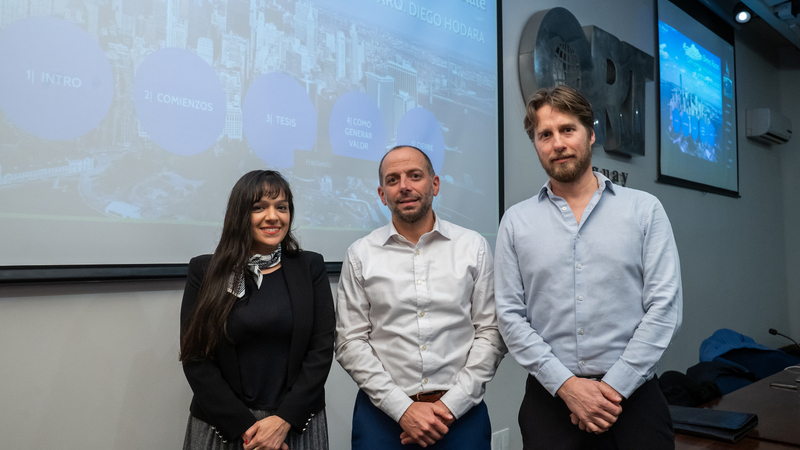
Dr. Dr. Michelle Fleitas and Architect Klaus Mill, the faculty members in charge of the event, thanked the speaker and the audience for their participation. The choice of Journal Square, the buildings constructed there, and the discussion about Uruguay demonstrated why the interpretation of the city and the financial structuring are part of the same real estate development process.
I watched Hodara's lecture again:
https://www.youtube.com/watch?v=bDWX4dD5EyY
Learn about the Specialization Diploma in Real Estate Business