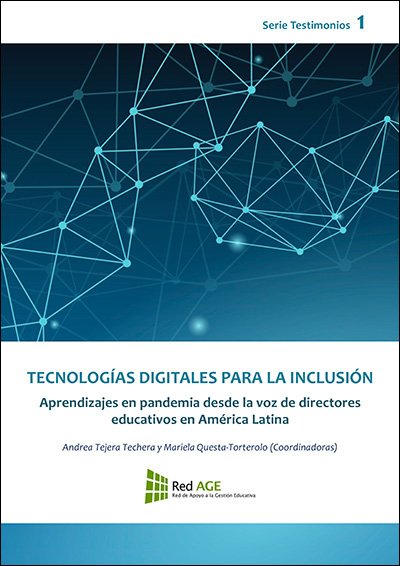
 “The topic at hand brings together two key issues that affect the reality and management of today’s schools: the implementation of digital technologies and their connection to the promotion of inclusive processes,” said Dr. Joaquín Gairín, chair of the Executive Committee of the Educational Management Support Network (RedAGE)― regarding Digital Technologies for Inclusion: Lessons Learned During the Pandemic, as Told by School Principals in Latin America, in the introductory text.
The publication was produced under the auspices of the RedAGE Policy Commission and coordinated by Dr. Andrea Tejera Techera, academic coordinator of the Master’s in Educational Management and the Master’s in Trainer Development, and Dr. Mariela Questa-Torterolo, assistant coordinator of those graduate programs.
This is a collaborative effort by researchers affiliated with the network, who have documented the realities of various countries, including Brazil, Chile, Colombia, Mexico, Uruguay, and Venezuela.
The publication also includes the chapter “Digital Technologies for Inclusion: Lessons Learned During the Pandemic from the Perspective of School Principals in Uruguay,” authored by Tejera Techera and Questa-Torterolo, along with Yesika Padrón and Gabriela Cella, instructors at the Institute of Education. The article highlights those aspects of policies and programmes related to educational technologies as a tool to alleviate the difficulties faced by vulnerable groups, with a focus on connectivity plans and access to devices.
Finally, Tejera Techera and Questa-Torterolo present “Digital Technologies for Inclusion: Lessons Learned on the Challenges of Managing Emerging Issues and Planning for the Future.” The book’s final chapter reflects on the challenges posed by the use of digital technologies from the perspective of educational management and inclusion.