Two sessions on cultural diplomacy, tourism, and national identity marked the conclusion of the course “Event Production, Ceremonial, and Protocol” at the School of Communication at Universidad ORT Uruguay.
The first,“Bridging Cultures: Beyond the Event,” brought together representatives from the Mexican Embassy, the Uruguayan Ministry of Foreign Affairs, the Canelones Municipal Government, and professional women’s soccer.
The second event,“Diplomacy and Wine: Flavors and Knowledge That Connect,” brought together speakers from the diplomatic and wine sectors in Uruguay, Chile, and Argentina to reflect on wine as a tool for cultural integration and national identity.
Are you interested in event production?
Become a Technician in Public Relations and Event Planning
Both events were organized by student groups from the associate degree programs in Corporate Communication and Public Relations and in Public Relations and Event Planning, and featured panelists from various countries, tastings, and exhibitions.
Bridging Cultures: The World Cup as a Pretext for Discussing Diplomacy, Tourism, and Women's Soccer
"Connecting Cultures: Beyond the Event" was held at the Mexican Embassy in Uruguay, which served as the institutional host.
The discussion used the 2026 FIFA World Cup —which Mexico will host—as a backdrop to explore the effects of major sporting events on diplomacy, tourism, regional development, and the role of women in sports.
The panelists and their perspectives
The panel was moderated by students Marina Ayala and Santiago Paz from the School of Communication at ORT Uruguay.
Andrés Ruiz Pérez, a representative of the Mexican Embassy in Uruguay and a diplomat specializing in public diplomacy and political affairs, described a specific initiative launched by the Embassy to capitalize on Uruguay’s upcoming match in Guadalajara.
A workshop on Jalisco as a travel destination, organized in collaboration with the Uruguayan Ministry of Tourism and Mexican provincial authorities, aimed at Uruguayan travel agencies.
Ruiz also noted that "events gain significance when they come together to form a much more cohesive narrative," emphasizing that the value of an event depends on the strategy behind it, not on the event itself.

Facundo Fernández Guerra, deputy director general for Cultural Affairs at the Uruguayan Ministry of Foreign Affairs—who has diplomatic experience in Brazil and China—distinguished between the concept of cultural diplomacy and that of the internationalization of culture: “At the Foreign Ministry, we view our cultural and artistic expressions, as well as our identity, as a tool for conducting foreign policy.”
At the end of the discussion, he summarized the rationale behind all bilateral relationships:
The most important aspect of a relationship between two countries is the people, because they are the ones who build it and for whom it is intended.
Ximena Acosta, director of tourism for the Canelones Municipal Government, linked the Uruguay Celeste Complex to the department’s tourism positioning strategy and referred to the promotional video filmed by the AUF in Los Cerrillos, a town in western Canelones: “It allowed the residents to take ownership of it as well, and today it is a source of pride for the ‘celeste’ capital.”
He also mentioned a joint project with Aguascalientes, Mexico, focused on wine tourism as a unique attraction in Canelones.
Yamila Badell, a Uruguayan professional soccer player, a pioneer of women's soccer in Uruguay, and the first Uruguayan woman to score goals in a FIFA World Cup, shared her perspective based on her personal experience.
She currently runs a women's soccer academy and is the co-author, along with journalist Patricia Pujol, of the book *Kicking Down Barriers Until We All Play*.
During the discussion, he noted that sports “have helped me forge so many connections; today I know people who are famous around the world,” and he emphasized the role of the knowledge he gained abroad: “It’s about bringing all those experiences, all that knowledge I gained abroad, back to our country to foster social growth starting at such a young age.”
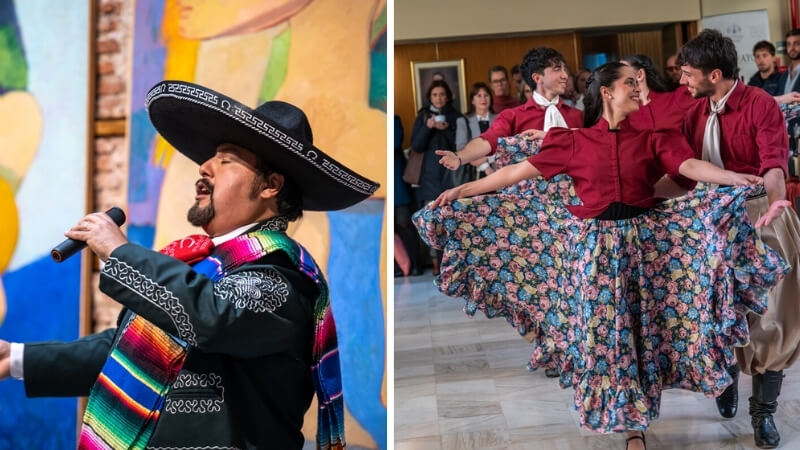
At the conclusion of the discussion, autographed copies of the book*Contame Abue*, by Canarian journalist Mateo Britos—a native of Los Cerrillos—and *Pateando barreras hasta que juguemos todas*, by Vadel and Pujol, were presented. The event also featured a performance by the Folk Ensemble of the 1st Infantry Brigade and a performance by the mariachi group Odín Villalobos.
https://www.youtube.com/watch?v=XtNsq6bkaGU
Diplomacy and Wine: Wine as a Portable Diplomatic Credential
"Diplomacy and Wine: Flavors and Knowledge That Connect" offered a reflection on the role of wine as a symbol of national identity, a tool for cultural diplomacy, and a driver of wine tourism, drawing on experiences from Uruguay, Chile, and Argentina. The event included presentations, an exchange of experiences among panelists, and a guided tasting.
Wine as a Symbol Forged in Silence: A Perspective from Chile
One of the event’s keynote presentations was delivered byLuz Ebensperger Orrego, Chile’s ambassador to Uruguay, who recounted her career as a lawyer, regional governor of a region in northern Chile, senator, and now diplomatic representative, to illustrate how wine has gradually become, over the decades, her country’s primary cultural symbol abroad.
Whenever we were welcomed, the word “wine” was always associated with Chile—or people would start to associate it with Chile—and we’d see a smile on the face of the person introducing us whenever that happened.
That recurring observation led her to a conclusion she elaborated on during her presentation: “Without many of us Chileans realizing it, our country had created a symbol abroad—a recognizable cultural symbol —and that symbol came in a bottle.”
The ambassador drew a comparison with other countries in the region—Mexico, with its cuisine designated as a World Heritage Site; Brazil, with its carnival; and Argentina, with the tango—to point out that Chile lacked cultural icons of comparable global prominence, and that wine came to fill that role.
"For a country like Chile—geographically remote and demographically small—a glass of wine is, in many ways, a portable diplomatic credential. It fits in a suitcase, is served at a reception, and is shared at a table without any speeches. It says something that represents us and who we are."

Regarding the diplomatic aspect of wine consumption in other countries, he described what he called a “micro-diplomatic ceremony.”
"Every time someone uncorks a bottle of Chilean wine in Brazil—our top market today—or in the United Kingdom, Japan, South Korea, or China, a small diplomatic ceremony takes place. For a few minutes, a distant country becomes close. People discuss its geography, its climate, its valleys, and its history. That abstraction is given a taste. That, it seems to me, is the true diplomacy of wine."
He concluded his remarks by acknowledging Uruguay and the Tannat grape as a similar example:
We are neighboring countries, and each of us, in our own way, has learned to tell the world who we are through a glass.
Terroir, Wine Tourism, and Diplomacy from Uruguay
The presentation by Alan Claudio Beraud, Ambassador of the Argentine Republic to Uruguay, addressed wine tourism from a systemic perspective and its connection to diplomacy at the Ministry of Foreign Affairs level.
The ambassador stated that "wine tourism expresses theterroir" and that "that terroir is not just the soil; it is its people and its customs."
He described wine tourism as a business unit complementary to wine production that “has helped position not only the winery and its product,” but also “the river, the ocean, national identity, the asado, and gastronomy.” He also referred to a positioning agreement at the Foreign Ministry level as an institutional tool for promoting the sector.
Geographical Indications, Patagonia, and Desert Wine
A third set of presentations focused on the geography of wine as an identity: geographical indications as a tool that defines not only a wine’s location on the map but also its unique characteristics —much like how Malbec found better growing conditions in Mendoza than in its native France.
Two examples were presented: Patagonian wine, produced more than 4,000 kilometers to the south and considered the southernmost wine in the world, andTamarugal wine, the result of a project in the desert that is already attracting the interest of scholars from the Middle East.
In both cases, the central argument was that wine serves asa " commonthread " linking history, territory, and identity:
The knowledge of protocol—which is the act of regulated interaction between cultures—and the knowledge of wine—which is the act of capturing a territory’s identity in a liquid.
Institutional Recognition and Academic Closing Ceremony
Virginia Silva, Lic., MSc, academic coordinator of Business and Global Communication and professor of Corporate Communication and Public Relations at Universidad ORT Uruguay, spoke at the closing ceremonies of both events.
In "Enlazando Culturas," the work of the group of students and their professor, Claudia Calache, was highlighted: "The results of their work this semester far exceed all the positive preliminary comments and the enthusiasm the professor brought to the project."
In “Diplomacy and Wine,” he congratulated the organizing group and Professor Gimena Chiazzaro, and acknowledged the role of ALADI—the institution that provides the institutional framework for these activities—for opening “the doors so that our students can engage in this academic and professional exercise, which is vital to their education.”
Are you interested in event production?
Become a Technician in Public Relations and Event Planning