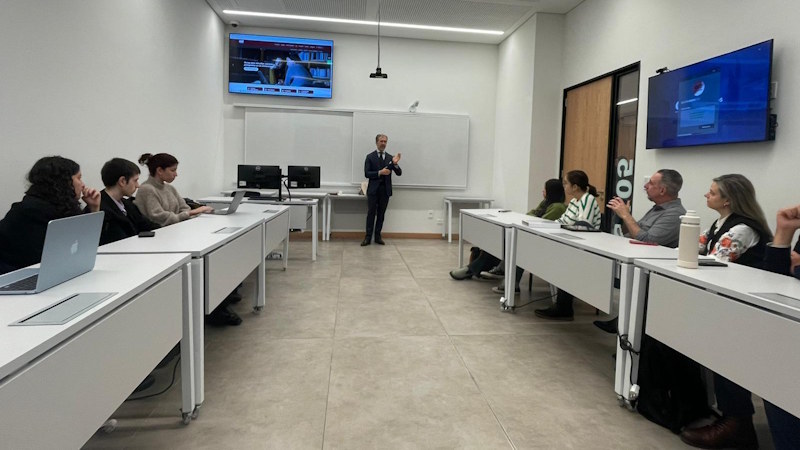
On this occasion, on Friday, May 8, at the Business School, the group led by Professor Dr. Diego Telias welcomed Felipe Llantada, ambassador and current director of the Artigas Institute of the Foreign Service (IASE) of the Ministry of Foreign Affairs, as a special guest. Ambassador Llantada, an economist who graduated from Universidad ORT Uruguay, has an extensive diplomatic career, having served at the Uruguayan Embassy in Vietnam and as Uruguay’s alternate representative to the World Trade Organization (WTO).
The event brought together faculty members from the department—including Andrés Bancalari, the academic coordinator of the Bachelor’s Degree in International Studies, and Lucía Neirotti, who teaches the course “Fundamentals of International Business”—as well as graduates and students. During his opening remarks, the diplomat reviewed his professional career at the Ministry of Foreign Affairs and explained the process that led to the selection of Vietnam as his posting, delving into the historical significance of that nation.
As he delved into his experience in the region, Llantada shared details about the logistical and personal challenges involved in establishing a diplomatic mission from scratch in a country so geographically and culturally distant. The ambassador illustrated the day-to-day and institutional complexities of establishing the first formal ties, explaining how differences in political systems and language barriers require the development of constant adaptation strategies to build bridges of trust.
The analysis also focused on the growing importance of Southeast Asia for Uruguay’s integration into the international community. Llantada highlighted the current priorities of Uruguayan diplomatic missions in the region and emphasized that opportunities for engagement go beyond strictly commercial matters, opening up fertile ground for fostering technical cooperation, cultural diplomacy, and academic exchanges. In another part of the discussion, the conversation broadened to address the regional geopolitical landscape. Participants discussed the pragmatism with which Vietnam and other Southeast Asian nations manage to balance their interests amid the growing strategic competition between China and the United States—a key dynamic for understanding the contemporary international system.
The event concluded with a question-and-answer session during which attendees were able to interact directly with the ambassador. With this second meeting, the East Asia Research Group continues to advance its goal of providing students with a deeper understanding of the region through direct dialogue with leading experts.