For one month, he conducted field research on the relationships between geology, mineralogy, water, and the landscapes of the Atacama Desert—an experience made possible by the Research Support Fund of the Universidad ORT Uruguay.
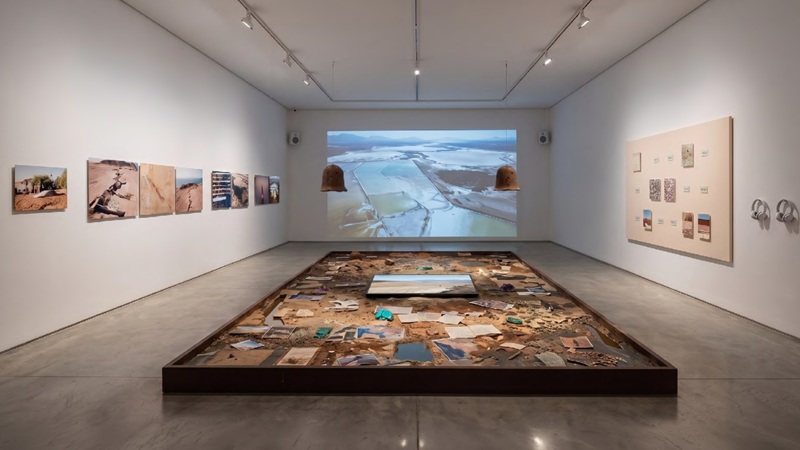
The residency allowed her to make progress on "A Mountain Entered My Body," an art installation based on a personal experience: a prosthesis in her spine serves as the starting point for reflecting on the relationship between the human body and geological matter.
The residency brought together artists and researchers from different countries and disciplines to develop projects related to geology, mineralogy,and otherEarth sciences—an area of work that the professor had already been exploring for several years through curatorial projects, sound research, and writing.
"I wanted to come with questions, not with a finished project. I was interested in having the region shape the research," the professor explained.
Exploring the Desert Through Art
During her residency, she traveled to various locations in the Atacama Desert and the Atacama Salt Flat, as well as areas affected by mining activity, where she was able to gain firsthand insight into the dynamics of lithium extraction and the relationships between geological processes, water, and local communities.
In addition to his fieldwork, he met with specialists in geology, mineralogy, archaeology, architecture, and hydrology, as well as with Atacameño communities, workers, and families with historical ties to the mining industry.
For the researcher, these exchanges were essential to broadening her perspective on the region.
Listening to these stories and learning about the different ways people relate to water, the earth, and minerals helped me understand that there are many forms of knowledge that go beyond the academic realm.
The experience was also physically demanding, involving long walks, treks through hard-to-reach areas, and adapting to desert conditions—aspects he considers inseparable from the research process.
A project that connects the body, the land, and memory
The proposal took the form of an installation consisting of a large sedimentation pool constructed from rocks, sand, liquids, and mineral particles, along with audiovisual works, photographs, sound recordings, and materials collected during excursions through the desert.
One of the central elements of the project is the use of bells from the former Chacabuco saltpeter mine, which have been modified with transducers that transform their metal surfaces into resonant bodies.
The work sought to explore how minerals, water, sediments, and infrastructure are all part of the same material fabric that connects the human body to geological processes.
Alluvial pools as a starting point
Among the sites that sparked the most interest during the research were the Antofagasta flood control basins, structures built to contain the floodwaters flowing down from the hills toward the city.
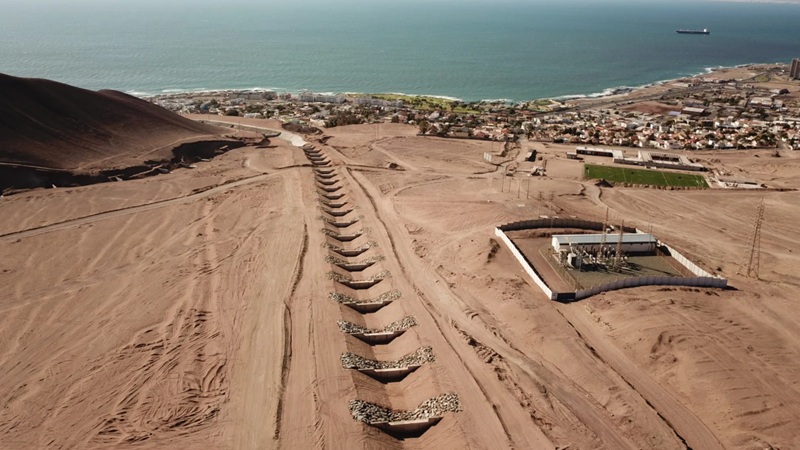
The researcher observed how these spaces, originally designed as flood control structures, gradually took on new uses and meanings, in some cases becoming informal settlements or garbage dumps.
"That contradiction interested me deeply. These are infrastructures created to protect the city that today also speak to migration, precariousness, risk, and new ways of inhabiting the territory," he said.
These observations broadened his research on sedimentation, understood not only as a geological process but also as a form of archive in which layers of history, objects, memories, and human experiences accumulate.
Transdisciplinary Research
The project integrates tools from the fields of art, geology, hydrology, mineralogy, and writing, based on the understanding that each discipline raises new questions rather than providing definitive answers.
For the researcher, writing plays a central role in her research, as it allows her to connect experiences, materials, and knowledge from different fields.
He also considers transmedia to be an essential part of his artistic practice, allowing a single line of inquiry to unfold through installations, sound works, audiovisual works, photographs, publications, and texts.
An experience that raises new questions
After completing her residency, the researcher returned with new lines of inquiry related to the conductivity of the earth and minerals, sound research, and the ways in which materials can be transformed into listening devices.
He also highlighted the value of the archive —comprising photographs, audio recordings, maps, conversations, and collections of materials—as an inseparable part of the creative process.
Finally, he emphasized the importance of teamwork and encouraged other students and graduates to apply for these kinds of international opportunities.
Often, the most valuable aspect of a residency is precisely what wasn't planned: a conversation, a walk, or a question that changes the course of the project.