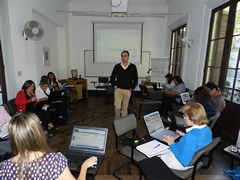
 Professor María Azpiroz was in China teaching Spanish to students at Harbin Normal University when he began to notice that teaching and learning processes were different from those in Uruguay. He started to wonder how to improve them, and so he began to conduct research. Little by little, he found answers and discovered that others were asking themselves the same questions. Like Azpiroz, many university professors and teachers from the National Public Education Administration (ANEP) decide to embark on a path of research to address their concerns. The Doctorate in Education at Universidad ORT Uruguay this need.
“It is a space for reflection and the systematization of knowledge, and an opportunity to develop a deeper understanding of the educational phenomenon by gaining access to the most up-to-date perspectives on learning and teaching, as well as the complex relationships underlying these processes,” explains Mag. Claudia Lagos, a Chilean student pursuing her doctorate alongside other Latin American professionals. “It takes place within the framework of an exchange with peers and professors who enrich this educational experience with their unique perspectives, interests, and professional experiences,” she added.
This academic doctoral program provides tools for addressing educational challenges, as research is a key input for decision-making. Today, “investing in education is key,” stated the director of the doctoral program and academic secretary of the Institute of Education, Dr. Denise Vaillant. “The fundamental task of a doctoral candidate is to produce work that represents an original contribution to knowledge,” she stated. Furthermore, students can “participate in the training of human resources and contribute to the dissemination of knowledge through publications and presentations at scientific events,” she noted.
This doctoral program covers the major themes in educational studies: organization and management of the education system, teaching and learning processes, educational technology, the teaching profession, and educational policy. The thesis proposal that applicants submit upon enrollment must be related to one of these areas.
Continuous updates
"This graduate program," explained Dr. Vaillant, "aims to equip doctoral candidates with a set of skills to investigate, analyze, and interpret the state of education at the national and regional levels, using an interdisciplinary approach to relevant issues."
In addition, earning the degree provides academic recognition in the graduate’s professional field. “My professional development has been marked by continuous improvement and staying up to date, so pursuing a doctorate was a logical step in my career,” said Lagos, Director of Early Childhood Education at the Diego Portales University School of Education.
The case of Azpiroz, Project Coordinator in the university’s Department of International Education, was different. She was working at Harbin Normal University, had completed a Master’s in Education at Universidad ORT Uruguay, had defended her thesis, and decided to continue her studies and explore the field of international education. “What drew me in the most was research, which I discovered relatively late in my master’s program. Because of the nature of my undergraduate training—I’m a psychologist—I didn’t have much training in research; I had to learn that over time because it wasn’t one of the strengths of my university program,” she said.
In this way, the doctoral program allows you to delve deeper into the subject that interests you and, at the same time, acquire professional skills that you would not have otherwise obtained.
In Search of Educational Equality
The major challenge facing education in Uruguay is the lack of equal opportunities. The doctoral students agreed on this point, arguing that the knowledge they have acquired is essential for addressing complex situations. “It has worsened over time and is now a problem that is staring us in the face. Everything proposed in education for the coming years must aim to narrow the gap between children who have access to these educational opportunities and those who do not,” Azpiroz noted.
The work of a Doctor of Education is essential when it comes to implementing strategies, since “they conduct research, contribute their ideas and findings to society, collaborate with other researchers, disseminate their findings, share them with others, and help shape educational policy decisions—thereby democratizing knowledge,” explained Mag. Margarita Romero, Inspector of Middle and High Schools for the Secondary Education Council and a doctoral student.
This is not only an issue affecting Uruguay, but also the rest of Latin America, as is the case in Chile. According to Lagos, the main obstacle in his country is the “deep inequality” that exists in terms of the quality of education, which is determined by one’s social class.
The director of the doctoral program echoed this sentiment, noting that this phenomenon and the professional development of teachers are two of the challenges currently facing the education system.
When Lagos was asked what solutions he would propose in light of this reality, he emphasized teachers’ capabilities and training. Fostering a reflective attitude and a sense of self-efficacy among them “can improve their future professional performance,” he argued. “Ultimately, it is about developing pedagogical reasoning that enables them to understand teaching as a process that involves decision-making.”
Azpiroz focused on the students, exploring the reasons behind academic failure in certain sectors and identifying ways to motivate them to study. “We need to investigate the situation, what people expect from education, and what they actually receive. We need to understand both the students’ perspective and the teachers’ perspective,” he said.
Challenges
The goals that motivated Lagos to pursue his doctorate were to help improve the quality of teacher training in Chile and the learning opportunities for children in that country.
Instead, Azpiroz proposes continuing to seek out interesting questions that will lead to others in the future—according to her—to learn a methodology that she can later use to conduct research and provide solutions to improve the teaching and learning process, as that is her goal. She cited as an example the question of whether Chinese students believe that group study is effective. “I want to write about this topic because I believe that international education has a bright future; more and more people are studying abroad, and an increasing number of people feel that studying foreign languages is just as important—if not more so—than earning a degree,” she said.
The challenge for the coming years is to generate empirical evidence through doctoral dissertations so that education authorities can implement appropriate policies and thereby improve the quality of education.
"The Programme represents a 'substantial step forward in training researchers in the field of education for Uruguay and the region, by promoting specialized systematic studies and encouraging interdisciplinary research, making it a novel initiative in our country that also draws on valuable international experience in this area,' concluded Dr. Vaillant."