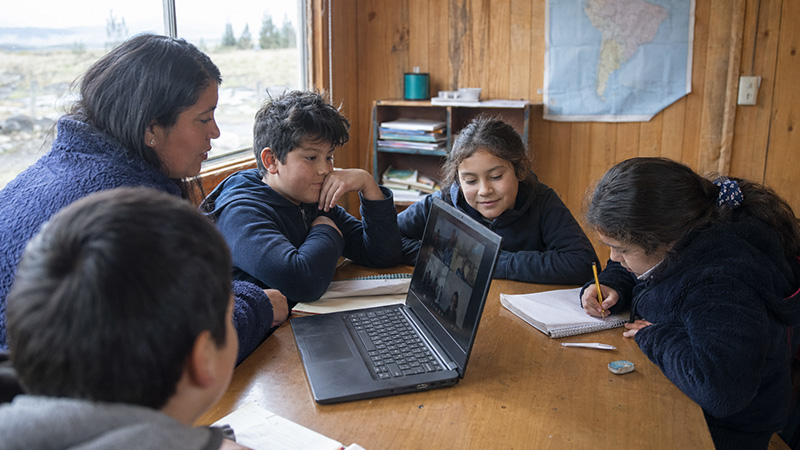
Having an internet connection and devices does not, in and of itself, guarantee that a school will transform the ways it teaches, learns, manages, or collaborates with others. To understand how technologies are incorporated into rural education, it is also necessary to examine school organization, teaching practices, leadership, professional networks, and the conditions in each region.
This premise guided a day of work held on July 27 in two consecutive sessions. In the morning, the meeting“Digital Transformation in Education and Rural Areas: Comparative Perspectives and Coordination of Fieldwork”took place in a hybrid format at ORT Rambla. In the afternoon, the workshop“Rural Schools, Territory, and Digital Transformation: An Exchange Among Colleagues”took place, also in a hybrid format, with in-person participation at the Agustín Ferreiro Center (CAF) in Cruz de los Caminos (Canelones) and via Zoom.
A Day of Collaboration and Listening
The morning session marked the first coordination meeting between the research teams from Uruguay and Chile involved in the project Digital Transformation in Education and Institutional Maturity. The session provided an opportunity to present the characteristics of rural education in both countries, identify similarities and differences between the regions, and discuss the methodological and operational criteria for the fieldwork planned in Canelones.
The afternoon workshop built on that work through a discussion with rural teachers from the three elementary school districts in Canelones. The opening presentations served as a starting point for identifying experiences, local conditions, existing practices, and the support needed to integrate technology in a pedagogically meaningful way.
The study began in April 2026 and has is expected to last 12 months. It is being conducted in rural public schools in Canelones, Uruguay; and in Aysén and Magallanes, Chile. Developed by the Institute of Education at the National University of Education ( Universidad ORT Uruguay ) in collaboration with the consulting firm ARS Chile, the project was selected to receive funding from the Ceibal Foundation and the International Development Research Centre (IDRC), with support from the National Agency for Research and Innovation (ANII).
In Uruguay, the study has received formal authorization from the General Directorate of Early Childhood and Primary Education (DGEIP). The preparatory stages were coordinated with the Department of Rural Education and with representatives from the three jurisdictions of Canelones (East/Coast, Central, and West).
The morning meeting was attended by Dr. Andrea Tejera Techera, scientific director; Dr. José Ignacio Porras, co-scientific director; researchers Dr. Mariela Questa-Torterolo and Dr. Claudia Cabrera Borges; researcher Miguel Juan Pérez Bade, M.A.; and Fernando Pino, technical assistant and communications coordinator.
Other speakers included Dr. Limber Santos, director of the Department of Rural Education and professor at the University of the Republic (Uruguay); Lucía González, inspector and rural education coordinator for Canelones East/Coast; Laura Damián, coordinating director of rural schools in Canelones West; Jenny Santos, coordinating director of rural schools in Canelones Central; and Mag. Patricio Muñoz, head of Innovation and Technology at the Aysén Local Public Education Service.
The Uruguayan team also includes researcher Dr. Dora Sajevicius and research assistants Mag. Matías Arniz and Mag. Camila Fajardo. Fajardo, who also runs a rural school in Canelones, joined the afternoon workshop. The Chilean team is rounded out by Dr. Paloma Sepúlveda, a researcher at the Autonomous University of Barcelona.
Digital Transformation Beyond Infrastructure
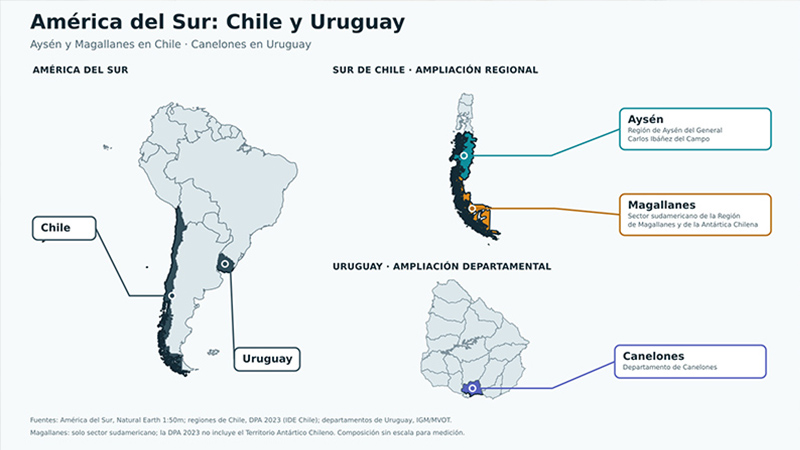
The general presentation of the project centered on two questions: what we aim to understand and where the study will be conducted. The first question seeks to understand how rural schools incorporate technology to manage, teach, learn, and collaborate with others. The second question defines the areas of analysis: Canelones, in Uruguay, and Aysén and Magallanes, in Chile.
During the workshop, this integration was explained through four interrelated aspects. The first covers school conditions, such as connectivity, available devices, transportation, schedules, and support services. The second focuses on practices—that is, how technology is used for teaching and learning.
The third level addresses organization: how each school makes decisions, coordinates work, and uses information. The fourth level examines the connections, including leadership, collaboration, and the networks that link schools, stakeholders, and institutions, even beyond a single locality or jurisdiction. In this regard, Dr. Andrea Tejera summarized the principle that links these dimensions:
Digital transformation is more than just having technology.
This approach shifts the focus from the inventory of equipment to the processes that enable the effective use of technology. To assess infrastructure and connectivity conditions, the plan was to rely primarily on official records and secondary sources, avoiding the need to ask administrators and teachers for basic information that was already available.
Consultation with school stakeholders will instead focus on what administrative records do not reveal: how technologies are used, what decisions accompany their integration, what difficulties arise in practice, and what networks help support educational processes.
- You might also be interested in reading:“Digital Transformation to Strengthen Rural Schools”
Three Regions, Different Forms of Rural Life
The 92 rural schools in Canelones are distributed among three elementary school districts:
- 7 in Canelones Este/Costa
- 42 in Downtown Canelones
- 43 in Canelones Oeste
As Dr. Limber Santos explained, Canelones is particularly relevant to this study because it brings together very different rural areas within a single department.
There are areas near the metropolitan region, regions associated with family farming and the so-called“chacra canaria,”more scattered areas north of Route 11, and towns in the northeast that have undergone processes of migration, depopulation, and changes in economic activity.
According to the description provided by Santos, Canelones Oeste is an exception within the Uruguayan rural landscape due to the predominant presence of multi-grade schools. Its 43 centers are organized into regional networks that facilitate access, coordination, and the sharing of resources.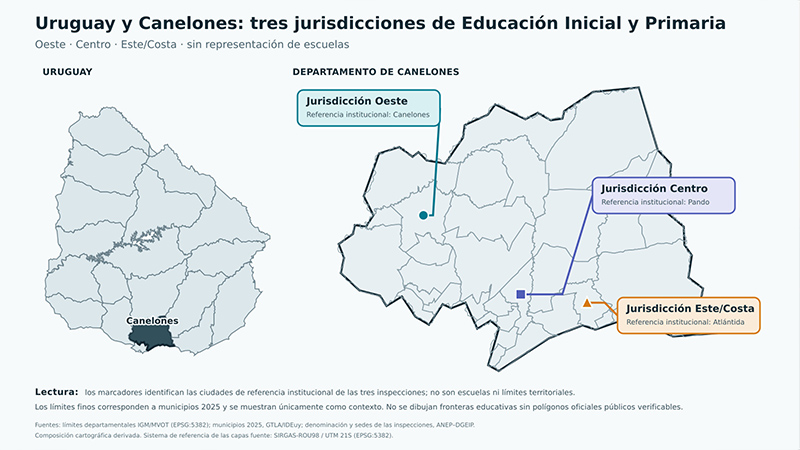
The regional representatives also explained that rural clusters help sustain professional communities among teachers and schools. These forms of organization can be maintained even when the members of the teams change, because they become integrated into the institutional dynamics of the schools.
In this context, isolation does not necessarily refer to the inability to commute daily, but rather to opportunities for professional and pedagogical collaboration. Technology makes it possible to hold meetings, share experiences, and access training opportunities. During the pandemic, the CREA platform played a central role in these exchanges and continues to be used by some groups of teachers.
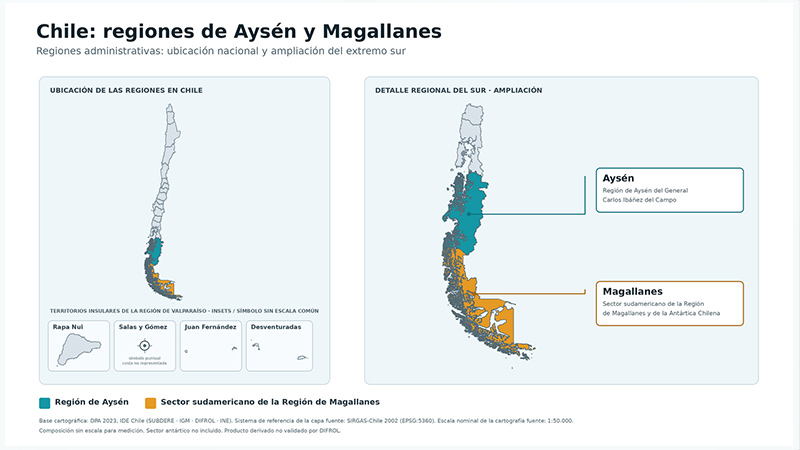 The Chilean team's performance demonstrated a different level of territorial control. Aysén and Magallanes These are two vast southern regions of Chile, characterized by low population density, geographic dispersion, and communities that may only be accessible by air or sea. Puerto Toro, at Cape Horn, was presented as the most isolated case within the studied population.
Isolation also affects educational trajectories. In some communities, incomplete coverage of secondary education interrupts those trajectories. Added to this is the loss of the “rural subsidy”: communities without this subsidy force families to migrate or send their children to boarding schools. These dynamics fuel a cycle of depopulation that puts pressure on school enrollment.
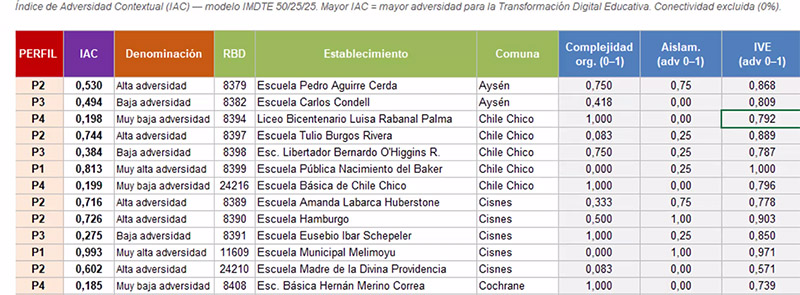
According to the data presented during the meeting, Aysén has has 33 rural schools spread across 10 localities, with enrollments ranging from one to 398 students. Of these, 23 offer multigrade classes. Magallanes has 13 schools in nine localities, with enrollments ranging from two to 51 students and a marked predominance of multigrade classes.
The organizational structure of the schools also varies. In Aysén, 20 schools are led by a teacher in charge, 13 have a formal principal, and eight have a Technical-Pedagogical Unit (UTP) director. In Magallanes, nine are led by a teacher in charge, four have a formal principal, and none of the 13 schools analyzed has have a UTP director as part of their structure.
The absence of such an internal role was identified as a significant factor: without a UTP director, the digital transformation may fall to a faculty member who, at the same time, leads, teaches, and manages.
Satellite connectivity served as an example of why having infrastructure does not equate to achieving digital maturity. In 2024, 11 of the 13 rural schools in Magallanes had received a connection through Starlink. Their educational use, however, also depended on leadership, institutional capacities, school organization, and available support.
In several southern towns, moreover, the school is the only public institution. Some schools have boarding facilities and are linked to local economies, such as those associated with ranches or with ENAP’s operations at Cerro Sombrero. In addition to teaching, they fulfill community, social, and regional roles.
- You might also be interested in reading:“5 New Educational Trends That Are Transforming the Way We Learn”
Rural Schools Speak Out
The afternoon workshop, in which Mag. Camila Fajardo—a researcher on the team and principal of Rural School No. 168 (Los Cerrillos, Canelones)—also participated, shifted the conversation from a general characterization of the territories to the day-to-day experiences of the schools.
Dr. Andrea Tejera Techera opened the session by presenting the project and the planned agenda for the meeting. She explained that the research aims to understand how rural schools incorporate technology to manage, teach, learn, and collaborate with others, from a perspective in which technology is a means rather than an end. She also emphasized that the comparison between Canelones, Aysén, and Magallanes is not intended to determine which country or territory is better, but rather to understand how schools develop responses to different conditions.
In this regard, following Dr. José Ignacio Porras’s presentation on rural education in Chile and Dr. Limber Santos’s comparative commentary based on the Uruguayan context, Dr. Mariela Questa-Torterolo led three rounds of discussion focused on territorial conditions, existing best practices, and necessary support.
As the third round began, Questa-Torterolo posed a question that encapsulated one of the main challenges of the discussion:“What kinds of support would be most effective in strengthening these efforts to integrate technology—in a pedagogically meaningful way—into rural schools in Canelones?”
With regard to the local environment, the presentations emphasized that the natural and productive surroundings serve as an immediate source of educational experiences. The challenge is not to replace this richness with digital activities taken out of context, but rather to learn how to integrate technology into the experiences offered by each school’s environment.
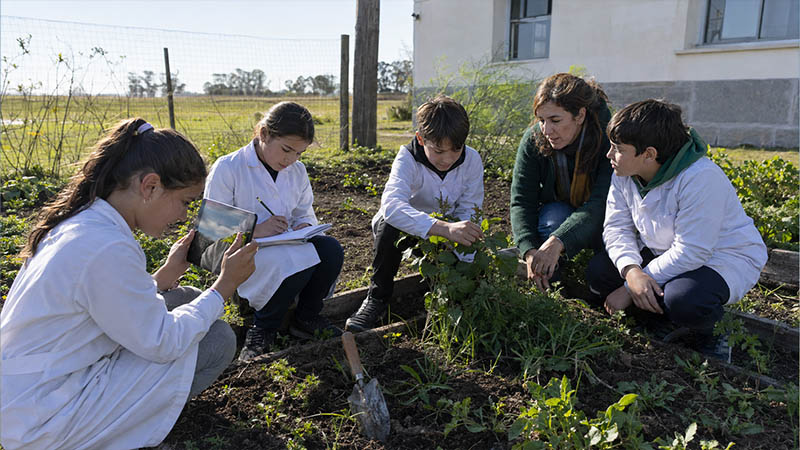
Conditions that may promote or limit these uses were also identified. Comments from rural teachers indicated that, in some schools, the involvement of families and proper care of the devices help ensure that the equipment is available. At the same time, in schools with one, two, or three teachers, the training, experience, and willingness of each staff member can have a significant impact on how the equipment is used.
The shared practices included the daily use of interactive screens, maps, news, and audiovisual materials; activities in computational thinking and robotics; virtual meetings with tutors and other schools; and work using educational platforms. The testimonials also highlighted the role of rural consortia and support networks in learning about tools, exchanging experiences, and making better use of available resources.
The need to maintain a balance between technology, books, workshops, the garden, animals, and the hands-on experiences offered by the local area was also raised. Digital integration is valuable when it enhances these learning opportunities, not when it replaces what makes rural education unique.
Regarding support, the presentations agreed on the importance of context-specific, practical training tailored to the unique characteristics of rural schools. In addition to courses and materials, participants valued on-site support, peer learning, the sharing of knowledge within school clusters, and the effective availability of necessary resources. The workshop thus demonstrated that some of the capabilities needed to move forward already exist in other schools or among nearby teachers, but they require channels through which they can be shared.
- You might also be interested in reading:“Educational Inclusion in the Digital Age: Strategies for Ensuring Equitable Access to Knowledge”
Compare to understand, not to rank
The comparative analysis of these situations in Uruguay and Chile does not seek to determine which country, region, or school is in a superior position.
In this regard, Dr. José Ignacio Porras explained:
We are not comparing countries; rather, we are comparing regions.
The goal is to understand how schools develop responses to different circumstances. Dr. Limber Santos summarized the value of this exercise by noting:
We cannot fully understand rural life and rural schools in Canelones unless we consider them within the context of the country as a whole.
To that end, the discussion was structured around three questions:
- Territory: Which factors carry the most weight in each specific context?
- School: What Practices and Organizational Structures Work?
- Support: What networks and sources of support make it possible to move forward?
These questions make it possible to identify common dimensions without assuming that contexts are equivalent. The practices and organizational models identified in Aysén or Magallanes cannot be automatically transferred to Canelones. Similarly, the solutions developed in Uruguay must be reinterpreted before being applied in areas that are extremely isolated, have different school structures, and different forms of governance.
The same approach guides the development of the Educational Digital Transformation Maturity Indicator (IMDTE). The profiles developed to characterize conditions in Chilean schools cannot be applied to Canelones without modification. The tool must allow for the identification of common dimensions without obscuring the initial conditions, organizational structures, and support systems specific to each region.
In this regard, it was agreed during the working meeting that the categories will not be used to compile rankings. The practices identified must be understood within their context before assessing the extent to which they can be adapted or transferred.
- You might also find it helpful to read:“Educational Research: A Key Factor in the professional development of Primary and Secondary Education”
Listen, Reflect, and Share
During the meeting, the study’s process was summarized in three key stages: listening, delving deeper, and sharing. In the first stage, the plan was to conduct a survey of administrators and teachers from all the schools included in the study. The survey will provide information to characterize and categorize the schools according to their levels of digital maturity, taking into account their local conditions. The census-style scope refers to the intention to invite all schools to participate and does not presuppose a 100% response rate.
The information will be treated as confidential and private, and the results will be presented anonymously. The team may identify the centers in order to carry out the planned stages, but the study does not seek to publicly identify or compare them with one another: its purpose is to generate knowledge about the processes being analyzed.
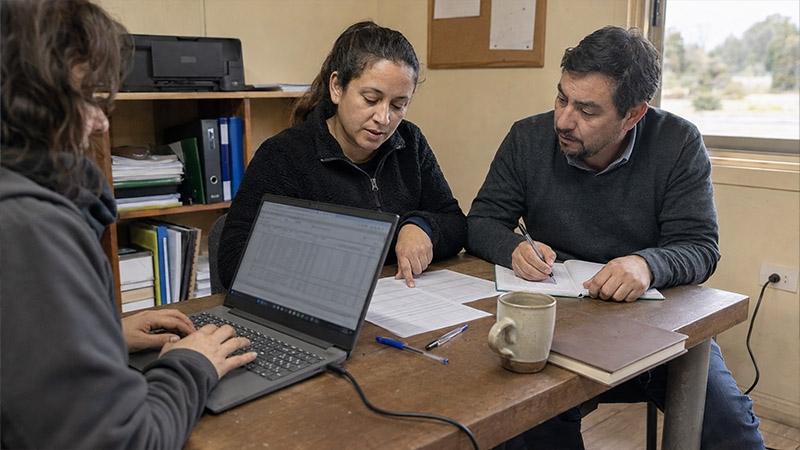
The responses will be supplemented with official data and secondary sources, particularly to gain insight into infrastructure, connectivity, and other contextual factors.
The second phase will seekto delve deeper into what quantitative data cannot explain. Based on the systematization of the survey—moving from the general to the specific—it was decided to intentionally select three or four schools in Canelones and three or four in Chile.
The site visits, interviews, and discussions will help identify the factors that promote digital transformation and the obstacles that hinder it. During the meeting, it was also projected that this qualitative phase could take place in August or September 2026. The case studies will be selected based on the categories developed in the first stage, the level of digital maturity, isolation, and geographic distribution.
The third phase will focus on sharing what has been learned. The plan is to provide feedback to the participating stakeholders, systematize practices and lessons learned, develop guidelines for decision-making, and promote new regional and institutional exchanges.
Building Networks Beyond the Project
The workshop’s conclusion was framed as a stepping stone toward future forms of collaboration. Dr. Andrea Tejera Techera proposed creating integrated forums where teachers from Uruguay and Chile could learn about the study’s findings, listen to one another, and share one or two selected experiences from each group. It was also proposed to explore a similar collaboration with Chilean microcenters.
Tejera summed up this possibility by saying,“Technology can bring us closer together and help us strengthen this rural identity—which perhaps we should refer to in the plural.” The reference to rural identities acknowledges that the project brings together different realities, but also that geographical distance does not prevent us from building shared spaces for learning.
During the event, it was also explained that the project is part of the Latin American Network for Digital Transformation in Education (Red LATE), promoted by the Ceibal Foundation as a regional platform for coordination, exchange, and knowledge generation regarding digital transformation in education.
The regional utility of the study will depend on identifying which practices work, under what conditions, with what support, and what adaptations they require. The challenge will be to develop a common indicator that captures digital adoption and allows for comparisons of processes while respecting regional differences.