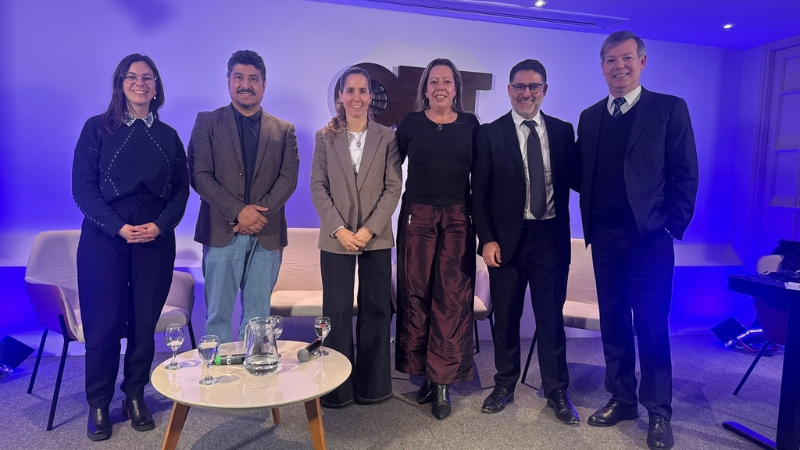
The event took place as part of an open class for the course “Public Affairs, Reputation, and Crisis Management,” offered as part of the Master’s in Creativity, Innovation, and Communication and the Master’s in Communication and Marketing Management at the Universidad ORT Uruguay.
The event provided an opportunity to connect the material covered in class with professional experiences and perspectives from the private sector, international organizations, and the public sector.
Throughout the discussion, the panelists addressed trust-building, engaging with various stakeholders, communicating on sustainability-related issues, and the challenges of crisis management.
Learn about theMaster's in Creativity, Innovation, and Communication and theMaster's in Communication and Marketing Management
The experts agreed that organizational communication has evolved from a function focused exclusively on disseminating messages to a strategic component of decision-making and relationships with various stakeholders.
They also analyzed credibility-building, spokesperson training, communication on sustainable development, media relations, and the role of communications professionals in increasingly complex institutional contexts.
Trust as a Strategic Asset
One of the themes that ran throughout the meeting was the importance of building long-term relationships.
Verónica Gené, Esq., stated that work in public affairs is based, above all, on building strong relationships.
Build relationships based on trust. Like any relationship, it can fall apart in an instant if we handle a crisis poorly.
Along the same lines, he explained that these relationships are what enable organizations to respond more effectively when faced with critical situations.
Communication for Advocacy
The experts agreed that strategic communication plays a key role in building consensus and influencing public policy.
José Peralta, M.A., Communications and Advocacy Advisor at the United Nations Coordination Office in Uruguay, stated that the true power of communication lies not in imposing positions, but in persuading through reasoned arguments and credibility.
Communication does not impose; communication persuades. Advocacy does not push; advocacy establishes a presence based on persuasion.
As he explained, the ability to influence depends on the trust that organizations are able to build with authorities, journalists, businesses, and other social actors. "The only real power of communication lies in the connections and the daily work that builds credibility."
Beyond Greenwashing
Another key focus was communication on sustainable development.
The panelists noted that today virtually all organizations incorporate this concept into their institutional strategies, although they cautioned that communicating sustainability requires understanding the context and avoiding the use of the issue solely for reputational purposes.

José Peralta explained that the challenge lies in adapting communication to each institutional and social context.
"It's not just a matter of falling into what is also known as 'greenwashing'; you have to do a lot of groundwork beforehand before you can use a concept like sustainable development correctly."
He also emphasized that the same message can have very different impacts depending on the political and cultural context in which an organization operates. "It's very important to understand the context you're in, the risks you might face, and what objectives you want to convey through your communications."
This topic relates to SDG 16: Peace, Justice, and Strong Institutions, which promotes effective, accountable, and transparent institutions, and with SDG 17: Partnerships for the Goals, which aims to strengthen cooperation among different actors in society. Both are part of the Sustainable Development Goals adopted by the United Nations in 2015 to address global challenges by 2030.
Prepare the spokespersons
Another issue discussed was the need to professionalize institutional communication.
The speakers noted that organizations must have spokespersons who are specifically trained to represent the institution to the media and other audiences.
In that regard, Javier Benech argued that the organizations that communicate best are those that assign that role to professionals trained to convey complex messages effectively.
Companies with strong communication skills also demonstrate this by having a specific, trained person who can speak publicly on these issues.
He also emphasized that such preparation serves as a way to provide institutional protection for organizations in situations where they are in the public eye.
The Challenge of Communicating Science
Toward the end of the meeting, a discussion on scientific communication began, prompted by a question from the communications director of the Uruguayan Institute of Meteorology (Inumet).
The question centered on the difficulty of conveying rigorous scientific concepts to the media without losing accuracy.
Learn about theMaster's in Creativity, Innovation, and Communication and theMaster's in Communication and Marketing Management
In response, Javier Benech noted that changes in the media landscape are forcing institutional communicators to provide more context and strengthen their ties with journalists.
"It forces us to redouble our efforts, to be better or more accessible in what we do."
As an example, he explained that he usually includes brief documents with the information to help readers better understand each topic. "By providing half a page of context, I at least give them some basic tools."
Communication, Ethics, and Credibility
During the discussion, it was also emphasized that credibility is one of the main assets of any organization.
José Peralta pointed out that, even when leadership or institutional priorities change, there are principles that must be upheld.
The non-negotiables in communication are always to uphold credibility and maintain certain standards of consistency, as well as ethics.
The insights shared during the event demonstrated how strategic communication is now integrated into the management of public, private, and international organizations as a tool for conveying information, building trust, fostering consensus, and strengthening dialogue between institutions and society.
https://youtu.be/MbFUrcFsSVY
Learn about theMaster's in Creativity, Innovation, and Communicationand theMaster's in Communication and Marketing Management