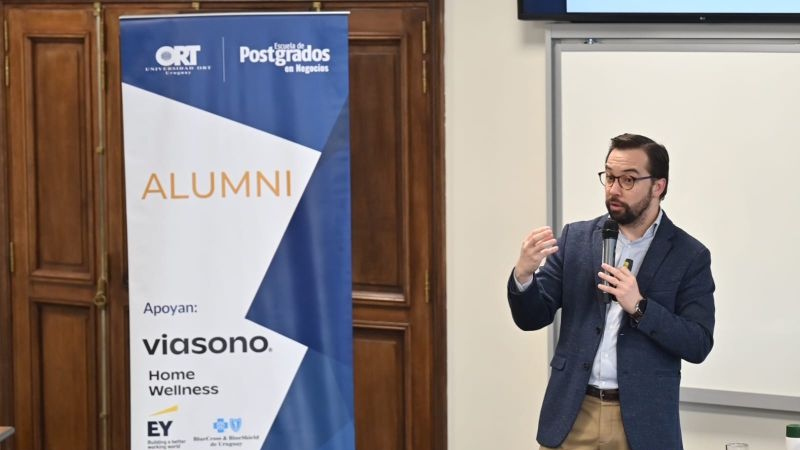
Organized by the Graduate School of Business, the conference “Geopolitics for Leaders” brought together industry leaders to explore how geopolitical factors directly impact business decision-making.
The event took place on Wednesday, June 18. The keynote speaker was Dr. Nicolás Albertoni, former Deputy Foreign Minister of Argentina and professor of International Relations and Integration at ORT, who offered a clear, up-to-date, and practical perspective on how international events shape regional markets and major global trade conflicts.
Geopolitics as a Tool for Business Leaders
In an increasingly volatile world, business leaders face challenges that go beyond the bottom line: from migration crises to environmental sustainability issues, as well as the transformation of democracies and economic uncertainty.
In this regard, Albertoni emphasized that “preparation is more important than prediction.” In times of severe crisis, it is not advisable to try to predict future scenarios, but rather to understand the present, analyze the relevant variables, and plan flexibly, prioritizing what is essential and decentralizing decision-making when necessary.
Participants were able to gain a deeper understanding of how geopolitics directly influences the business world, from investment decisions to companies’ international expansion. This perspective, which is increasingly sought after by executives and leaders, enables them to anticipate risks and opportunities in a complex, globalized environment.
Generations, Trends, and New Leadership Skills
The conference also addressed the generational shifts that are shaping today's leadership.
Albertoni noted that millennials and centennials face different challenges than previous generations, having grown up in environments of constant monitoring and exposure to virtual worlds, which has given rise to what is known as the “super-anxious” generation.
He also noted that severe episodes of depression have increased among children of these generations, a factor that leaders must take into account when managing teams and designing business strategies that adapt to an uncertain and constantly changing environment.
Key Strategies for Navigating Global Complexity
Dr. Albertoni emphasized that we are living in an era of exponential growth in key variables such as temperature, water use, and the availability of natural resources, which directly impacts business decision-making. Among the key strategies for managing this complexity, he mentioned:
- Flexible planning: designing strategies that can adapt to rapid changes and unexpected crises.
- Decentralization of decision-making: empowering teams to act quickly in response to changing circumstances.
- Prioritize what matters most: focus on what truly adds value and reduces risks. These tools are essential for leaders who seek not only to survive but to thrive in a challenging geoeconomic environment.
The event not only provided an analysis of global trends but also offered concrete examples of how geopolitics and geoeconomics affect regional trade and the strategic decisions of Uruguayan and multinational companies.
The conference “Geopolitics for Leaders” reaffirmed that understanding the globalized world is essential for making sound business decisions. Leaders who successfully integrate geopolitics into their strategic vision not only anticipate risks but also identify opportunities in an environment marked by uncertainty and complexity.
https://youtu.be/w_570ZoCBhU