
The piece, designed as a symbol of peace and unity, was presented to the pontiff during a private meeting with representatives of the CJU at the Catholic University of Uruguay (UCU). It is a dove of peace crafted from silver and amethysts, Uruguay’s national gemstone.
A Special Assignment
The proposal reached Kleist a fewmonths before the visit, when he was contacted bythe Central Committee of the Uruguayan Jewish Community to present a gift on behalf of the entire community.
The goldsmith accepted the commission with enthusiasm, though also with a strong sense of responsibility.
"It wasn't just about designing and crafting a piece of jewelry, but about creating a gift that would represent an entire community and convey a message on its behalf," she explained.
For that reason, he sought to ensure that the result would have deep meaning—both artistically and symbolically—and that it would live up to what it represented.
An idea that became a piece of jewelry
The creative process involved various stages of exploration. Although his initial idea was a dove of peace, Kleist also considered other symbols—such as the hamsa and the tree of life—associated with Jewish identity.
Finally, he decided to return to the original proposal and choose a figure with universal appeal, associated with peace, unity, and hope.
At one point, I realized that I didn't want to limit myself to representing a symbol that was exclusively Jewish. I wanted to find a more universal concept—one that could convey a message we could all relate to.
From the very beginning, she also knew she wanted to incorporate amethysts, as a nod to Uruguay.
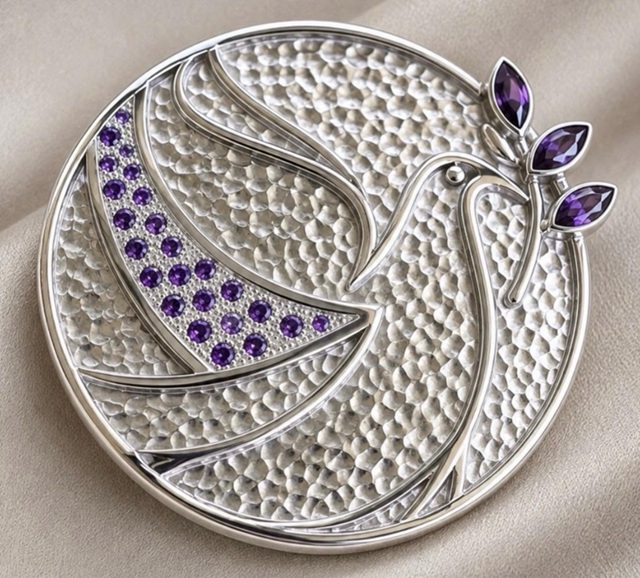
During the design process, she evaluated various options, using both rough and faceted stones, before ultimately choosing the latter to enhance their brilliance and luminosity. The number, size, and arrangement of the stones were adjusted based on tests of the composition.
The medallion was crafted from silver, featuring simple lines and traditional silversmithing techniques. The hammered texture, characteristic of Kleist's work, lent the design a personal touch.
For the goldsmith, the challenge also lay in achieving a balanced composition:
Achieving simplicity is often one of the greatest challenges in design. You have to find the right balance so that every element has its place and nothing stands out too much.
A Craftsmanship and Technical Challenge
The project required more than 60 hours of work in the workshop. The medallion's dimensions—seven centimeters in diameter—posed a challenge, as the team does not usually work with pieces of that size.
Kleist explained that the scale affects various stages of the process, from cutting and handling the metal to the heating times with a torch.
The project required adapting tools, techniques, and methods. It took numerous sketches, tests, and revisions to work out every detail.
The silversmith described the experience as a learning opportunity for the entire workshop team and highlighted the meticulous nature of the craftsmanship, both in the silverwork and in the setting of each amethyst.
A Special Gathering
The presentation took place during a private meeting between Pope Leo XIV and representatives of the Jewish community, held at UCU. At that time, a representative of the community presented him with the piece designed and crafted by Kleist in his studio.

Reflecting on the piece's journey, from the initial idea to its completion, Kleist highlighted the significance the project had come to hold:
Learn more about theBachelor of Science in Fashion Design at the