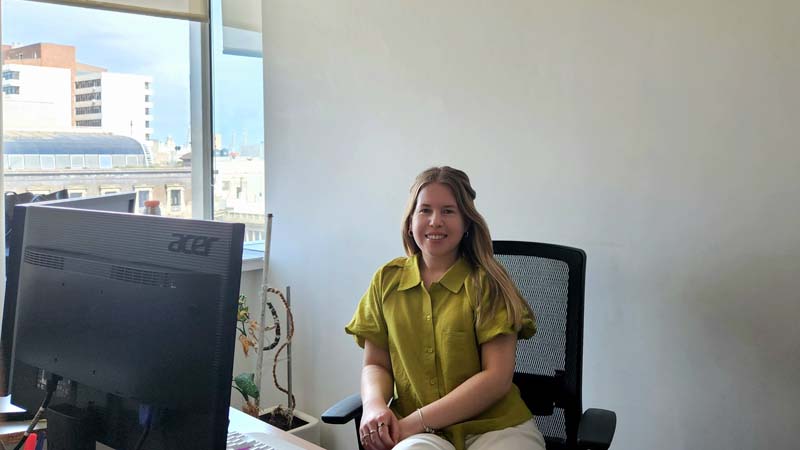
With a bachelor’s degree in biology and a master’s degree in environmental science, Agustina Serrón decided to further her education by pursuing a degree that would allow her to incorporate new technological tools. What began as a search for new professional opportunities ended up becoming an experience that allowed her to combine two fields of knowledge: biology and engineering.
For his final project in Systems Engineering, he researched the use of artificial intelligence models to predict the effects of mutations on enzymes, with the goal of providing tools that could facilitate experimental work in biotechnology.
The thesis, titled “Study of the Effect of Mutations on Enzymes Using a Multimodal Protein Language Model with a Focus on the Explainability of Predictions,” was supervised by Dr. Lorena Betancor and Dr. Sergio Yovine.
From Biology to Systems Engineering
Before starting her degree in Systems Engineering, Agustina had already been exposed to programming and computational modeling during her studies in biology and environmental science. That experience sparked her interest in exploring other career options.
The opportunity to combine his scientific training with engineering knowledge was a key factor in his choice of major. However, the beginning was not without its difficulties. Programming was one of his main challenges, especially during the early years.
"At first, I really struggled with programming. It was hard to understand some of the concepts, but it was important not to give up."
As his studies progressed, he discovered new areas of interest, particularly in courses related to artificial intelligence, knowledge of which would ultimately prove essential for his thesis.
AI for Studying Enzyme Mutations
The project arose from contact with researchers at the Biotechnology Laboratory, particularly with the Protein Technology group, of which Dr. Lorena Betancor is a professor.
The group is working with an enzyme called cytosine deaminase, which is being studied for its potential application in treatments for pancreatic cancer. To improve its properties, the researchers are studying different mutations—that is, changes in the amino acid sequence that makes up the protein.
The challenge is that there are thousands of possible combinations, and experimentally testing their effects requires time and resources. Faced with this problem, Agustina investigated the use of protein language models—artificial intelligence tools capable of analyzing sequences and generating predictions about the possible effects of certain mutations.
We saw an opportunity to investigate models that would help us identify which mutations might be most favorable and guide the tests conducted in the laboratory.
During the research, he evaluated different models and compared some of their predictions with experimental data provided by the laboratory. The results varied: while some predictions yielded favorable results, others did not match the experimental observations.
The study also incorporated explainability techniques aimed at understanding and interpreting the predictions generated by the models.
A bridge between biology and engineering
One of the aspects Agustina valued most was the exchange with researchers from both fields. While working on her thesis, she held meetings with the lab team to present her findings, receive feedback, and adjust the direction of her research.
"I often served as a bridge between biology researchers and engineering researchers. Being able to understand both fields and facilitate communication was one of the most important aspects of my education."
The experience also involved learning about a field of biology different from his original area of specialization, which was related to environmental sciences.
Another challenge was the open-ended nature of the research. Unlike his previous academic experiences, in which the objectives were defined from the outset, this time the project’s direction evolved based on the results and the needs of the laboratory.
"I was used to starting a research project with clearly defined objectives. With this thesis, it was different: the objective took shape through discussions with the lab and the results we were obtaining."
A research project with potential for continuation
Although the thesis took a primarily research-oriented approach, its results open up the possibility of moving toward a practical application.
The proposal is that, at a later stage, a platform could be developed that integrates the models and tools used, so that researchers can enter a protein of interest and obtain predictions that help them select which mutations to study experimentally.
This would make it possible to focus testing on promising alternatives and optimize the time spent on laboratory testing.
It would be interesting to develop a platform that integrates the tools currently in use and allows the laboratory to make more practical use of them.
For now, the study provides computational tools and code that could serve as a starting point for future research.
A career path that combines science and technology
Agustina currently works at the Ministry of the Environment, where she began as a biologist and later moved to the IT department.
From that point on, he has been applying knowledge from both disciplines and acknowledges that his engineering background has enabled him to develop better technological solutions.
The experience of working on her thesis also sparked her interest in new career opportunities related to biotechnology and health.
I would like to work in a role that combines both areas. I chose biology as my field out of a sense of calling, and I don't want to set it aside. I believe I have a lot to contribute by integrating these areas of knowledge.
Learn more about Systems Engineering