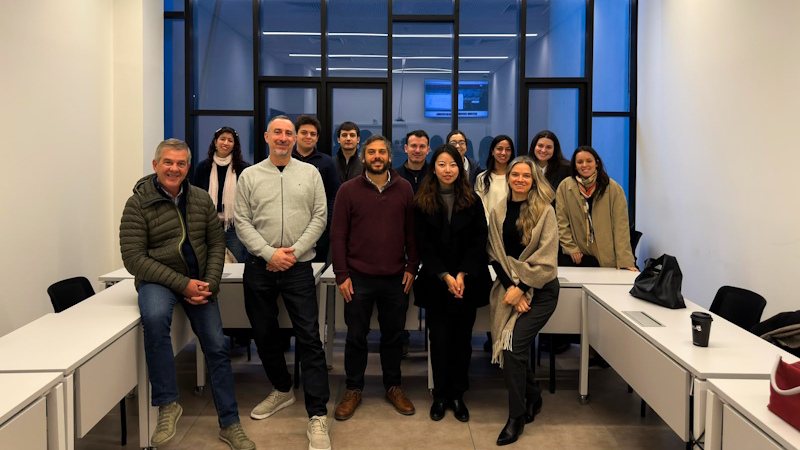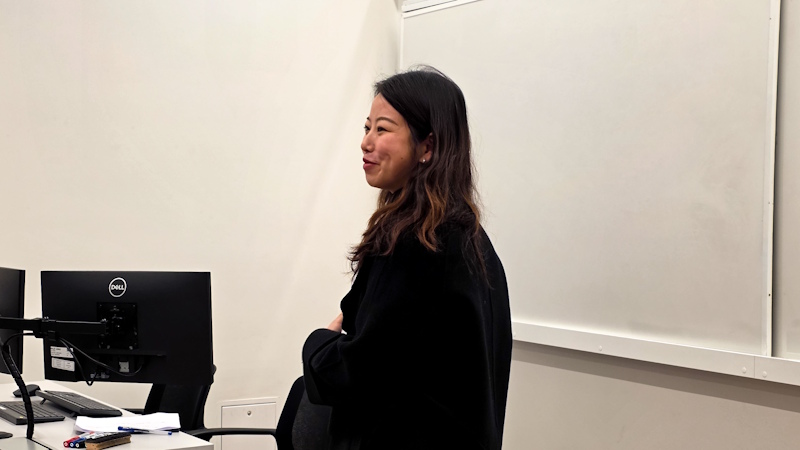
At a recent meeting of the East Asia Research Group, led by Dr. Diego Telias, associate academic coordinator and professor in the Bachelor’s Program in International Studies, the faculty welcomed Dr. Shiao Wang from Fudan University. The research associate at the Millennium Nucleus on China’s Impacts on Latin America (ICLAC) and assistant professor at the Fudan Development Institute shared her research projects on Chinese investment in the region.
The guest spoke with faculty, alumni, and students about lithium policy in Chile and Bolivia and the presence of Chinese companies. During her presentation, Wang analyzed how the “Lithium Triangle” is responding to the growing international demand for this mineral, which is now considered a strategic resource. She placed special emphasis on China’s high dependence on lithium, as the country produces a large percentage of the world’s lithium-ion batteries and relies on Latin America for its supply.
In addressing the case studies, the expert summarized and compared the different governance models implemented in response to this demand. On the one hand, Chile has a mixed and highly regulated model in which the state is moving toward greater involvement, and where Chinese presence has been indirect, through equity investments. On the other hand, Bolivia promotes a model that is heavily centralized around the state, prioritizing sovereignty and local industrialization; however, despite having signed direct agreements with Chinese companies, its development has been held back by various barriers. In closing, the discussion provided an opportunity to reflect on the challenges facing the industry in the international arena.
As part of his visit, Wang met with the Department of International Studies to discuss opportunities for cooperation between the “Global South Field Research Laboratory, Fudan University (GSFRL-FDU)” group, of which he is a member, and the East Asia research group.