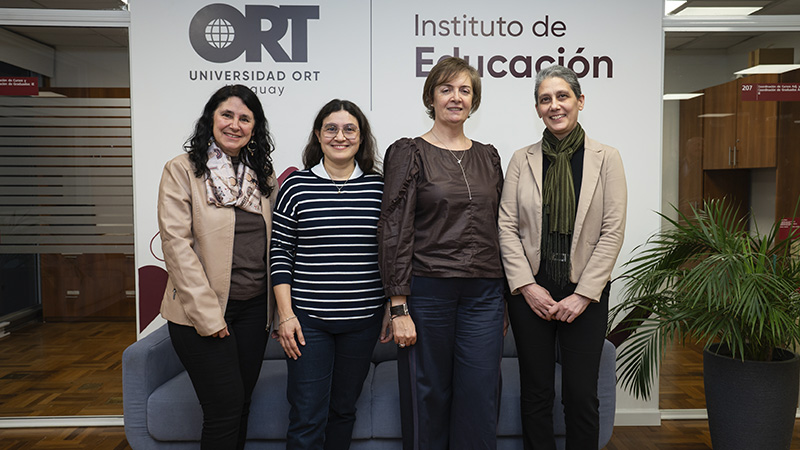
Although 72.8% of the teachers surveyed believed that artificial intelligence presented an opportunity to improve teaching, only 24.6% used it to assess their students’ academic performance. What was the reason? 88.8% cited a lack of specific training as the main barrier to incorporating these technologies.
These were some of the results presented during the closing ceremony of the project “Strengthening Teachers’ Digital Competencies in Secondary Education for Artificial Intelligence-Mediated Assessment,” developed by the Institute of Education of the Universidad ORT Uruguay with funding from the Education Sector Fund of the National Agency for Research and Innovation (ANII) and the Ceibal Foundation.
This research aims to strengthen the digital skills of secondary school teachers, particularly with regard to technology- and artificial intelligence-supported assessment.
On Tuesday, August 18, the project’s closing ceremony was held at ORT Rambla. The event was titled“Integrating AI into Learning Assessment”and, in addition to presenting the main findings, featured a presentation by Eduardo Mangarelli, dean of the School of Engineering at the National University of the City of Buenos Aires ( Universidad ORT Uruguay ) and a leading expert at the intersection of artificial intelligence and education.
https://www.youtube.com/watch?v=ZKhl8Nx_DsI
The Paradox of Adoption
The Institute of Education’s research involved teachers from 12 schools in nine departments across the country, all located in vulnerable communities. It combined quantitative, qualitative, and participatory methods to study digital competencies, as well as the barriers and opportunities associated with the use of artificial intelligence —and, specifically, its incorporation into assessment.
Dr. Claudia Cabrera Borges —one of the project’s co-leaders—explained that one of the findings was what, within the framework of the project, was termed the“adoption paradox”: the teachers surveyed expressed openness to using these technologies but stated that they lacked sufficient training to effectively integrate them into their assessments.
In turn, as Cabrera Borges pointed out, the least developed component Among the digital skills surveyed was the one related to the use of artificial intelligence to evaluate, both in designing assignments and in grading students' work.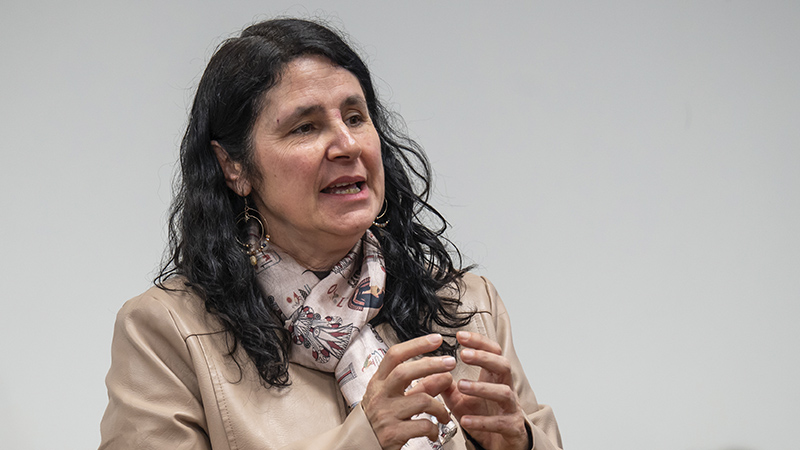 To arrive at these results, the research was conducted in three stages: a diagnostic phase, which included surveys for teachers; an opportunity for in-depth study through focus groups; and a participatory phase collaboration with teachers to design a training program tailored to the identified needs.
The Red Lines of Evaluation
“Artificial intelligence is not a tool that has value in and of itself; rather, we give it value the moment we use it, ”said Dr. Mariela Questa-Torterolo, the project’s scientific director, who noted that it is necessary to “view it as an opportunity to strengthen human and pedagogical capabilities.”
During the discussion with teachers, the “Strengthening Teachers’ Digital Competencies” initiative helped identify “the indispensable”—those aspects that should not be delegated to artificial intelligence systems.
Among these were an understanding of each student’s specific context, as well as the affective, emotional, and relational dimensions that come into play in teaching, learning, and assessment. In this regard, the research team defined these aspects as the “red lines” or the non-delegable components of the assessment process.
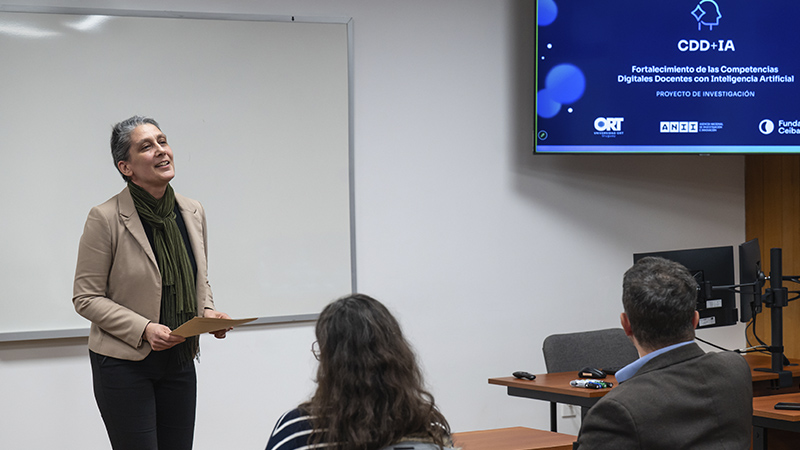 Another one of the specific features of the research was listen to the voices of the main characters, in this case, the teachers. Thus, the project team co-designed the Training Proposal: “AI Expedition: Evaluation with a Human Touch”, which was later validated by a panel of experts on the subject.
The initiative aims to promote the critical, ethical, and pedagogically relevant use of artificial intelligence, while seeking to address the training needs identified through research. Its components include flexible learning paths, personalized mentoring, opportunities for peer exchange, and a repository of best practices validated by the educational community.
“We felt it was very important for the research to be grounded in the reality of teachers and the families who send their children to schools,” said Questa-Torterolo. Although she explained that the materials developed in this research are intended for secondary school teachers, she noted that they can also be “read and used by other teachers.”
You might be interested in:
- Guide | Assessing with AI Without Losing Sight of the Pedagogical Purpose
- Guide | Designing Authentic and Inclusive Assessments with AI
Evaluate the process
Before the findings were presented, Eduardo Mangarelli, Ph.D., analyzed the progress of generative artificial intelligence and its implications for education. The dean of the School of Engineering at the National University of Buenos Aires ( Universidad ORT Uruguay ) argued that the speed at which these systems are evolving creates a need for a “new form of literacy” that enables people to understand how they work, what capabilities they have,and what their limitations and risks are.
 His presentation covered the basics of How Generative Artificial Intelligence Systems Work and some of its key strengths. Among them, his potential to offer different perspectives, his ability to follow instructions accurately and multimodality, which allows users to interpret text, audio, video, and images, as well as generate content in various formats.
He also addressed the risks related to privacy and bias, an understanding of which is necessary to grasp both the potential of these technologies and the conditions for using them effectively. In particular, he emphasized “cognitive inactivity, ” which he defined as the risk that students, instead of trying to solve a problem, will “go straight to the solution” by relying on systems that “will have the answer.”
These capabilities inevitably have an impact on evaluation. “Today, it is clear to us that an answer can be obtained in seconds, even if the problem is complex,” Mangarelli stated. Given this scenario, he argued that it becomes importantto “evaluate the process beyond the result.”
To move in that direction, the expert highlighted the importance of strengthening skills such as problem comprehension and the ability to ask appropriate questions, since“the quality of the answers”obtained from these systems is “heavily influenced by the questions”and by the context provided.
But we must not forget that generative artificial intelligence can “enhance the learning process” and open up “new possibilities” when it comes to expanding the resources available for teaching. Among other uses, he mentioned its potential for designing activities, generating variations of exercises with different levels of difficulty, personalizing content, and providing feedback to students.
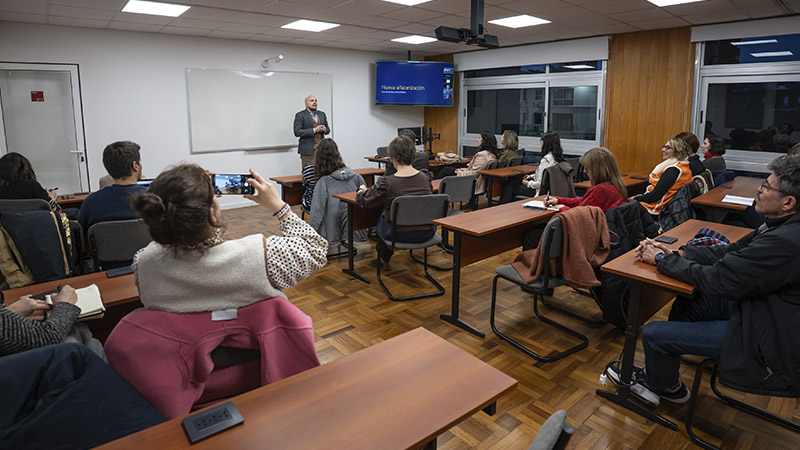 Toward the end of his remarks, Mangarelli suggested that the discussion educational I shouldn't leave of expectation that students do without these technologies. “The tools are there, and the reality is that they're going to use them. The best thing we can do is guide students so they can use the tools effectively", he concluded.
Resources and Next Steps
In addition to the training program, the project produced reports, academic articles, infographics, videos, and guides on the use of artificial intelligence in assessment, all of which are available as open access on its website.
At the event’s conclusion, the researchers noted that “Expedición IA” is being considered for possible implementation in 2027 through Ceibal’s platforms. The team proposed continuing to study its implementation and generating new knowledge based on that experience as their next lines of work .
Image Gallery

The project is linked to Sustainable Development Goal (SDG) 4: Quality Education, one of the goals adopted by the United Nations to address global challenges by 2030, due to its emphasis on teacher training and the development of educational practices relevant to technological changes.