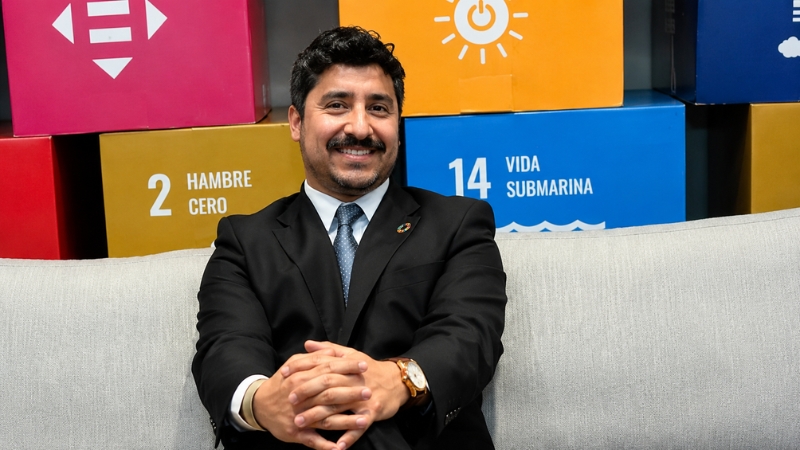
As part of the course“Communication Management and Corporate Social Engagement,” José Peralta gave a talk focusing on the challenges of communication related to sustainable development, corporate social responsibility, and organizations’ commitment to their communities.
During the event, Peralta shared his professional experience in institutional communications and discussed how organizations can develop more effective strategies when they understand the context in which they operate, identify their audiences, and anticipate potential communication risks.
The speaker has background in journalism, international communication, and sustainable development, and holds a master’s degree in Design, Management, and Administration of International Cooperation Projects from the European University of the Atlantic.
Before joining the United Nations Office in Uruguay, he worked for 14 years at the weekly newspaper *Búsqueda*, where he covered a variety of topics and policy issues, and later served as editor for the Americas at IFEX, an international organization dedicated to defending freedom of expression. For the past seven years, he has been working at the United Nations Office in Uruguay, where he develops communication strategies related to the country’s sustainable development.
Are you interested in communication and corporate social responsibility?
Learn about the Master’s in Creativity, Innovation, and Communication
Context as a Starting Point for Communication
One of the main themes of the talk was the need for communications professionals to understand the context of organizations before developing campaigns or initiatives.
A communication strategy requires combining creative ideas with a deep understanding of the institutional reality, the objectives, and the context in which each organization operates.
“Make sure you know exactly where you’re working, or who you’re working for,” he said during the talk, noting that a communication strategy may not achieve its objectives if it isn’t aligned with the context of the institution or company for which it was created.
In this regard, he noted that understanding the organization's history, capabilities, and objectives is essential for crafting appropriate messages and avoiding strategies that are out of touch with reality.
Sustainable Development, the SDGs, and Responsible Communication
Another topic discussed was communication regarding the Sustainable Development Goals (SDGs) and the challenge of translating these concepts into concrete strategies for companies, public agencies, and social organizations.
- You might be interested in: What are the SDGs, and how are they addressed in higher education?
Peralta explained that the SDGs serve as a framework to guide actions related to sustainable development, but he cautioned that they must be analyzed in light of each organization’s specific circumstances.
When it comes to sustainable development communication or social responsibility communication, you need to be very clear about who you want to target with your message once you've done this.
To illustrate this point, he presented examples related to the work of the United Nations and its agencies, showing how the same action may require different messagesdepending on the target audience.
Audiences, Results, and Measurement: Keys to an Effective Strategy
During the talk, the importance of setting measurable goals and expected outcomes before launching a campaign was also emphasized.
Peralta explained that a communications initiative should not be evaluated solely on the basis of its reach, but rather on whether it succeeded in achieving its initial goal.
“I ran a communications campaign that reached 70,000 people. Great. What was your goal? What result were you hoping to achieve?” he asked as an example to distinguish between visibility and communication effectiveness.
In this regard, he emphasized that strategies related to social responsibility require precisely identifying who the message is aimed at and what change it seeks to bring about.
The Challenge of Communicating Without Engaging in Greenwashing
Another key point of the presentation was the risk of communicating social or environmental commitments without genuine support within the organization.
Peralta pointed out that companies should avoid making statements that are not backed up by concrete actions, as this can lead to a loss of credibility with their audiences.
“You can’t portray your business or your company as something it isn’t, or it will backfire on you,” he explained, referring to the risk ofgreenwashing andother communication practices that seek to associate a brand with social causes without a genuine commitment.
In closing, he summarized the key principles that should guide communication related to sustainable development: understanding the context, analyzing risks, defining the audience, and establishing clear outcomes.
Are you interested in communication and corporate social responsibility?
Learn about the Master’s in Communication and Marketing Management