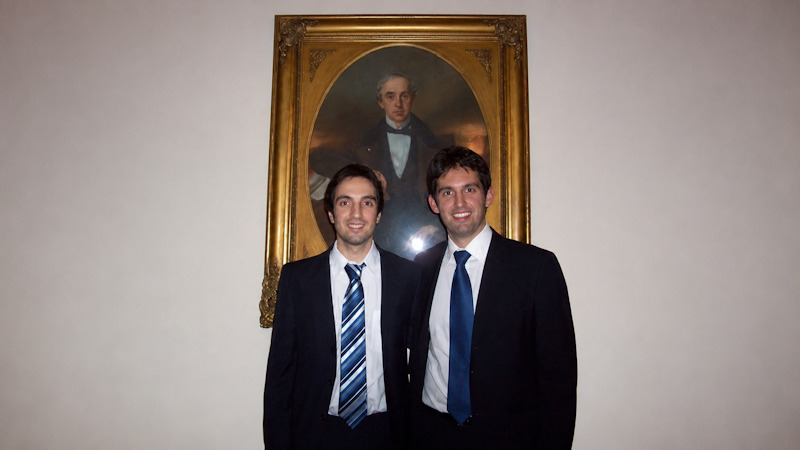
Andrés D’Albora, 24, and Joaquín Thul, 23, graduates of the Bachelor’s program in Economics, won second prize in the contest on the topic “A Comparison of the 1929 and 2008 Crises: Characterization, International Measures, Uruguayan Measures, and Consequences,” organized by the National Academy of Economics (ANE). The awards ceremony took place on November 10 at the National Chamber of Commerce and Services.
The topic of the research project was proposed by the ANE itself for all the professionals who participated in the contest.
The graduates learned about the contest from one of their professors, Juan José Barrios, who suggested that they submit a project, as Thul recalled.
World War I and the 1929 crisis; September 11 and the 2008 crisis
The graduates argued that World War I.
It cannot be considered one of the causes of the crisis of ’29,” since they attribute the main causes of the Great Depression (the name given to the crisis of ’29 in the United States) to the 1920s.
They argue that “while it is true that the Western world suffered a postwar recession, it was overcome in the early 1920s when the United States entered a period of strong growth and Europe began its reconstruction process.”
The September 11 attacks “were an isolated event in a relatively stable political context, at least when compared to the years leading up to World War I,” they noted.
Thul and D’Albora acknowledged that in the months following the attacks, “the U.S. Federal Reserve’s (FED) interest rate cut was exacerbated, which ultimately created the conditions for the crisis that would unfold later.”
Europe Affected
"The Great Depression caused global trade to fall by more than half, 'which clearly affected European countries, given that the United States was already one of their main trading partners and a key player in the reconstruction process,'" D'Albora said.
Given the inflexibility that the gold standard imposed on the European countries that still used it, we can see that the crisis in Europe was triggered by both external factors and internal causes.
Thul stated that the main cause of the spread of the 2008 crisis was “due to the globalization of international financial markets.” He explained that many European banks held large positions in risky U.S. assets and suffered just as much as U.S. banks. “When these assets lost value, it mattered little where the bank was geographically located; the massive losses in equity and bankruptcies were similar for all.”
Terra: A Proponent of the Status Quo in Economic Policy
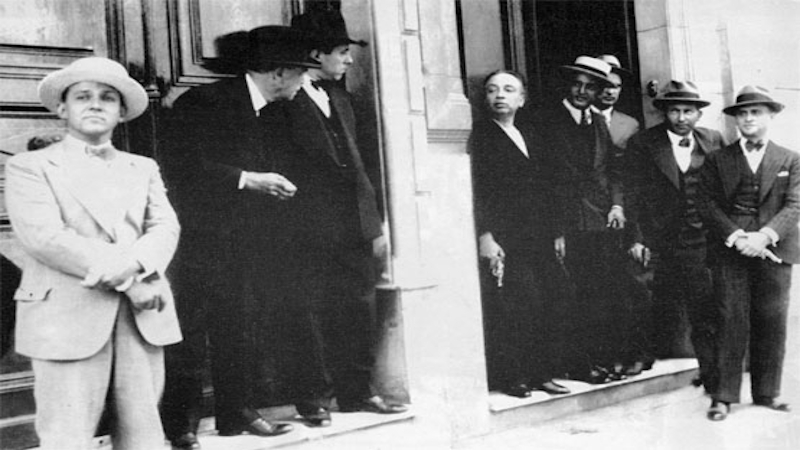
The study argues that the government of Gabriel Terra (1931–1938)—part of which was a de facto regime—maintained the policies of the National Administrative Council (CNA), which allowed Uruguay to continue emerging from the economic crisis that was also affecting the country.
According to Thul, when conducting an economic analysis, one must, in some cases, “separate the political context from the economic results .” “It is necessary to set aside the prejudices associated with dictatorial periods, since there are examples of strong economic performance during de facto governments.” Furthermore, he noted that in Terra ’s case, “he came to power with the support of the majority factions of the main political parties, which allowed him to continue the CNA’s economic measures, with certain modifications.”
For D’Albora, the success of Terra’s government was due precisely to the fact that it did not substantially alter the reforms implemented by the CNA.
"The goal was to restore some prominence to the agricultural sector, but without altering the fundamentals of the economic reforms that had been initiated after the crisis," he argued.
The graduate argued that “ultimately, Terra’s economic policy was not out of step with what was happening in the rest of the world, where the role of the state in the country’s economic life was becoming increasingly important.”
Economics at ORT University
The graduates emphasized that the Bachelor’s Degree in Economics “is structured in such a way that students gradually become accustomed tosubmitting short research papers.” They noted that the required assignments in some courses “develop students’ analytical skills and provide them with the tools necessary to carry out projects like this one.” In particular, several of the program’s courses, such as History of Economic Thought and Economic History of Uruguay, “provided us with a basic framework to begin developing the project,” they concluded.
Interview published in December 2009