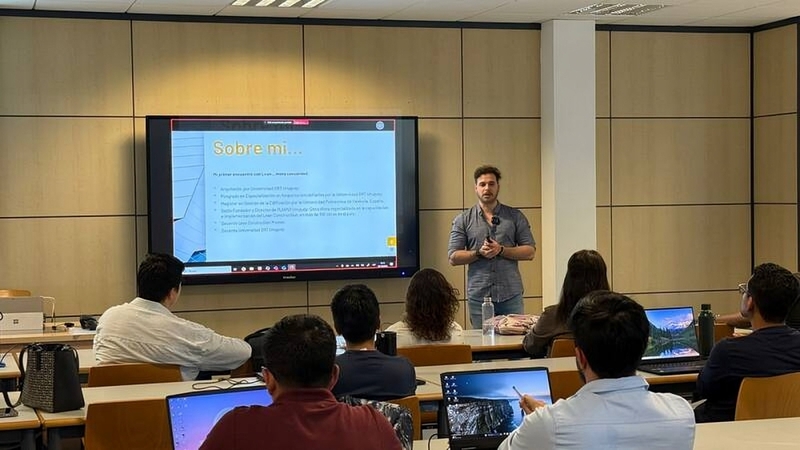
In the final stage of the Master’s Degree in Building Construction at the Polytechnic University of Valencia, the Architect Guillermo Loblowitz served as a guest lecturer in one of the program’s courses to share his experiences related to Lean Construction, BIM, and construction site management.
Graduate of the Architecture program and the Specialization Diploma in Real Estate Business from the Universidad ORT Uruguay, Loblowitz is currently a member of the faculty team responsible for the course "Lean Construction: Methodologies for Improving Productivity" at the School of Architecture.
For about an hour, the talk covered the state of Lean Construction in Uruguay, the human dimension of this management approach, and its connections to BIM, a case study at UPM2 , and the skills Loblowitz considers relevant to professional development in the sector.
Lean Construction in Uruguay: Communication, Collaboration, and Productivity
One of the first sessions focused on the situation of Lean Construction in Uruguay. Drawing on his professional experience, Loblowitz described the progress he has observed in its implementation over the past few years and placed special emphasis on thehuman dimension of construction processes.
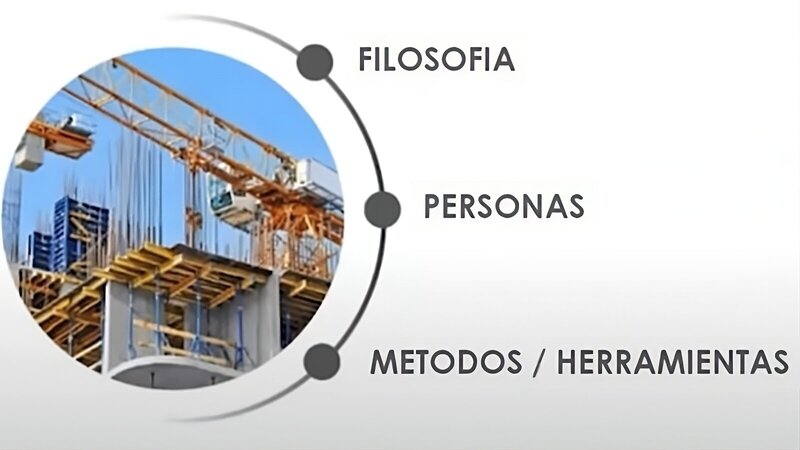
In that regard, he highlighted Lean’s contribution to “improving communication and collaboration on construction sites” and linked both aspects to the way processes are organized and carried out.
Collaboration thus played a central role in his approach: in addition to influencing planning and production, implementing Lean Construction requires coordinating the people involved in the project, sharing information, and creating the conditions to work toward common goals and processes.
- You might also be interested in reading: “How to Increase Efficiency in Construction with Lean Construction: A Hands-On Workshop”
BIM and Lean Construction: Points of Intersection Between Design and Construction
Another segment of the program focused on the relationship between Building Information Modeling (BIM) and Lean Construction. As Loblowitz explained, both can help improve communication at different stages of the project.

In his argument, BIM can be incorporated as early as the preliminary design phase, whereas Lean tools are particularly evident during construction. The relationship between these two approaches made it possible to ensure continuity between planning, information sharing, coordination, and production.
The topic is directly related to the field of study in which the talk was given. The UPV lists the following as specific areas of focus for the Master’s Degree in Building Construction: BIM management, advanced planning, and Lean Construction, as part of a program focused on multidisciplinary building management.
- You might also be interested in reading: “Benefits of BIM: 7 Reasons to Work with Building Information Modeling”
UPM2: A Uruguayan Case Study on the Application of Lean Construction
To translate these concepts into a concrete experience, Loblowitz presented UPM2 as a case study and described his experience implementing Lean Construction during the project’s development.
During the presentation, he explained the characteristics and scope of the project and shared examples of how Lean tools were applied. The case study pertains to the UPM Paso de los Torosproject, the company’s second pulp production plant in Uruguay.

The scale of the project helps put into perspective the context in which this experience took place. According to Uruguay XXI, UPM Paso de los Toros represented an investment of US$3.47 billion and represents the largest productive investment in Uruguay’s history.
The case study provided students with an opportunity to learn about an initiative carried out in Uruguay and to see how the principles and tools discussed in the presentation can be applied from the planning stage to the actual processes involved in a large-scale construction project.
- You might also be interested in this article: “In conversation with La Columna, Professor Loblowitz gave an interview about Lean Construction”
Management, Efficiency, and Skills for Professional Practice
The final part of the talk focused on the skills that Loblowitz considers relevant to professional development in the sector. In particular, he emphasized on management, agile methodologies, process improvement, and collaborative work.
In summarizing the purpose of these methodologies, he highlighted the need to “improve processes, become more efficient, and be more collaborative” and linked these capabilities to the competitiveness of both the projects and the sector.
Loblowitz also addressed the barriers he identifies to the adoption of Lean Construction. According to his assessment, Uruguay has already overcome several of the difficulties associated with the initial approach to and adoption of these methodologies.
Participation in this activity also builds on a history linked to the UPV itself. Loblowitz earned a master’s degree in Building Management there between 2019 and 2020 and subsequently pursued a career in Uruguay in the fields of management and Lean Construction. Years later, he returned to the Spanish university to share insights gained from that work.
Currently, this area of specialization is also part of his teaching activities at the ORT School of Architecture.
Learn about the Lean Construction course: Methodologies for Improving Productivity