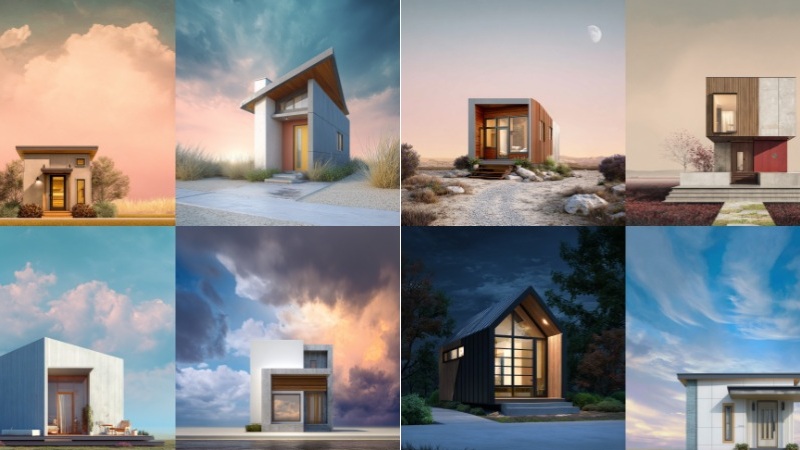
In its 11th edition, the international architecture competition organized by Buildner, in partnership with Kingspan, proposes revisiting a central question for contemporary architecture: how accommodate daily life in a smaller footprint, with greater spatial precision and sustainability criteria.
The call for proposals invites design a microhome capable of housing a young professional couple, with no geographical restrictions on the proposed site. The guidelines state that the home may be situated in an urban or rural setting, anywhere in the world, provided that the proposal thoughtfully responds to its surroundings.
Micro-housing, sustainability, and small-scale design
Buildner’s Microhome 2026 proposes micro-housing or minimal housing as a field of architectural exploration. Rather than an obstacle, the restriction on floor area is thus presented as an opportunity to work with greater precision on spatial organization, materiality, energy efficiency, and the quality of living space.
Within an maximum area of 25 m², the proposals must create a compact, livable, and functional home. The competition places special value on projects that incorporate sustainability and propose architectural solutions to economic, social, and cultural challenges.
The official competition brief states that the competition aims to encourage participants to rethink micro-housing as a path to innovation in contemporary residential architecture.
- You might also be interested in reading: “Rome Rain Rooms: Buildner’s International Architecture and Sustainability Competition”
A modular, off-grid microhome of up to 25 m²
The competition brief calls for a off-grid modular home designed for a young professional couple. The total floor area of the building must not exceed 25 m², which requires the project to be streamlined without compromising on comfort, functionality, and livability.
The construction plan is flexible and open to modifications or improved development strategies. However, the guidelines recommend considering an organizational structure that includes:
- Sleeping area;
- Living or work area;
- Kitchen area;
- Toilet and shower;
- Limited storage space.
The brief also recommends incorporating conceptual strategies for electricity generation, water collection and filtration, and waste management. It also recommends addressing the proposal’s spatial efficiency, environmental responsibility, energy efficiency, and economic viability.
- We also recommend reading: “5 Reasons to Enter and Compete in an Architecture Competition”
Awards and Recognitions
The contest has total prize pool of €100,000 and includes grand prizes, special awards, and six honorable mentions.
https://www.youtube.com/watch?v=BR2PleJLOjk
The prizes are distributed as follows:
- 1.to be prize: €30,000.
- 2nd prize: €10,000.
- 3.be prize: €5,000.
- Buildner Student Award: €10,000.
- Kingspan Award: €30,000.
- Kingspan Awards: 3 awards of €5,000.
- 6 honorable mentions.
The Kingspan Award is an additional recognition for participants who choose to incorporate selected Kingspan products into their proposal. The use of these products is optional for general participation, but those aspiring to this award must declare their use during the submission and explain how they were incorporated into the project.
The winning projects, honorable mentions, and a selection of entries will be published in the next annual issue of the magazine MICROHOME magazine. The organization will also award certificates of merit to the winners.
- You might also be interested in reading: “ORT’s School of Architecture is ranked highest in Uruguay according to Buildner”
How to participate and what to submit
The competition is open to participants with a variety of backgrounds and does not require professional qualifications. All submissions must be written in English.
Submissions must be made through the upload panel on architecturecompetitions.com and include four horizontal A2 panels, each up to 10 MB in JPG format. The boards may include sketches, renderings, plans, sections, elevations, diagrams, or other representational tools that help explain the proposal.
Video files are not accepted as part of the main submission. Additionally, the boards must not include names, logos, or any information that could identify the participant or team. The rules state that anyone who fails to comply with these requirements will be disqualified without a refund.
Along with their submission, participants must upload a cover image and a project description for publication purposes. These materials will not be evaluated by the jury.
- You might also be interested in reading: “Architecture students were finalists in the Kaira Looro 2025 competition”
Outreach Campaign and Partnership with ArchDaily
The competition is part of a strategic partnership between Buildner and ArchDaily, and the official website states that the winning proposals will be presented on ArchDaily.
In addition, Buildner notes that the results will be published on its website and shared through its social media channels, newsletters, and international network of media outlets focused on architecture and design.
The campaign also includes the publication of selected projects in the magazine MICROHOMEmagazine. After submitting their project, participants may optionally upload a written questionnaire and a video about themselves to the Buildner dashboard; these materials may be included in the dissemination of results if the project is selected.
- You might also be interested in reading: “‘Piso 25 Sinergia Faro,’ by Vamo.uy, nominated for ArchDaily’s 2026 Building of the Year Award in Spanish”
Key Dates for Microhome 2026
The official contest schedule includes the following dates:
- Registration deadline: September 30, 2026.
- Deadline for questions and answers: October 5, 2026.
- Project submission deadline: November 2, 2026, at 11:59 p.m. (London time).
- Announcement of winners: December 15, 2026.
The official documentation also clarifies that it is still possible to participate after the initial deadlines, although in that case a higher late registration fee will apply.