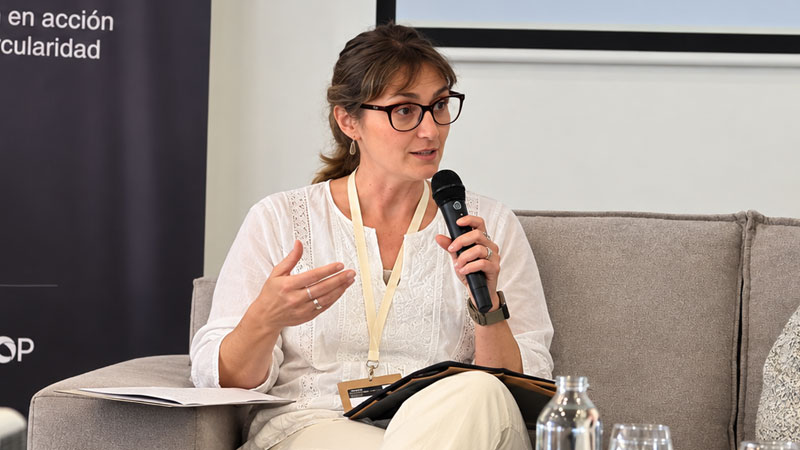
Inés Tiscornia, M.A., ORT’s Environmental Management and Sustainability Coordinator, participated in the Regional Meeting on Extended Producer Responsibility (EPR), organized by Compromiso Empresarial para el Reciclaje (CEMPRE), on October 6 and 7 in Montevideo.
The event brought together representatives from academic institutions, public agencies, companies, and waste sorters' cooperatives from various Latin American countries to share experiences on the circular economy, waste management, and material recovery.
Tiscornia participated in the panel discussion “REP Systems and Education,” held on Wednesday, October 7, at the Innovation Park of the Technological Laboratory of Uruguay (LATU), alongside Isis Burguez, a professor at the University of the Republic.
The Role of Education in the Circular Economy
During his remarks, Tiscornia emphasized the responsibility of universities to train professionals capable of addressing environmental challenges and contributing to the development of more sustainable models of production and consumption.
“We have a great responsibility to train professionals who will be the ones to drive all these changes,” he said.
He also noted that the knowledge needed to move toward a circular economy is generated in various fields and that one of the main challenges is to connect the contributions of academia with the experiences of the private sector and those working in materials recovery.
In this regard, he emphasized the importance of taking into account the actual conditions for waste sorting and recovery from the earliest stages of new product development.
View this post on Instagram
Tiscornia argued that “it’s no use for us in the lab to develop a solution—a biomaterial that we think is fantastic—if it ends up causing a problem when it comes time to classify it.”
The discussion highlighted the need to integrate scientific knowledge with the experience of the various stakeholders in the value chain in order to develop alternatives that can be implemented in practice.
Training and Collaborative Work
During the panel, the coordinator shared what she had learned from her participation in CIRCULAB, an action-oriented training program sponsored by CEMPRE, in which she conducted training activities on biomaterials and their application in packaging, including opportunities for exchange with waste sorters.
One of the topics discussed was the importance of distinguishing between concepts such as “bio-based,” “biodegradable,” and “compostable,” which describe different characteristics of materials and have implications for their subsequent management.
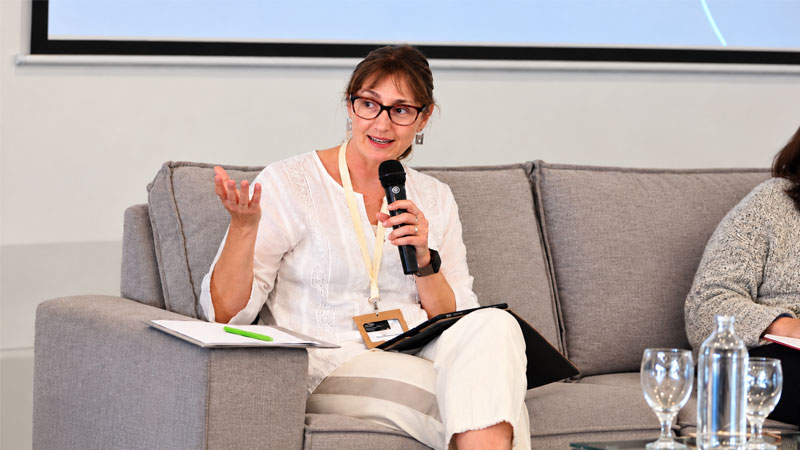
He also mentioned the opportunities offered by inter-university collaboration to develop joint research and training projects, particularly through the University Network for Sustainability (UNIS).
In this context, he explained that the University of the Andes ( Universidad ORT Uruguay ) is working to integrate sustainability across all degree programs in its various schools, as well as to link academic projects and student theses to specific challenges faced by organizations and productive sectors.
The university’s participation in this event is linked to the Sustainable Development Goals (SDGs), adopted by the United Nations in 2015 as part of the 2030 Agenda. In particular, it relates to SDG 12, Responsible Consumption and Production, due to its focus on waste management and recovery, and to SDG 4, Quality Education, due to the role of university education in developing skills for sustainability.