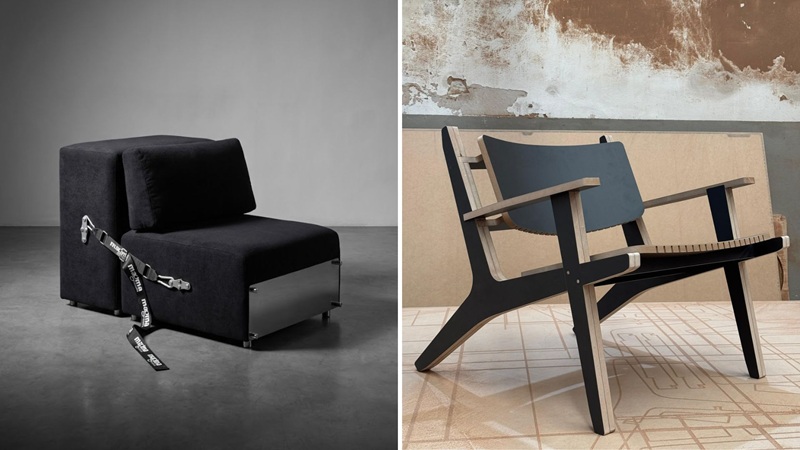
One of the projects on display wasthe Bond Project, a multifunctional modular system designed by Natalie Wiener, a graduate of the Bachelor of Industrial Design program, as her capstone project, which was exhibited and presented at Re|creación 25.
The second was Lucha Set, a digitally designed armchair that won the Professional category of the 2025 National Furniture Design Competition, created by the design duoAndrés Bonino and Mariana Carreto.
The exhibition took place from August 19 to August 22 at Vía Disegno. The event was organized by Newton+, a communications agency that promotes design, led by Carina Martínez and Gabriela Pallares.
Bond Project
The piece of furniture features a multifunctional modular system developed for Magma Futura.
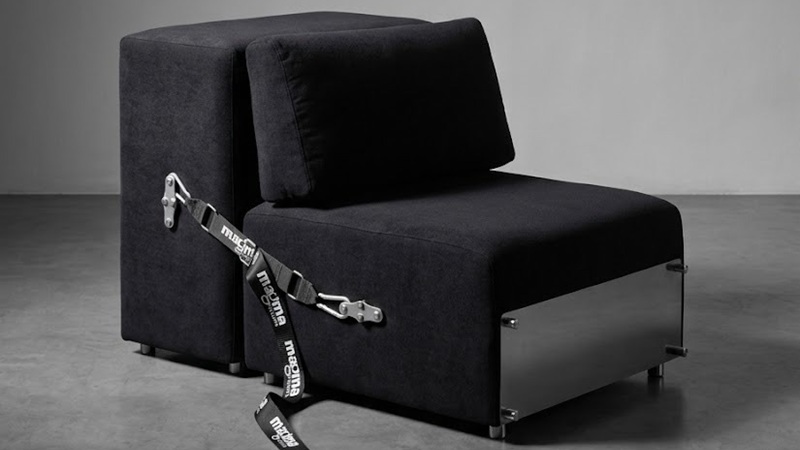
The project, supervised by professors Alejandro Trinidad and Pablo Pirotto, who is also the assistant academic coordinator for Industrial Design, arose from the need to optimize the use of space and strengthen the bonds among the people who inhabit it.
The system consists of identical modules that can be reconfigured to suit the needs of each activity. They can be used individually or together as a pouf, armchair, recliner, or corner unit, as well as serving as support surfaces.
The proposal incorporates a visible joint system that reinforces its concept of connection and, through its aesthetics, seeks to reflect Magma Futura's identity.
In this way, the furniture not only adapts to different spatial configurations, but also seeks to encourage people to linger, meet, and interact with one another.
Wrestling Set
Lucha Set is a product line that offers a contemporary and dynamic way to experience shared spaces.
The project received an award at the competition organized by Universidad ORT Uruguay and Pronto Maderas, where it stood out for its integration of industrial manufacturing and circular economy principles.
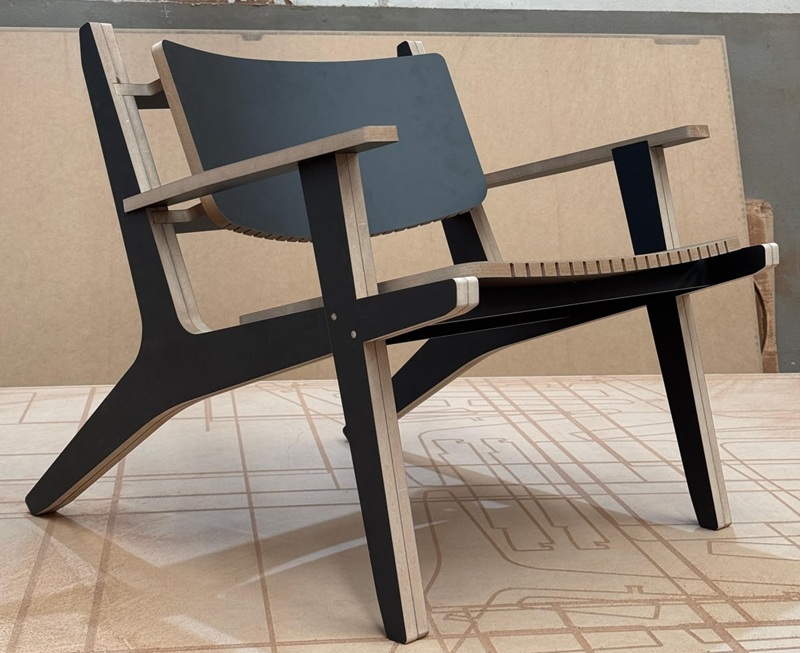
The proposal is based on a construction using flat pieces, which allows for the optimal use of materials and enables work based on a single-material approach.
In addition, the system is compatible with CNC cutting technologies, which are used to perform controlled cuts using computer numerical control machines.
One of the techniques used is kerfing, a technique that allows wood to be bent through a series of precise cuts, eliminating the need for molds or more complex industrial processes.
The assembly is achieved through interlocking joints between the pieces, without the need for metal fasteners. Stability is ensured by using adhesive and wooden dowels, maintaining the single-material design of the structure.
The design also incorporates anthropometric criteria—that is, the study of the dimensions and proportions of the human body—to tailor products to their users.
To determine these measurements, different percentiles were used for each component: the 95th percentile for backrest angle and leg length, the 5th percentile for seat height, and the 50th percentile for armrest placement.
Learn more about the
's Bachelor's Degree in Industrial Design