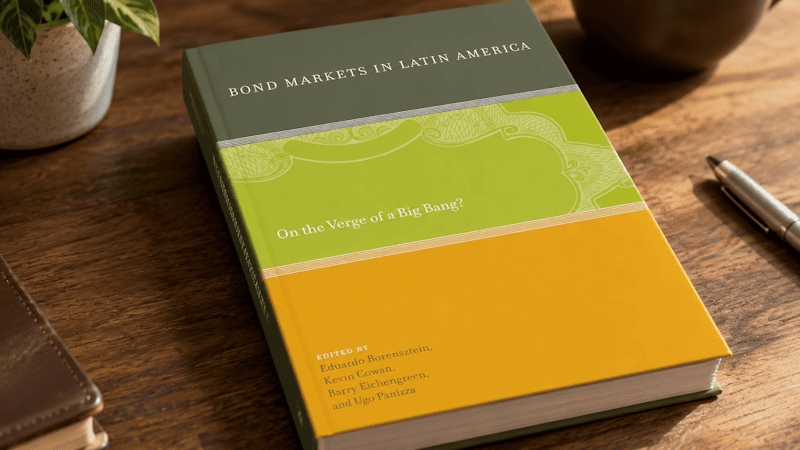
Dr. Néstor Gandelman, Academic Coordinator of Economics at the School of Administration and Social Sciences, and Ec. Julio de Brun, Professor of Economics at the University of Uruguay, along with Drs. Herman Kamil and Arturo Porzecanski, contributed the chapter “The Fixed Income Market in Uruguay” to the book *Bond Markets in Latin America on the Verge of a Big Bang* by Eduardo Borensztein, Kevin Cowan, Barry Eichengreen, and Ugo Panizza. The book was published in Cambridge by MIT Press.
Interview with Dr. Néstor Gandelman
Dr. Gandelman noted that Uruguay’s capital market “remains insufficient” because “the government has the capacity to raise funds domestically and internationally in a liquid bond market,” yet private firms “continue to finance themselves through retained earnings or via bank loans and supplier credit.”
- What is the subject matter of the book that includes the research chapter written by you and other Uruguayan scholars?
"The book's overall theme is the bond markets in Latin America. Most of the chapters focus on the specific situation in a given country and seek to identify the factors that determine the current state of development—or relative underdevelopment—of the corporate bond market in particular and the capital market in general."
- What exactly is the chapter of the book you wrote about?
"Our article focuses on the fixed-income securities market in Uruguay."

- What new features does it offer?
"Following a brief overview of the development of the bond market (in Uruguay, corporate bonds are commonly referred to as 'negotiable obligations'), we present a survey we conducted in collaboration with the National Institute of Statistics (INE) among potential issuers."
In other words, a survey of the business sector regarding its financing practices, its awareness of financial alternatives, and its views on the obstacles to making better use of the various available sources.
"In addition to the direct results of this survey, it is used to conduct a "stress test" on the financial fragility and soundness of companies in Uruguay. This test consists of estimating the percentage of companies that would face serious problems under various scenarios involving sudden changes in the exchange rate. Finally, after examining the supply side of securities, we focus on the demand side. This chapter reports the main findings of another survey we conducted among institutional investors and financial intermediaries operating in the country."
-What conclusions does the research draw?
"Despite the country's financial liberalization, which began in the 1970s, and several additional laws passed in the 1990s aimed at promoting local financial markets, the development of Uruguay's capital market remains insufficient. The government is able to raise funds domestically and internationally in a liquid bond market, but private firms continue to finance themselves through retained earnings or via bank loans and supplier credit."
Compared to other Latin American countries, Uruguayan companies have the highest debt dollarization ratios and corporate debt structures with the shortest maturities—resulting in high currency and maturity exposure that makes them extremely vulnerable.

"A deeper domestic capital market would likely alleviate this vulnerability in the Uruguayan economy, but it is precisely the financial fragility of Uruguayan firms—exacerbated by corporate governance issues— that constitutes the main obstacle to the development of this capital market.
Given the common practices of firms and the absence of major institutional investors other than pension funds, it is most likely that, barring significant changes, the fixed-income market will continue to bea secondary source of financing, limited to only a very few firms."
-Why did you decide to study fixed-income securities?
"As I explained earlier, some of the financial weaknesses of domestic companies could be alleviated if they had access to long-term financing, such as that typically obtained through these types of instruments. Therefore, examining the factors that led to such a marked slowdown in this source of financing following a brief boom, as well as exploring the development opportunities it presents, are issues of enormous importance for the country’s economic development."
-Why did an MIT Press publication take an interest in the Uruguayan case?
"In March 2005, the Research Department of the Inter-American Development Bank issued a call for research proposals on the development of bond markets in Latin America. At ORT University, we formed a team with Julio de Brun, Herman Kamil, and Arturo Porzecanski and prepared a proposal that was selected in this international call for proposals."
MIT Press took an interest in the project for Latin America as a whole. At the heart of the book are the six case studies that were conducted: Mexico, Argentina, Colombia, Chile, Brazil, and Uruguay.
https://youtu.be/IRjmo4noTKM?si=hRZN2la9HIhXAcNP
Interview published in July 2008