
The commemoration provides an international framework for addressing these challenges through education, the media, public policy, and citizen participation.
What's on the agenda for the Week in 2026?
World Media and Information Literacy Week is celebrated each year from October 24 to 31. In 2026, the theme “We All Play a Part – Media and Information Literacy for the People” (a free translation of the original title) highlights the shared responsibility in addressing the challenges of the information ecosystem.
Sponsored by the United Nations Educational, Scientific and Cultural Organization (UNESCO), the commemoration brings together policymakers, educators, researchers, journalists, young people, content creators, regulators, families, and civil society organizations.
This edition will feature regional and thematic activities organized in different parts of the world.
The initiative has been observed since 2011. In 2021, the United Nations General Assembly adopted Resolution 75/267, which recognized the Week within the United Nations and emphasized the need to promote fact-based, timely, clear, accessible, multilingual, and science-based information.
Why It's Important
Media and information literacy encompasses the knowledge, skills, attitudes, and values needed to search for, access, analyze, evaluate, use, and produce information and content in a critical and responsible manner .
It is not limited to knowing how to use devices or apps. It also involves evaluating the origin and reliability of a source, comparing different perspectives, recognizing biases, understanding how content is produced and circulated, and deciding what information is relevant to a specific situation.
These skills take on particular importance in contexts such as electoral processes, where the spread of misleading content poses new challenges for citizens.
To address this issue, the School of Communication at the University of the Andes ( Universidad ORT Uruguay ) will hold a workshop on October 22, 2026, on electoral disinformation and digital fact-checking, led by Mag. Manuela Silva, editor of the digital fact-checking service at Agence France-Presse (AFP). The workshop will introduce participants to tools for verifying the origin of images, videos, and information sources.
The importance of developing these skills is also has backed by scientific evidence. The article“Media literacy interventions improve resilience to misinformation: a meta-analytic investigation of overall effect and moderating factors,”published in 2024 by Communication Research, synthesized 49 experimental studies involving 81,155 participants, with the aim of assessing the extent to which media literacy education helps combat misinformation.
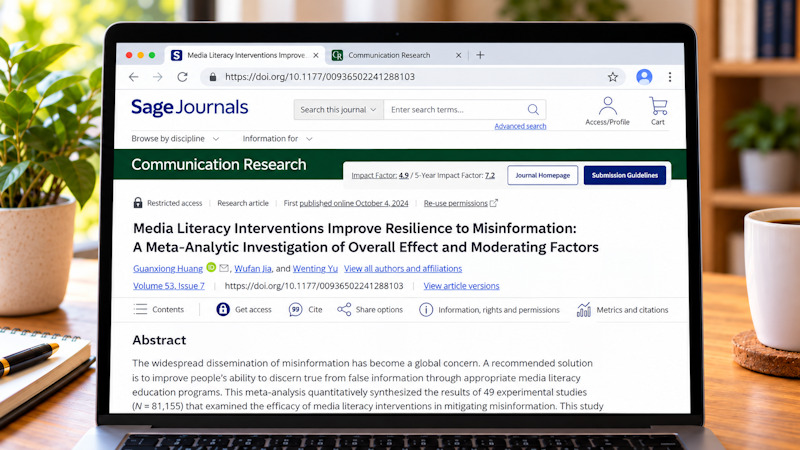
The results showed that educational interventions in media literacy improve the ability to distinguish true information from false content, reduce trust in misleading information, and decrease its spread. In addition, the study found that better results were achieved when training was conducted over several sessions rather than as a single activity.
Artificial Intelligence Is Changing the News Landscape
The rise of generative artificial intelligence (AI) adds a new dimension to the problem. These systems can produce realistic text, images, audio, and video in a matter of seconds, but the fluency or convincing nature of a response does not allow us to determine whether the information is correct.
That is why AI literacy is not just about learning how to use a tool. It requires understanding its capabilities and limitations, recognizing potential biases and errors, evaluating the results, and deciding when to verify, cross-check, or discard an answer.
In addition to identifying potential errors, it is essential to ensure that the ease of obtaining answers does not replace analysis and personal reflection.
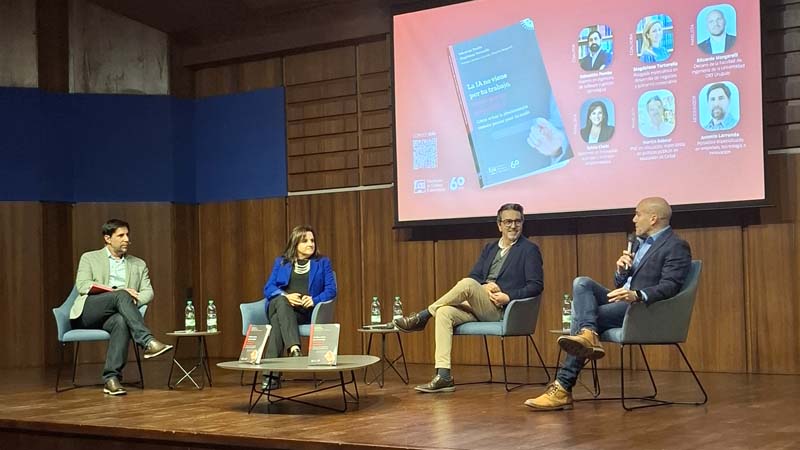
This concern was raised during the book launch for *AI Isn’t Coming for Your Job—It’s Coming for Your Comfort*, held on June 2, 2026. During the event, Eduardo Mangarelli, dean of the School of Engineering at the Universidad ORT Uruguay, warned of the risk of losing the processes of analysis, trial and error, and reflection that contribute to the development of knowledge and independent judgment.
In the field of education, this discussion also extends to teacher training. A review published in 2024 in *Computers and Education Open*, titled“In search of artificial intelligence (AI) literacy in teacher education: a scoping review,”notes that AI literacy in teacher training is still an emerging field and highlights the need to integrate knowledge about how these technologies work with practical and ethical insights.
Critical thinking also features in recent research. The study“Critical questioning with generative AI: developing AI literacy in secondary education,”published in *Thinking Skills and Creativity*, showed that the quality of students’ questioning regarding AI-generated content depends, among other factors, on the design of the activities, teacher intervention, and the students’ prior knowledge of the tool.
What's Changing in Teaching
The immediate availability of answers generated by artificial intelligence makes it necessary to reevaluate which activities promote learning and which processes students should carry out on their own.
According to Dr. Gabriel Díaz Maggioli, a graduate-level instructor at the Institute of Education at the Universidad ORT Uruguay, access to information is no longer the main educational challenge.
“Our job is less and less about conveying information and more and more about creating the conditions for learning to take place,” he says.
This change takes on particular significance when AI can generate content that previously required individual effort.
If artificial intelligence can produce the essay, summary, or answer we request in a matter of seconds, perhaps the most interesting question isn't how to prevent students from using it, but what we need to ask of them now so that they have to think.
Processes That Artificial Intelligence Should Not Replace
Natalia Zambon Ferronato, M.A., deputy coordinator of the Language Center at the Universidad ORT Uruguay, agrees that educational transformation goes beyond simply incorporating new technologies.
While he acknowledges the opportunities that AI offers for personalizing explanations, providing feedback, and facilitating self-directed practice, he warns against prioritizing speed.
I feel that we often associate the use of AI with making everything faster and saving time, but learning isn't always about doing things faster.
According to the expert, it is essential to maintain activities that require effort, reflection, and active participation from students.
“Writing, reading, comparing, arguing, making mistakes, revising, and trying again are all part of learning, and we cannot delegate those processes,” says Zambon Ferronato.
In this context, it is important to emphasize the need to develop digital skills without losing sight of human qualities such as empathy, communication, and sensitivity to context, which are essential for maintaining pedagogical support.
Critical Thinking, Pedagogical Judgment, and Learning
Both teachers agree on one point: integrating artificial intelligence does not mean delegating learning. The challenge lies in using technology in a way that expands the possibilities for teaching and learning without replacing reflection, authorship, or professional judgment.
In this vein, the Universidad ORT Uruguay has provides guidance for teachers and students on the academic use of generative artificial intelligence, with an emphasis on transparency, critical thinking, academic integrity, and learning.
Beyond the university setting, these skills are necessary to function in a society where information circulates at an ever-increasing pace and technology plays a role in its production. Therefore, teaching people how to use AI also means equipping them with the ability to question and verify information and make informed decisions, both inside and outside the classroom.

This educational dimension links media literacy and critical thinking to Sustainable Development Goal 4: Quality Education, which promotes inclusive, equitable, and high-quality education. In environments shaped by digital technologies and AI, these skills are part of an education that enables people to participate in an informed and responsible manner.
In this context, information literacy no longer means simply teaching people how to find information: it involves developing the skills to ask questions, verify information, interpret it, and decide what to do with it— even when an answer appears in seconds.