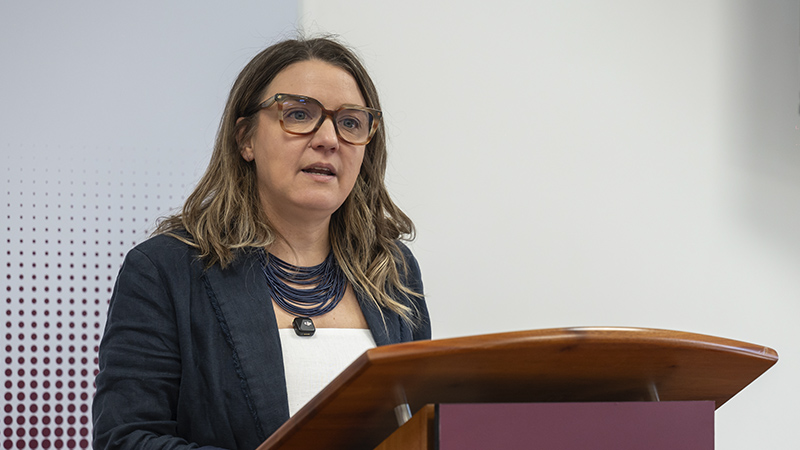
There are teachers who dare to break away from traditional school structures. They challenge the lecture-style classroom, redesign learning spaces, experiment with other teaching methods, and build different kinds of relationships with their students. They often do this without recognition, right inside their own classrooms.
What characterizes these teachers? What drives them to challenge the status quo? What conditions do they need to develop their proposals? These were some of the questions that guided Lucía Acuña’s doctoral dissertation, titled “Didactic Rebellions: An Analysis of Disruptive Practices Incorporating Digital Technologies” in the third cycle of Uruguay’s public Integrated Basic Education system.
The research conducted by the ORT Ph.D. in Education graduate identified innovative practices facilitated by digital technologies in Uruguayan middle school education, established a profile of disruptive teachers, and developed a theoretical model to understand how these transformations occur.
I believe we can change education because there are a lot of teachers who are changing it behind the scenes, often hidden away inside a classroom.
Rebellion as a Starting Point
A concern that Acuña had from her earliest years as a teacher served as the starting point for the research: wondering why teaching is organized in certain ways and what possibilities exist for doing things differently.
This concern intensified during the pandemic, when the rapid adoption of digital technologies forced educators to change their practices, experiment with new resources, and reevaluate established pedagogical assumptions.
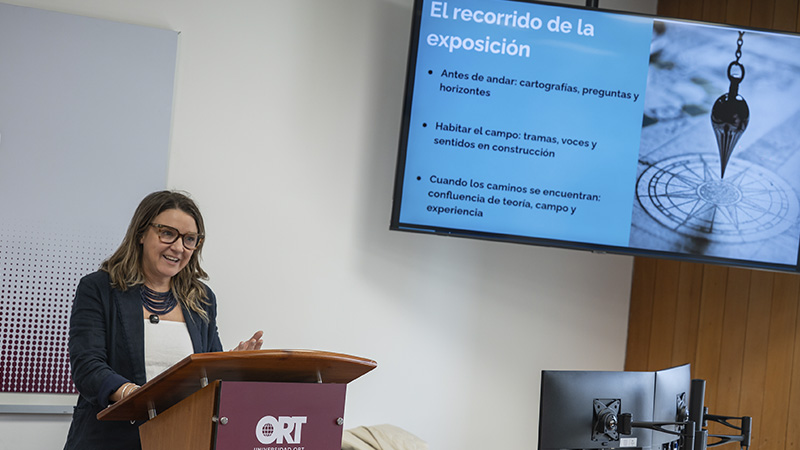
The experience led him to recognize that technology could open up new possibilities, but that its adoption —on its own— did not guarantee a transformation in teaching.“Not every innovation is disruptive, nor does every adoption of technology necessarily transform teaching,” he explained.
And that distinction became one of the central themes of the dissertation. While innovation may introduce new tools or strategies, disruption involves questioning deeper aspects of the school organization: the allocation of time, the separation between disciplines, the ways in which knowledge is constructed, and the roles of teachers and students.
“Disruption involves a break or interruption of an established order, ”said Acuña, who added that in order to recognize such a break, it is first necessary to identify “what has become normalized” and is therefore rarely questioned.
Digital technologies can expand learning environments and foster new forms of collaboration and creativity.
What are disruptive teachers like?
To answer this question, Acuña conducted a qualitative study based on multiple case studies. He analyzed experiences at high schools, technical schools, Associated Educational Centers, Community Educational Centers, and María Espínola centers through interviews, project analyses, lesson plans, and records of educational experiences.
https://www.youtube.com/watch?v=10tI5RZAkm8
One of the main findings was that the profile of a disruptive teacher cannot be explained solely by their training or technological skills. In this regard, the dissertation identified six key traits linked to their professional identity, such as vocation, reflexivity, commitment, empathy, responsibility, and innovation.
Behind every teaching practice there is always a teacher who, more often than not, dares to doubt, ask questions, challenge the status quo, imagine other possibilities, and think differently.
However, what do these teachers do, and what sets their practices apart? A recurring theme that emerged was “ongoing transformation” and the “need to move away from lecture-based instruction and hierarchical relationships” in order to foster horizontal connections.
“I found a professional identity still in the making, shaped by pedagogical decisions but also by ethical stances toward students, ”added Acuña, who noted that disruptive teachers share a willingness to reevaluate their decisions, take risks, experiment with alternatives, and recognize students as the protagonists of their own learning processes.
Practices that take risks and pamper
Acuña's analysis identified three categories of disruptive practices: flexible, indulgent, and transgressive.
The Flexible teaching practices challenge the idea that a class must always follow a linear sequence and predetermined. They do not imply a lack of planning, but rather the ability to adapt instructional decisions to the needs and situations that arise during the learning process.
For their part, transgressive practices challenge certain expected school structures through experimentation, collaborative work, interdisciplinary approaches , and activities that go beyond the confines of the classroom.
However, one of the most significant categories in the research was that of “nurturing practices.” The doctoral graduate in education revived this expression—associated with the idea of “caressing the soul”—to describe experiences in which caring for, listening to, and acknowledging students take center stage.
To imagine a teacher who nurtures, shelters, and supports is to imagine a new kind of teacher who will become indispensable.
Another distinctive feature of the dissertation was its demonstration that the emotional bond “was not a secondary element,” but rather occupied “a central place” in pedagogical decisions: “The bond ceases to be merely a condition that facilitates teaching and becomes an integral part of the educational experience.” This dimension also emerged in relationships among colleagues, through collaboration, dialogue, and the creation of spaces of trust.
“All the subcategories share a common concern, which is to create conditions that allow students to feel valued, participate , and find meaning in their own learning experiences, ”Acuña explained.
Rebellion also needs institutions
During the defense of his doctoral dissertation, Acuña asserted that disruptive practices do not depend solely on individual initiative nor do they develop in isolation; rather, they require “institutional conditions that allow for them.” In fact, the analysis showed that management teams, institutional cultures, and spaces for collaboration can either foster or limit these experiences.
In particular, Associated Educational Centers and Community Educational Centers appeared as “Meaningful formats for disruption", to the move away from traditional forms of school organization, such as disciplinary fragmentation, the centrality of the classroom, and vertical relationships.
“This allows us to recognize that innovation does not lie solely in what happens inside a classroom; it isalso shaped by the conditions that an institution creates, ”Acuña explained. Thus, pedagogical disruption was understood as“an institutional, relational, and collective process.”
Disruption is not merely a method, but also an ethical and pedagogical stance toward teaching.
The graduate pointed out that not all schools have dedicated spaces for reflection, coordination, and collaboration among teachers. “I believe that creating spaces for meetings, reflection, and coordination is essential for all institutions, ”she said.
“Without training, there can be no disruption either,” Acuña added, highlighting the role of teachers who seek to stay current, conduct research, publish, and continue their academic training as “key players” in driving transformative practices.
From Rebellion to Theory
Based on these findings, Acuña developed an emergent theoretical model to understand disruptive teaching practices, organized into five dimensions: disruptive teacher identity, transformative pedagogical practices, institutional formats, technological mediation, and expanded pedagogical time.
“This model allows us to shift our focus from the concept of innovation —understood as the incorporation of resources or methodologies—toward a more complex understanding of the educational experience, ”he noted.
The model does not aim to be “a one-size-fits-all solution,” but rather seeks to provide tools for understanding how educational transformations take shape in different institutional contexts.
For her, the thesis’s central contribution lies in having “developed a conceptual framework for the various disruptive teaching approaches that is not limited to innovation, technology, or methodological novelty”: “The research shows that transformations in teaching occur in conjunction with different teacher identities, pedagogical decisions, and institutional conditions.”
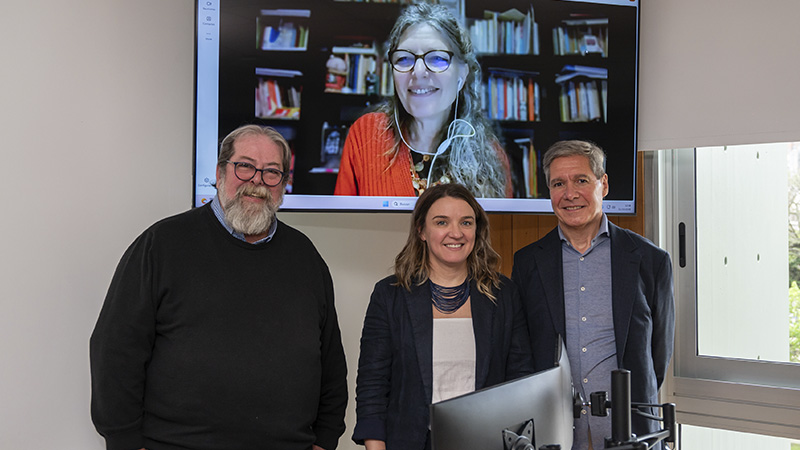
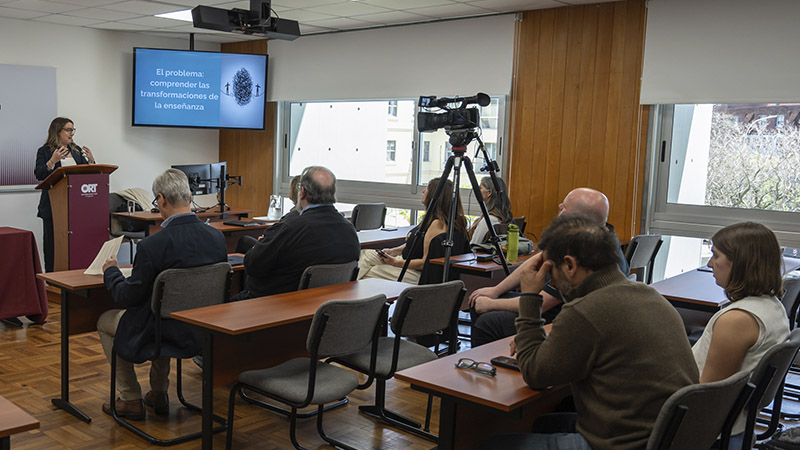
On Wednesday, October 21, Acuña defended his doctoral dissertation at ORT Rambla. The committee consisted of:
- Dr. Miriam Kap, professor at the National University of Mar del Plata (Argentina).
- Dr. Gabriel Díaz Maggioli, graduate-level instructor at the Institute of Education.
- Dr. Wellington Mazzotti, associate academic coordinator of the Doctorate in Education and the Master's in Education.
Dr. Carina Lion—a professor at the University of Buenos Aires (Argentina)—and Dr. Silvia Umpiérrez—a professor and advisor at the Institute of Education—served as Acuña’s thesis advisors.
For me, the doctoral program brought about a profound transformation in the way I view professional practices.
Image Gallery

Acuña's research is linked to Sustainable Development Goal (SDG) 4: Quality Education, which promotes inclusive, equitable, and quality education by addressing pedagogical practices that seek to transform teaching and improve learning experiences.