The project was carried out as part of Re|creación 26 as a guest project from the Bachelor's Program in Design, Art, and Technology.
The Beginning
The project arose from a personal question: how certain smells, tastes, or textures can evoke childhood memories and moments spent with family. It also stems from a connection to cooking that is very much a part of her daily life:
I really love cooking, but I also enjoy watching my relatives—like my grandmothers—cook. There’s always that idea of “grandma’s cooking,” and that’s where it all kind of starts.
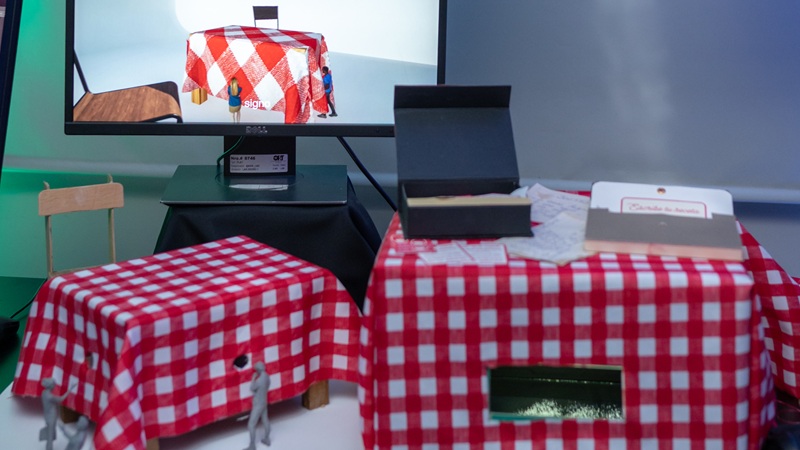
Based on that idea, the student created an installation consisting of a table three and a half meters high and four interactive prisms, each associated with a different sense: smell, touch, hearing, and sight.
Taste, for its part, would be represented in a complementary setting through a culinary experience.
“Reminiscence”takes its name from the concept of recalling distant memories, drawing inspiration from both her family memories and her connection to gastronomy and food design.
I described the project as an experience that engages all the senses, because my main themes were food, memory, and the five senses.
Through *Reminiscencia*, the student sought to evoke emotions associated with nostalgia, warmth, and family rituals related to food, exploring how the senses can trigger memories and shared emotional experiences.
The Composition of "Reminiscencia"
The installation operates using sensors and interactive programming. When a user approaches the prisms hidden beneath the tablecloth, projected visuals, scents, sounds, and specific textures are triggered.
In the case of smell, for example, as the viewer approaches, an audiovisual projection is triggered simultaneously with the release of a scent associated with the experience.
The auditory component features a soundscape composed of familiar recordings and sounds from gatherings around the table, while the tactile component invites interaction with different surfaces linked to the projected visuals.
One of the central elements of the project is the idea of making the viewer an active part of the work.
As the student explained, the installation only makes sense through user interaction; it is the user’s presence and participation that complete the experience.
To develop a proposal centered on interactive gastronomy, the student researched international projects involving table mapping and immersive experiences, and then incorporated insights from her earlier academic work on the senses.
He also cited the work of Japanese artist Yayoi Kusama as an inspiration, particularly her use of infinite mirrors—a technique he incorporated into the prisms to create a sense of visual immersion.