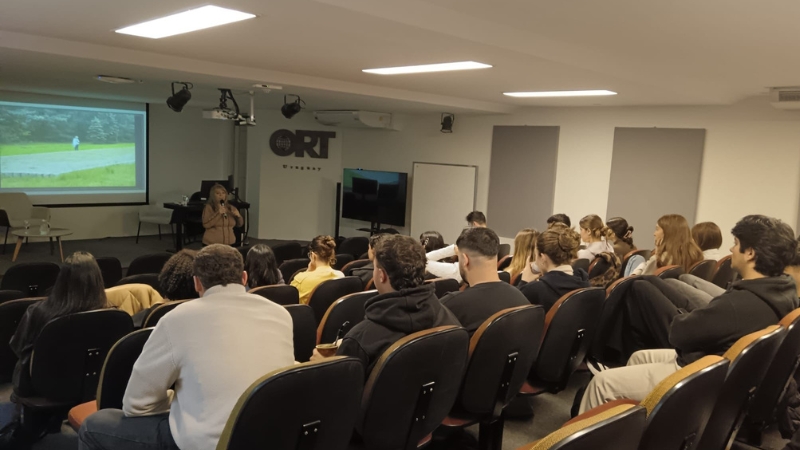
Rita Vinocur, president of the Uruguayan Holocaust Memorial Center, participated in a discussion with students in the Contemporary World History course at the School of Communication at Universidad ORT Uruguay.
The event focused on the life story of his mother, Ana Benkel de Vinocur, a Jewish survivor of the Nazi extermination camps during World War II. The discussion was moderated by professors Daniel González and Kaloyan Stanev and took place in the faculty auditorium.
The event gave students a chance to explore the human and personal aspects of the Holocaust, complementing the material covered in class on totalitarianism, Nazism, anti-Semitism, and political violence in the 20th century.
Rita Vinocur and her work to preserve collective memory
Rita Vinocur is the president of the Uruguayan Holocaust Memorial Center, an institution dedicated to preserving historical memory, education, and the promotion of human rights. Through lectures and educational activities, she fosters opportunities for reflection on the consequences of hatred, discrimination, and intolerance.
During the talk, she shared her family’s story and her mother’s experience— Ana Benkel de Vinocur—giving the students a glimpse into the lives of those who lived through one of the most tragic episodes in contemporary history.
A microhistory to understand the impact of war
Professor Daniel González highlighted the academic and human value of the event, noting that the course examines the consequences of World War IIfrom a general historical perspective, but that events like this one help participants understand the specific impact of those events on individuals.
“When we talk about the dead, the maimed, the displaced, or those enslaved, we cite statistics. Rita’s presence and her story bring us a microhistory that is part of that process and help us understand how that historical event forever changed her family’s life— a testament to what millions of people had to endure,” he said.
He also emphasized the importance of keeping the collective memory alive:
The significance of Rita’s work lies, in my view, in the preservation of a collective memory that, while it does not guarantee, at least helps ensure that such inhumanity is not repeated.
For González, remembering the Holocaust also means reflecting on the present and on the consequences of political decisions and hate speech. “Remembering the Holocaust is, for me, a way of ensuring we never forget that hatred knows no bounds and is therefore a constant threat to humanity, ”he said.
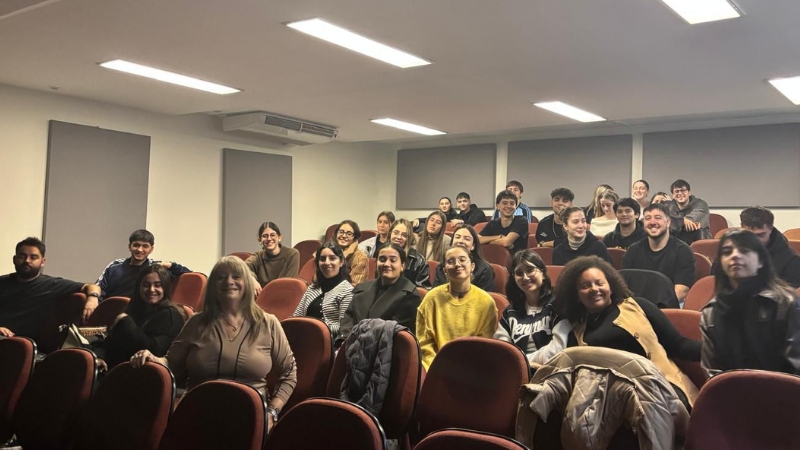
History as a living experience
For his part, Professor Kaloyan Stanev noted that the visit helped bridge the gap between academic study and real-life experience.
“Listening to Rita Vinocur tell the story of her mother, Ana Benkel de Vinocur, allowed the students to gain a concrete understanding of the Holocaust. Beyond historical processes, numbers, dates, and concepts, her testimony helped them understand how the major events of the 20th century affected lives, families, and personal memories, ”she explained.
Stanev also emphasized the importance of survivors and their families continuing to share these stories with future generations. As he noted, the testimonies:
They keep alive a memory that cannot be confined solely to books or documents.
“They also help us understand ‘the gravity of racism, persecution, and dehumanization,’” he explained.
Memory, critical thinking, and civic engagement
The talk also aligned with the course's educational objectives, which are aimed at fostering a critical perspective on historical processes and their human consequences.
We hope that students will understand that studying history is not just about learning facts and dates from the past, but also about asking how those events continue to shape our present.
In that regard, he highlighted the role of the university in the current climate of misinformation and hate speech: “The university must be a place that fosters critical thinking, rigorous analysis, and a commitment to democratic values.”
Finally, the professor thanked Rita Vinocur for sharing her family’s story and emphasized the importance of recognizing that Uruguay is also part of global historical processes. “There are many personal and family stories in this country that have been affected by major world events, both past and present,” he concluded.