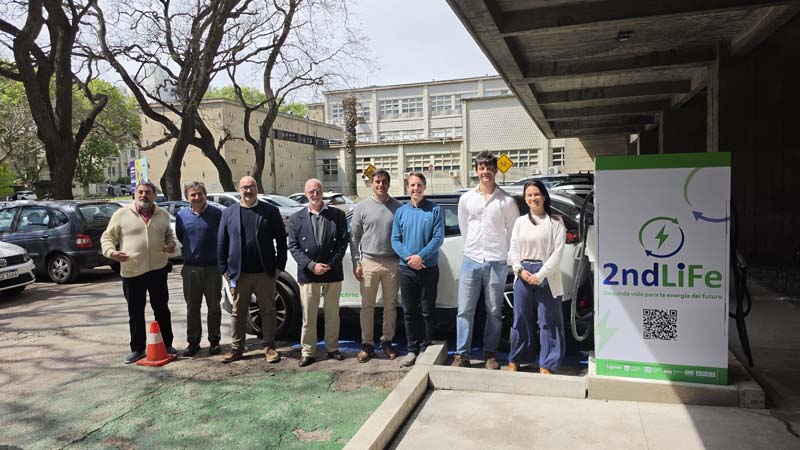
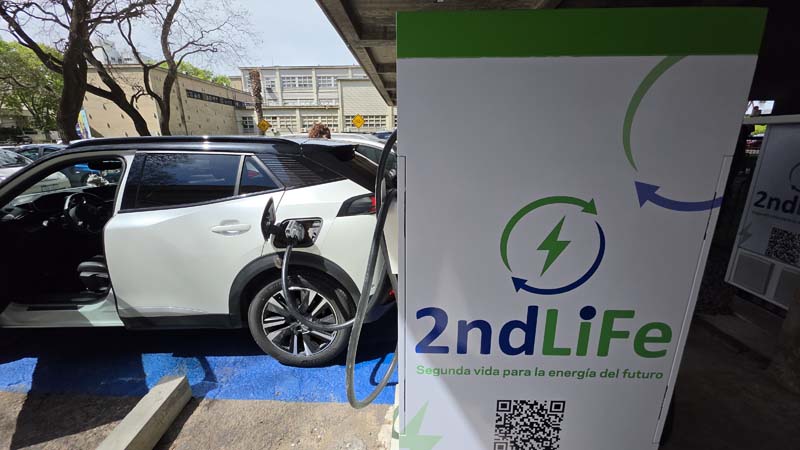
 On Thursday, October 22, the 2ndLife prototype was unveiled at the Faculty of Engineering of the University of the Republic (FIng-Udelar). This system reuses electric vehicle batteries to facilitate the operation of fast chargers and reduce the power they draw from the electrical grid.
The device is the result of a joint project between the Udelar School of Engineering—through the Faraday Lab, Uruguay’s first academic and technological laboratory specializing in batteries and electromobility—the School of Engineering at the National University of the South ( Universidad ORT Uruguay ), and the company Ingener S.A., with support from the National Agency for Research and Innovation (ANII).
The inauguration was attended by Dr. Andrés Ferragut, professor of Networks and Communication Systems at ORT and a researcher on the project; Dr. Fernando Paganini, associate dean for research at the School of Engineering at the University of the Republic ( Universidad ORT Uruguay); Dr. Pablo Ezzatti, dean of the School of Engineering at Udelar; and representatives from the Ministry of the Environment, Ingener S.A., and the research team.
A Second Life for Electric Vehicle Batteries
The growth of electric mobility poses a challenge that is often overlooked: What happens to the batteries in vehicles that are taken off the road?
In many cases, especially when they come from wrecked vehicles, these batteries retain a significant portion of their capacity and could continue to function for years.
2ndLife aims to harness that potential. To that end, the research team analyzed batteries from electric vehicles to determine their condition and assess their potential for reuse.
Based on that work, he designed and integrated a battery energy storage system (BESS) that complements the operation of a fast charger.
During peak demand periods, the batteries supply part of the energy needed to maintain the charging speed, without increasing the power drawn from the electric grid.
Fast charging with lower power requirements
The prototype uses a 30-kWh battery, salvaged from a wrecked vehicle, which underwent various tests to assess its condition and ensure the system's safety.
According to Sebastián Bibiloni, a research engineer at the Faraday Lab, this development reduces peak power demand on the electrical grid by 30 percent . In addition, the models developed by the team project significant savings in the cost of meeting demand—an estimate that will need to be validated during the next phase of testing.
This technology could facilitate the installation of high-power fast chargers in locations where the existing electrical infrastructure does not have sufficient capacity to power them directly.
In this way, the solution would help expand the availability of fast-charging stations throughout the region and meet the growing demand associated with electric mobility.
The project also represents a concrete application of the concept of the circular economy, as it extends the useful life of batteries that might otherwise be taken out of service and assigns them a new role within the electric mobility system.
From Research to a Technological Solution
During the inauguration, Paganini highlighted the collaboration among the participating institutions and the diverse range of expertise required to develop the prototype, from battery research to electrical engineering and software.
The associate dean also mentioned Ferragut's involvement in the project and the academic results achieved in collaboration with Bibiloni.
"We have both sides of academia: the research that produces papers and the actual engineering prototype that we all want to see," Paganini said.
In that regard, he noted that Ferragut and Bibiloni wrote a scientific article that is scheduled to be presented at an international conference in the coming days.
The initiative demonstrates how academic research can lead to concrete technological developments, while also generating scientific knowledge and strengthening collaboration between universities and companies.
A project with growth potential
2ndLife has is supported by ANII through the Innovative Tax Credit Projects program.
With the prototype now installed, a new validation phase begins, during which its performance under real-world conditions will be evaluated and the results will be compared with the estimates obtained through numerical models.
The goal is to move toward a solution that can be replicated, scaled up, and made economically viable, with the potential to contribute to the development of electric vehicle charging infrastructure in Uruguay.
In this way, 2ndLife serves as an example of how collaboration between academia and the business sector can drive innovative solutions for the energy transition.
The project is linked to the SDG 7: Affordable and Clean Energy and SDG 9: Industry, Innovation, and Infrastructure, of the United Nations Sustainable Development Goals, which promote access to sustainable energy, the development of resilient infrastructure, and the promotion of innovation.
In this regard, 2ndLife contributes to more efficient energy management and the development of infrastructure for electric mobility through a technological solution that reuses batteries and stems from collaboration between universities and companies.