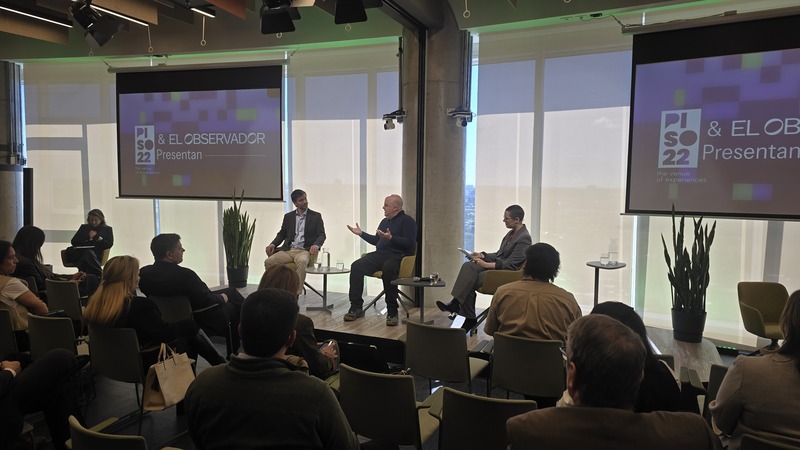
The second edition of Smart Cities: The Cities of the Future, organized by El Observador and Piso 22, took place on Tuesday, September 8, in Montevideo. The event’s program addressed various challenges associated with the development of smart cities based on topics such as public digital infrastructure, artificial intelligence, public innovation, mobility, talent, and urban regeneration.
One of the panels was “Connectivity, AI, IoT, and Digital Twins for Better Decision-Making”, featuring Diego Garagorry, executive director of the Vidart Institute, and Architect Gabriel Lambach. The discussion was moderated by Lucía Bellocchio, founder of Trend Smart Cities. The session was dedicated to examining how these technologies can influence urban decision-making and territorial management.
Architect Lambach is the coordinator and adjunct professor of the Simulation and Video Games Laboratory at the School of Engineering of the Universidad ORT Uruguay —Gamelab—and a professor of BIM Methodology, Artificial Intelligence, and Virtual Reality in the School of Architecture. He also teaches in the School of Design, where he leads the course “Art in Immersive Environments.”
Simulate Before Taking Action: The Benefits of Digital Twins
A digital twin is a digital representation that reflects a real-world object, process, or system. These models can be linked to represent larger-scale systems, such as a city, and used to build scenarios, anticipate possible behaviors, and support decision-making.
One of the possibilities opened up by the convergence of artificial intelligence, data, and simulation technologies is, precisely, to analyze scenarios before implementing certain decisions in the physical world.
During Smart Cities, Lambach explained this capability in terms of the integration of various technologies:
“Digital twin simulation, in particular, is a technology that involves an entire chain; it involves the ability to simulate and cross-reference information among different inputs.”
For the architect, this integration makes it possible not only to work with controlled simulations but also to explore future scenarios. In his view, the value does not depend solely on having a digital representation, but on the ability to combine different inputs to analyze situations and construct scenarios.
During his remarks, he mentioned, in this context, initiatives developed by Studio 4D—whose CEO is architect Hilario Canessa. A graduate of the ORT architecture program, Canessa has previously explained that a digital twin allows one to “experiment, simulate, and adjust projects in real time,” using environments in which it is possible to explore urban scenarios interactively.
From that perspective, in architecture and urban planning, this ability opens up the possibility of test and compare alternatives before translating them into the physical space. It does not in and of itself determine which decision to make, but it allows for the incorporation of new forms of analysis into the evaluation process.
- You might also be interested in reading: “Urban Planning and Technology: Digital Twins That Transform Architecture”
From Generating Data to Gaining Useful Information
The challenge, however, does not end with having large amounts of data.
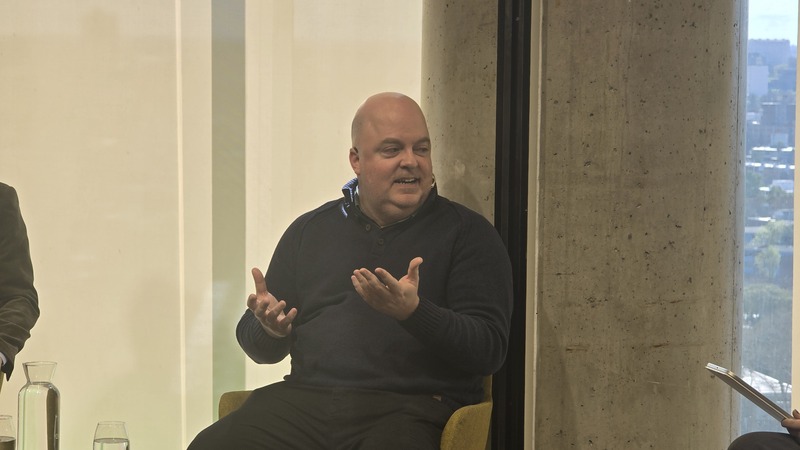
During the panel discussion, the professor from the School of Architecture argued that obtaining raw data does not in and of itself guarantee that anything relevant can be gleaned from it. The problem, therefore, is not merely having data; it is being able to correlate and interpret it in light of a specific question or decision.
This approach helps us understand another aspect of digital twins. Their usefulness becomes apparent when different inputs can be integrated to analyze situations, explore alternatives, and build scenarios that would otherwise be difficult to study collectively.
Furthermore, according to Lambach, these possibilities must serve a specific purpose. When referring to the changes these technologies can bring about in cities, he pointed to “improving residents’ quality of life, which is, in fact, the ultimate goal.”
- You might also be interested in reading: “AI Tools for Architects and Designers”
AI in Uruguay: Home-grown Capabilities to Address the Country's Challenges
The conversation also took on a national scope thanks to the participation of Diego Garagorry, executive director of the Vidart Institute, Uruguay’s National Center for Artificial Intelligence.
The institute had been publicly unveiled on September 7, one day before the meeting. Following in the footsteps of Uruguay Innova, it was created with the goal of generate cutting-edge knowledge, develop talent, and translate the use of artificial intelligence into concrete capabilities and results for the country.
During the panel discussion, Garagorry raised the need to identify which capabilities, sectors, and challenges are priorities for Uruguay. From this perspective, conducting our own research allows us to take advantage of global technological advances without losing sight of the country’s specific needs and opportunities.
This line of reasoning also raises an important question for cities: not only what a given technology can do, but also which problems we want to solve with it and what capabilities are needed to achieve that goal.
- You might also be interested in reading: “Cities of the Future, AI, and Sustainability: Architect Lambach at the Forbes Real Estate Summit”
Artificial Intelligence with Guidance and Discernment
That transition from technological possibilities to their intended purpose was one of the main themes of Lambach’s presentation.
When discussing the opportunities presented by artificial intelligence, he noted:
“When you talk about opportunities in artificial intelligence, if you don’t give it a direction, if you don’t establish criteria, you end up with something very vague, very general.”
This statement shifts the focus from the tool to the ability to decide how to use it. In architecture and disciplines related to space, AI and simulation technologies can expand the possibilities for representation and analysis. However, increasing these capabilities does not, in and of itself, resolve the question of which problem to address, which information to consider, or which objective to pursue.
View this post on Instagram
This reflection builds on other recent discussions addressed by the Faculty. At the IA Human Future 2026 Summit, various presentations steered the conversation toward the need to integrate new tools without compromising professional judgment, contextual understanding, human sensitivity, and responsibility.
During Smart Cities, Lambach also linked this discussion to his university work and specifically mentioned his involvement with the schools of Engineering, Architecture, and Design. His academic work at the School of Architecture includes teaching courses related to BIM, artificial intelligence, and virtual reality.
In this context, education is not limited to the technical learning of new technologies. Lambach’s own approach also frames the challenge as providing guidance, establishing criteria, and determining which applications are appropriate for each problem.
- You might also be interested in reading: “Summit IA Human Future 2026: Artificial Intelligence and New Questions for Space-Related Disciplines”
Why Build Smarter Cities?
Toward the end of the panel discussion, the conversation turned to what the outcome of developing new technological capabilities should be.
Garagorry highlighted people’s well-being and the improvement of services as among the impacts to which, in his view, artificial intelligence should contribute. Lambach echoed that perspective and added participation, inclusion, and the improvement of quality of life as criteria to guide these processes.
Thus, the discussion on smart cities is no longer focused exclusively on the ability to generate data, build models, or simulate scenarios. It also requires asking what these capabilities are used for and who is involved in defining their objectives.
The topics addressed during the panel discussion relate to Sustainable Development Goal (SDG) 11: Sustainable Cities and Communities, one of the 17 goals adopted by the United Nations in 2015 to address global challenges by 2030. Among other aspects, this SDG calls for progress toward more inclusive, safe, resilient, and sustainable cities—a challenge that ties into the discussion on how to use data, simulation, and artificial intelligence to inform better urban decision-making.
In Lambach’s view, technological possibilities do not eliminate the need to establish a direction and criteria for deciding how to use them. Toward the end of his remarks, he summed it up with a question:
“If all of that doesn’t involve human beings, what’s the point of what we’re doing?”
For disciplines dealing with space, this question brings the technological discussion back to the territory, the project, and the people who experience its consequences. Simulation can expand the scope of what can be analyzed before taking action, and artificial intelligence can increase the capacity to process information. The challenge remains in deciding which questions to ask, which scenarios to evaluate, and toward which objectives to direct these tools.
Relive the match:
https://youtu.be/ZFsN0ble4DI?t=7355
Are you interested in applying artificial intelligence to architecture and design?
Learn about the course on Artificial Intelligence Applied to Architecture and Design