
Although at first glance it may seem unrelated to the space sector, based on its presentations, the Summit IA Human Future 2026 raised new questions particularly relevant to architecture, interior design, landscape architecture, and the real estate industry: how to integrate new tools without compromising professional judgment, contextual understanding, human sensitivity and ethical responsibility.
View this post on Instagram
It is at this juncture that the most direct link to the faculty emerges. AI can speed up tasks, expand analytical capabilities, and transform professional processes, but it also requires us to strengthen the very foundations of the work in these disciplines: design judgment, contextual reading of the territory, understanding of users, responsible use of data, sensitivity to the human experience and the ability to make decisions in contexts of uncertainty.
Artificial Intelligence, Work, and Decision-Making
Organized by Cacique Group, with the support of Universidad ORT Uruguay, the artificial intelligence event of the year took place at the LATU Technology Park Event Center. The day of lectures and panel discussions on Wednesday, May 20, centered on one key question: in the face of the advance of artificial intelligence, protagonists or spectators?
View this post on Instagram
That question was raised throughout the various sessions of the event. At the opening, the technology writer Jon Hernández put forward one of the most provocative ideas of the day:
“Artificial intelligence, in one way or another, generates intelligence that has economic value”.
From that perspective, Hernández argued that AI changes the way people and organizations create value. His presentation addressed the advancement of AI models, the emergence of agents capable of performing tasks, and the impact these technologies can have on companies and work teams.
For disciplines related to spatial design, the question takes on a concrete dimension. In architecture, interior design, landscape architecture, and real estate, professional competence involves understanding problems, interpreting contexts, making context-specific decisions and foresee consequences on people’s lives.
- You might also be interested in reading: “How Artificial Intelligence Is Transforming Architecture”
From cognitive work to the physical world: revisiting criteria for AI
Milagros Hadad's interview with Jorge Milburn, a former executive at Tesla and 1X, turned the conversation to the so-called “physical AI”: robots, bodies, material tasks and everyday environments.
View this post on Instagram
Milburn explained that one of the current challenges is enabling humanoid robots to enter unfamiliar spaces, interpret their surroundings, and perform tasks based on instructions. In this context, he shared a key insight for the faculty’s disciplines:
““We have designed the physical world to be adapted to people.”
The phrase relates directly to architecture and interior design. If the built environment was designed for human bodies, the arrival of technologies capable of operating in homes, offices, factories, or public spaces calls for a reevaluation of criteria regarding circulation, safety, accessibility, ergonomics, maintenance, interfaces, and coexistence between people and autonomous systems.
- Recommended reading: “Hostile Architecture: Challenges and Alternatives for Inclusive Urban Design”
It also raises questions for landscaping and the design of outdoor spaces. In environments where climate, vegetation, soil, pathways, dwell time, and social uses come into play, the integration of smart technologies requires addressing variable conditions and location-specific data.
Milburn took a resolutely optimistic view of technological tools. “Artificial intelligence is a tool, and ultimately, tools expand human capabilities,” he said.
That idea allows us to think of AI as a way to better plan, analyze more scenarios, visualize alternatives, automate repetitive processes, and devote more energy to judgment.
- You might also find this article useful: “AI Tools for Architects and Designers”
Critical thinking, local data, and accountability
The panel “Deciding When No One Has All the Answers,” moderated by Milagros Hadad and featuring Lorena Betancor, Víctor Valle and Marcelo Abreu, provided one of the most significant highlights of the day for the academic community.
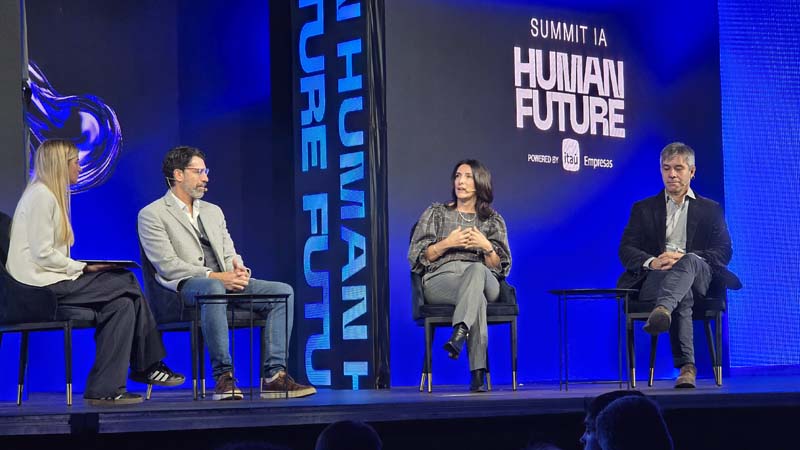
Dr. Betancor, professor of Biotechnology at Universidad ORT Uruguay CEO of Promethenz, noted that “uncertainty is inherent to the work of a scientist.” For her, that uncertainty allows us to ask new questions, advance research, reformulate hypotheses, and push the boundaries of knowledge.
- For more information, we also recommend reading: “Uncertainty is inherent in scientific work”
The idea also resonates particularly well with design work. Design involves making decisions based on incomplete information, testing hypotheses, trying out different approaches, making mistakes, correcting them, and proposing new solutions. In that process, AI can provide speed and analytical capabilities, though the starting point remains human: knowing how to ask the right questions.
View this post on Instagram
Valle, former CEO of Google Argentina, steered the discussion toward human skills. In his remarks, he argued that AI invites us to ask ourselves what is valuable in people and stated:
“The machine sees data, not the essence”.
From that perspective, critical thinking, creativity, empathy, and the ability to interpret complex situations emerge as core skills for any discipline that works with users, spaces, and organizations.
Abreu, Antel’s Innovation Manager, made another key point: the importance of local data and digital sovereignty. “If the data is global, the solutions will be global,” he said.
For disciplines related to the built environment, this statement is particularly relevant: designing in Uruguay requires an understanding of local conditions, regulations, climates, ways of living, urban data, markets, and specific material cultures.
- You might also be interested in reading: “Building from the Ground Up: Architect Beccar Varela, Glenn Murcutt, and the Logic of Landscape”
Creativity, authenticity, and the human experience
Jerónimo Pino, director and founder of Cacique Group and the Summit AI Human Future, and a certified public accountant from Universidad ORT Uruguay, interviewed the renowned Argentine DJ Hernán Cattaneo, a moment that added a cultural and creative dimension to the debate on artificial intelligence.
View this post on Instagram
In this regard, Cattaneo discussed how technology transformed production and electronic music itself, from the analog era to today’s endless possibilities in digital manipulation. “I believe technology was our greatest ally,” he said.
The DJ also corrected the simplistic notion that technology magically simplifies everything, stating that “there’s a tremendous amount of behind-the-scenes work that goes unseen” and that what AI produces and offers is actually the result of the human work behind it.
His most significant contribution to this interpretation becomes apparent when he distinguishes between tool and authorship. For Cattaneo, two people with access to the same technology can produce different results because the difference lies in talent, personality, intention, and individual pursuit. In this regard, he noted:
““If you and I have access to the same AI, we’re going to do different things.”
And that perspective is linked to design in the broadest sense. In architecture, interior design, or landscape architecture, a tool can speed up renderings, generate variations, or support technical processes. The authenticity of a proposal, its relationship to the site, its sensitivity to users, and its conceptual coherence depend on human decisions.
In addition, Cattaneo also offered a particularly insightful reflection on space and experience. When discussing his sets (performing a live mix), he noted that no two were ever the same and that a performance changes and evolves depending on the time of day, the weather, the audience, and the venue: “It’s not the same if you’re outdoors as it is if you’re indoors.”
For the spatial disciplines, that phrase contains a central idea: context shapes experience. A plaza, a home, a room, an office, a garden, or a cultural space are not neutral settings. They shape how people meet, move, remember, listen, work, and live.
Toward the end of the interview, Cattaneo also recalled a quote from rector of Universidad ORT Uruguay, Dr. Jorge Grünberg, at the 2025 edition of the IA Human Future Summit, when he noted:
“People will lose their jobs to other people who are better at using artificial intelligence.”
Paraphrasing the university rector, the artist stated that “AI isn’t going to replace you; the one who uses it better than you will.” In his view, AI can be an ally for those who integrate it with intelligence, judgment, and their own personality; not as a substitute for authenticity, but as a tool capable of expand creative and professional possibilities.
- You might also be interested in reading: “EPICA: Artificial Intelligence to Boost Creativity in Architectural Research”
Science, Ethics, and Powerful Technologies
The conversation between Martín Aguirre, editor-in-chief of the newspaper El País, and Gonzalo Moratorio, a Uruguayan scientist and virologist, steered the discussion toward research, biotechnology, and responsibility regarding high-impact technologies.
View this post on Instagram
Moratorio discussed the advancement of AI in scientific practice and noted that “the doors that are already opening” hold a potential that is difficult to measure. He also cautioned that this potential can be used for good or for ill, which is why ethical standards are absolutely essential.
When explaining his work with viruses engineered to attack tumor cells, he was clear about the issue of responsibility: “Our primary concern as scientists is biosafety.”
Even if their field is not that of design disciplines, this reflection offers a cross-cutting caution that does resonate with the practice of spatial disciplines: any technology capable of intervening in complex systems demands responsibility.
In architecture, interior design, landscape architecture and real estate, these systems are the spaces, territories, organizations, and experiences that affect people’s daily lives.
Moratorio also highlighted the importance of working with diverse, multidisciplinary teams, made up of people with different perspectives and from different age groups. This idea resonates with the interdisciplinary nature of contemporary projects, where innovation requires bringing together knowledge, experiences, and different ways of looking at a problem.
- You might also be interested in reading: “Digital Architecture at ORT: Designing with AI, AR, and VR Starting in the First Year of College”
Augmented intelligence: learning, deciding, and acting
The event concluded with a keynote address by Jonatan Loidi titled “Augmented Intelligence.” From the outset, Loidi explained that this is how he understands this stage: an era in which AI can expand human capabilities, but also test the attitude with which each person and each organization face change.
View this post on Instagram
“It has never been easier to access knowledge, and it has never been harder to find people willing to do something with it,” he said. For Loidi, knowledge is increasingly available, but the difference lies in the willingness, curiosity, and attitude needed to turn it into transformation.
His presentation also suggested examining teams from two perspectives: aptitude and attitude. The first is linked to verifiable knowledge and experience; the second, to a willingness to embrace change. At that intersection, he identified the profile he considers most essential: proactive and studious individuals, capable of learning, adapting, and taking action.
For real estate businesses, construction companies, professional firms, and organizations involved in the design and management of the built environment, this matrix offers a clear picture: the adoption of AI depends on tools, processes, data, and teams capable of reviewing how they work, how they make decisions, and how they engage with their clients.
In the final section, Loidi summarized one of the most useful ideas for thinking about the role of AI: delegating repetitive tasks can free up time “to be more human”. This statement resonates with much of the discussion. If AI allows us to reduce bureaucratic or routine tasks, the challenge lies in deciding what to do with that freed-up time.
For the departments of ORT's School of Architecture, integrating artificial intelligence means learning to use tools, strengthening the ability to read contexts, asking relevant questions, interpreting local data, designing experiences, acting responsibly, and upholding what technologies cannot replace: human connection, spatial sensitivity, and meaningful decision-making.
At that intersection of technology, judgment, and experience lies one of the central challenges of contemporary professional education: to prepare people capable of planning, managing, and envisioning possible futures without losing sight of the human, territorial, and cultural impact of every decision.
Relive the Human Future 2026 AI Summit:
https://www.youtube.com/live/WGi6_g9qYVc
You can also watch the full discussion here.
Learn about the undergraduate and graduate programs offered by the School of Architecture