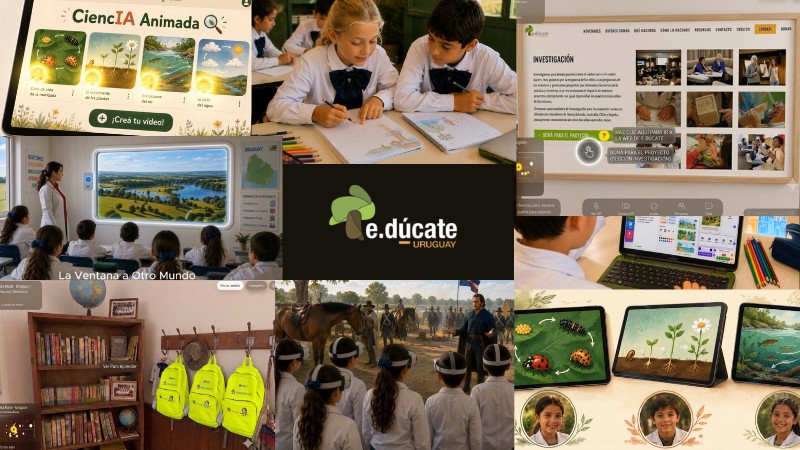
As part of the course“Technologies Applied to Creativity”inthe Master’s Program in Creativity, Innovation, and Communicationat the School of Graduate Studies and Continuing Education in Communication and Design, students developed proposals in collaboration with Educate Uruguay, a nonprofit organization that has been working since 2009 to strengthen public education in the country’s rural areas.
The course is taught by ProfessorFabián Barros, who also serves as the academic coordinator of the Bachelor's Degree in Design, Art, and Technology.
Educate Uruguay: An NGO Dedicated to Rural Education
Educate Uruguay isa Uruguayan nonprofit organization that has been working within the public education system since 2009, with a specific focus on the rural sector.
Its work focuses on teachertraining: the organization provides theoretical training in teaching methodologies to rural teachers and supplements that training withteaching materials to helpthem apply those methodologies in the classroom.
The NGO does not receive public funds nor has guaranteed has , so it must constantly rely on finding partners to help it sustain its projects.
Inés López, Director of Expansion and New Projects at Educate Uruguay, joined Mónica, the organization’s chief operating officer, in presenting the students’ final projects.
Proposals that combine approaches
When asked about the students' work process, López described the experience as extremely rewarding, both from a human perspective and in terms of the proposals they presented.
We really didn't have any expectations about what we were going to find, but honestly, when we saw each of the proposals today, the results were very rewarding, as was the fact that they so clearly captured the essence of our NGO and what we prioritize.
Regarding the specific projects, López noted that the various projects, each with a different approach, complemented one another: “I’m leaving with an idea—not just one, but the possibility of drawing on aspects of several of them—and perhaps we can begin to consider developing and implementing a proposal that combines elements from the different proposals presented today.”
Among the approaches presented, López mentioned proposals aimed at implementing existing programmes, others focused on designing a new program, and one specific proposal related to institutional communication: how to showcase the Foundation’s work to attract new individuals interested in collaborating with the NGO.
"It's something we have to do on an ongoing basis—finding partners who will enable us to continue our work. So the ideaof coming up with innovative ways to present ourselves, to share what we do, and to do so clearly was also very appealing to me."
Some of the projects presented
E.dúcate Immersive
Esquivel, Diniz, Macció, and Smerdiner developed E.dúcate Immersive, a project that creates a digital twin that can be explored using Matterport. Through this experience, visitors can freely explore a virtual environment and interact with various objects that represent E. programmes main programmes . The platform functions as a virtual school organized into themed stations, each linked to an actual program within the initiative.
https://youtu.be/Q1b84Z977kE
A Window to Another World: E.dúcate
Scavuzzo, Albónico, Detomasi, and Clamer developed " Window to Another World," an educational platform that allows teachers and students to learn, explore, and create using artificial intelligence tools, augmented reality, and immersive experiences.
https://youtu.be/M6D5FUdhG5k
Illustrated Worlds
Beloqui, Fanzía, Goenaga, and Núñez created *Mundos ilustrados*, a platform where stories find a new way to grow. Schoolchildren write their stories in the *ceibalitas* and create characters with their own traits. The app guides them through the entire creative process, helping them shape their ideas and transform them into a complete illustrated book.
https://youtu.be/C5egyNXu_s4
Science in Motion
The students themselves also developed " Ciencia animada," an app that transforms the records and observations that schoolchildren make during their nature explorations into educational materials for science learning. Instead of using videos downloaded from the internet, the platform generates its own resources that can be shared and used by different schools through the Ceibal network.
https://youtu.be/Fo73xMFwuM4
The Value of Tackling Real-World Challenges
For López, the greatest benefit of this type of academic experience is that it forces students to design solutions that can be applied to organizations with limited resources, rather than proposals that remain purely theoretical.
If one does not apply this to specific cases of organizations like ours—which face limitations in terms of resources, accessibility for the public, and even connectivity or available technologies—one may end up with something that is unfeasible or that ultimately remains purely theoretical.
As he explained, all the projects presented were feasible precisely because they were designed with progression or scalability in mind.
"Everything we saw today is feasible, and precisely because of the scalability or the progressive implementation of each of these projects, I believe it provides them with tremendous value in terms of developing, innovating, and inventing—but on things that will later become real and applicable, rather than just a theory or an idea that remains just that: an idea."
Learn more aboutthe Master's in Creativity, Innovation, and Communication