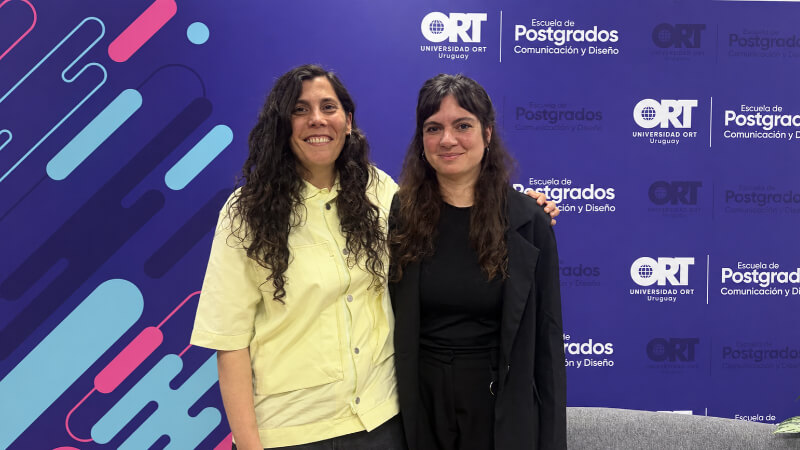
As part of the “Technologies for a Possible Future” series, the School of Graduate Studies in Communication and Design at the National University of the Arts ( Universidad ORT Uruguay ) hosted the symposium“UX: A Responsible Approach and New Narratives,”an event that addressed the ethical challenges posed by the design of digital products in a context of rapidly advancing artificial intelligence.
The event brought together perspectives related to user experience design, artificial intelligence, futures studies, and speculative design. The gathering encouraged participants to question some of today’s design practices and to consider alternatives that take a more responsible approach to the impact of technology.
Rethinking the User Experience from a Responsible Perspective
The first session was led by Lucía Guedes de Rezende Montes, who holds a bachelor’s degree in graphic design from the Universidad ORT Uruguay, and is a former Senior UX Manager at PedidosYa and former UX Manager at Mercado Libre. She presented a critical analysis of current design paradigms and their relationship with artificial intelligence.
During his presentation, Guedes addressed user experience from a perspective that integrates people’s needs, organizational goals, and the specific conditions of communication and information. Within this framework, he emphasized the importance of understanding how design decisions can influence user behavior.
The exhibition explored concepts related to cognitive psychology, biases, mental models, information architecture, and human-centered design. It also focused on so-called “dark patterns,” or deceptive design patterns: practices that can influence or condition users’ decisions to benefit certain interests.
https://www.youtube.com/watch?v=gzcztNK0Sew
In light of these dynamics, the proposal highlighted the need to move toward a conception of user experience that is not limited to creating functional or visually appealing products, but rather incorporates ethical criteria and accountability for the consequences of design decisions.
“These days, just making beautiful things isn’t enough,”Guedes said during the meeting, referring to the need to question standard practices and adopt a more responsible approach to design.
Envisioning Alternative Technological Futures
The second session was led by Andreína Grasso, a researcher, strategist, and designer at ++hellohello, who uses methodologies from future thinking, foresight, philosophy, and the theory of futures to support organizations in navigating uncertain scenarios.
Drawing on futures studies and speculative design, Grasso presented tools for envisioning different technological scenarios and reflected on the role of design in shaping those futures.
One of the concepts discussed was the so-called “cone of futures,” which allows us to distinguish between probable, plausible, possible, and preferable scenarios. This tool encourages us to look beyond what seems most predictable in order to explore different alternatives and ask ourselves what kind of futures we want to build.
https://www.youtube.com/watch?v=8FDud_95Zyg
In this regard, Future Thinking was presented as a methodology that enables us to work with uncertainty using tools, frameworks, and artifacts that help bring still-abstract scenarios into focus. Among the methodologies mentioned is backcasting, which starts with a desired future and works backward to identify the steps and decisions needed to move toward it.
As discussed during the meeting, building the future also involves reexamining the narratives through which we think about technology. Imagining new possibilities means creating different stories about what might happen and, based on those stories, opening up paths for their realization.
Shaping the future also means taking responsibility
The two exhibitions broadened the discussion on technological design from complementary perspectives. While user experience design allows us to analyze everyday interactions with digital products and services, futures studies provide tools for envisioning scenarios and challenging the notion thatcertain technological trajectories are inevitable.
The “Technologies for a Possible Future” series was part of Graduate Studies Week and aimed to explore the social and cultural impact of artificial intelligence from different perspectives. Within this framework, the activities were organized around four themes:
- data and digital platforms
- The Foundations and Tensions of Responsible Artificial Intelligence
- ethical design of digital products
- stories about alternative technological futures.
The proposal thus encouraged a shift in the focus of the question from “which technologies are being designed” to “how are the decisions involved in that process made, and what futures do they help to shape?”

This activity is linked to SDG 4: Quality Education, one of the Sustainable Development Goals adopted by the United Nations in 2015 to address global challenges by 2030, due to its educational approach to providing tools and perspectives for critically analyzing the design and impact of technologies.
Learn about the Master's in Strategic Design and Innovationand the Master's in Creativity, Innovation, and Communication