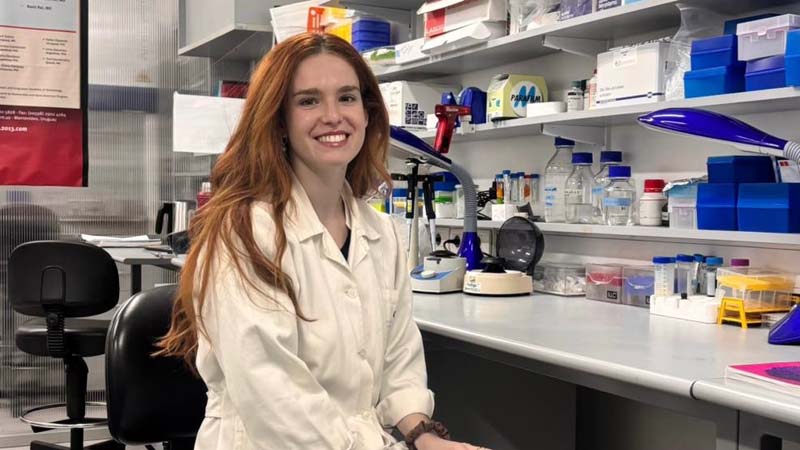
The research that Eugenia began while studying biotechnology engineering continues to yield results five years later. Her master’s thesis, titled “Implications of S100A9 Protein Expression During the Progression of Chronic Lymphocytic Leukemia,” received two awards: the Eugenio Prodanov Award for the Best Master’s Thesis from PEDECIBA and the Award for the Best Master’s Thesis granted by the Institut Pasteur de Montevideo with the support of the French Embassy in Uruguay.
“It’s really nice when people outside the field truly see the value in what you’re doing.” For Eugenia, receiving these recognitions also gives her the motivation to continue her research: “It motivates you a little more, and you think, ‘What I’m doing is really good.’”
A Possible Treatment Strategy
Chronic lymphocytic leukemia is a blood cancer that primarily affects older adults and can progress differently in each patient. While some patients can live with the disease without needing treatment, others develop more aggressive forms that may not respond to available therapies.
Eugenia's research focuses on these latter cases. Previous studies had observed higher levels of the S100A9 protein in patients with a more complex clinical picture. Her work sought to understand what role that protein might be playing in the progression of the disease.
“We found that there appears to be a pathway that activates this protein and allows the cell to survive and proliferate in this inflammatory environment.”
The next step was to study what happened when that pathway was inhibited. In experiments conducted with cells from patients, they observed increased tumor cell death when specific inhibitors were used. The results were also evaluated in preclinical models developed in collaboration with Moffitt Cancer Center in the United States.
In these models, they observed increased survival and a reduction in tumor cells. The results suggest that this pathway could be explored as a therapeutic strategy, especially for patients with aggressive forms of the disease.
From the Lab to the Patients
Identifying a potential therapeutic target is just one step in a process that can take years. “This project actually began in 2015. We’ve been working on it for more than ten years, making a little more progress each time.”
For a laboratory finding to be translated into a treatment, it is necessary to continue generating evidence and advancing through various stages of research. The pharmaceutical industry also plays a role, especially when it comes to developing a new drug.
In this case, there is also the possibility of studying inhibitors that are already in use or being evaluated in clinical settings to determine whether they might have applications for this type of cancer. “That makes the process of developing a drug from scratch a little easier.”
A journey that began at ORT
Eugenia's connection to this line of research began when she was looking for a place to complete her final thesis project. However, her interest in science—and specifically in cancer—had started long before that.
“My passion for science has been with me for as long as I can remember; I’ve always been very curious. When I was a little girl, my parents gave me a microscope, which I still have.” Over time, that scientific curiosity also intersected with personal experiences, as her family had to face situations related to this disease on several occasions.
In high school, he initially thought about studying medicine, but toward the end he began looking for other options. That’s how he discovered biotechnology engineering at the Universidad ORT Uruguay. “I went with my mom to the lab and loved it. I said, ‘I want to do this.’”
In biotechnology, he found a way to approach his interest in health from a different angle: not through direct patient care, but by researching the mechanisms of diseases and seeking answers that could contribute to the development of new strategies for treating them.
When it came time to choose her final thesis project, she looked for an opportunity specifically related to cancer. Although there was no open call for applications at the Institut Pasteur in Montevideo—the lab she was interested in—she decided to write anyway.
“I sent an email saying that I was a student, that I was interested in the topic, and that I wanted to write my thesis on it. I didn’t think they’d ever reply.”
Two weeks later, she received a reply. The lab was about to announce a job opening, and they invited her for an interview. That’s how she began working on chronic lymphocytic leukemia and the role of S100A9, a line of research she later continued during her master’s program.
Between Academia and Industry
While completing her master’s degree, Eugenia also began to get involved with the pharmaceutical industry. She is currently participating in a collaborative project with GSK at the chronic lymphocytic leukemia laboratory at the Institut Pasteur in Montevideo. This experience allowed her to begin exploring the link between academic research and industry.
This degree offers a lot of versatility. It doesn't limit you to a single career path.
Her next goal is to pursue a Ph.D. to delve deeper into some of the questions that remain unanswered regarding S100A9. After that, she is considering various options for continuing her career in both academia and industry.
“My small contribution”
When she chose to study biotechnology engineering, Eugenia had a goal she described as curing cancer. After years of working in cancer research, her understanding of that goal changed. “Curing cancer is a very broad concept, because it’s not a single disease.”
Today, find a more concrete way to think about that goal.
If my small contribution ends up being useful in an application and helps even one person, I feel completely fulfilled.
Looking back and thinking about the student who was just starting her college career, Eugenia feels that her initial interest found its way: “I can tell that Eugenia, ‘See, that’s right—that was the path.’”
Learn more about Biotechnology Engineering