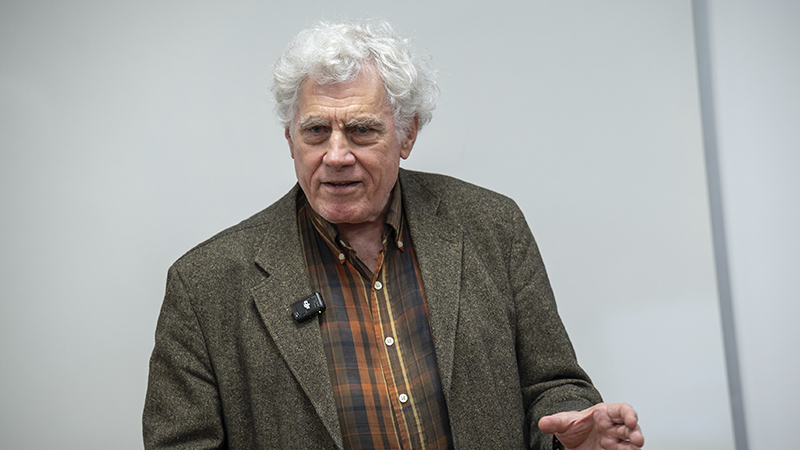
Every July 4, the United States celebrates a date that is an integral part of its national identity. 250 years after its proclamation, the Declaration of Independence remains much more than a historical document. Its words, its principles, and even its tensions allow us to examine the origins of the nation, gain insight into its culture, and understand some of the debates that are still present in American society.
In this context, the Institute of Education at Universidad ORT Uruguay Dr. James Deutsch —an assistant professor in the Department of American Studies at George Washington University (United States) and senior content coordinator for the Smithsonian Institution’s “America at 250” publishing project—who delivered a lecture titled “We hold these truths to be self-evident: The Declaration of Independence at 250.”
What Really Happened on July 4?
At the start of his presentation, Deutsch proposed examining a seemingly simple question:What actually happened on July 4, 1776? Although that date is celebrated every year as Independence Day in the United States, he explained that the answer is not always so obvious. In fact, he noted that many people in the United States “are unable to answer that question” and have not even read the entire Declaration of Independence.
The scholar explained that on July 4, the Continental Congress did not declare independence or sign the Declaration, but rather adopted the document setting forth the reasons why the colonies had decided to separate from Great Britain.
Strictly speaking, independence had been declared two days earlier, on July 2. However, since the date of July 4 was printed in the approved text, that day became established as the national holiday. “It’s a kind of historical accident,” Deutsch explained.
https://www.youtube.com/watch?v=bzVyHzt8rV8
During his first visit to Uruguay, Deutsch also expressed his particular admiration for the Declaration of Independence, which he described as a “beautiful document” and one of his favorite texts.
As he put it, part of its power lies in the precision of its writing and in the ability of each word to explain to the world the reasons behind a momentous political decision. “Yes, we are revolutionaries, but we feel we are in the right, and we believe the world will agree,” Deutsch said, summarizing the spirit of the text.
A nation built from its states
Another key theme of the conference was the importance of the states in the organization of the United States. Deutsch explained that, in 1776, the emphasis was not on the idea of a unified nation as it is understood today, but rather on the states of America. That conception, as he pointed out, helps explain several distinctive features of the U.S. system, such as the functioning of the Electoral College or the organization of education.
Building on that idea, he explained that education is primarily the responsibility of each state, and that the Electoral College also reflects that distribution of power.“The key point was the states,”Deutsch said.
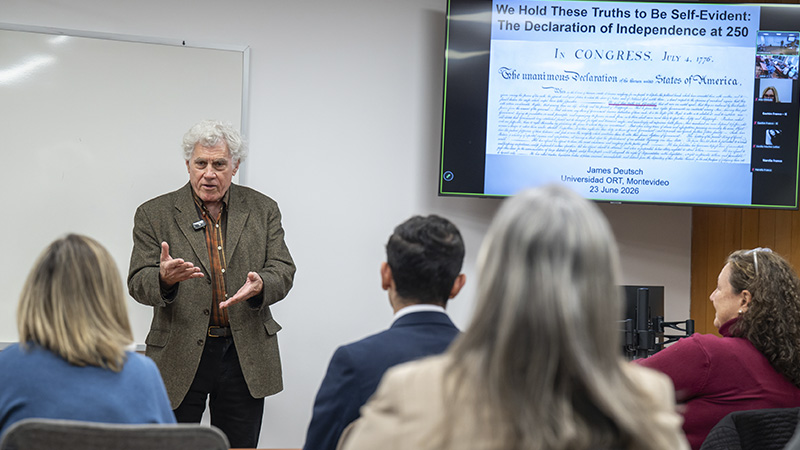
“People often ask, ‘Why do you have this crazy Electoral College system? Why not just count the number of votes and let that determine who becomes president?’” the speaker explained. In his view, the key is that the system gives power to the states; if everything were decided solely by the number of votes, candidates would “hardly” campaign in states with small populations.
“And that is why there are so many unique characteristics in the United States, and why the states have so much power,” he summarized. Deutsch added that this autonomy is also reflected in the fact that each state has its own laws, with regulations —and restrictions— that can vary significantly from one state to another.
A document shaped by the Enlightenment
Deutsch devoted a significant portion of his presentation to analyzing the Declaration as a text deeply influenced by the ideas of the Enlightenment. In this regard, he emphasized the central role of human reason in understanding the world, as well as the importance of individual liberty, natural rights, religious tolerance, secularism, progress, perfectibility, the social contract, and the consent of the governed.
“It is a wonderful coincidence that when the Declaration was drafted, the principles of the Enlightenment were deeply rooted,” he added.
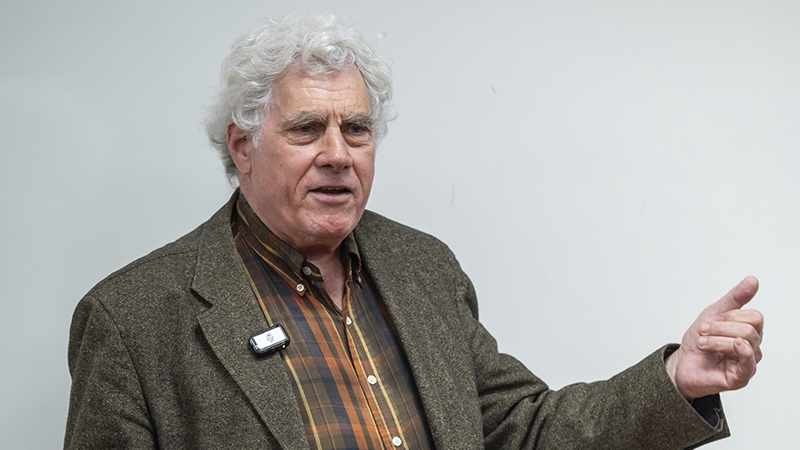
In that context, he stated that the unanimous Declaration of the thirteen United States of America established inalienable and fundamental rights, including life, liberty, and the pursuit of happiness. This last phrase, he noted, became particularly significant within American culture.
“We have the right to pursue happiness, ”Deutsch said. “We may not always find it, but we aspire to the pursuit of that perfection or perfectibility,” he added.
The Effects of the Declaration on American Society
Specifically,what did the Declarationmean to the people of the United States? First and foremost, it solidified a central idea: equal opportunity and the assertion that“all men are created equal.”
As Deutsch emphasized, this is another phrase deeply rooted in American culture, which holds that a person’s place in society should not be determined by their birth or their family’s status, but rather by their ability, effort, and work. Even so, the speaker pointed out a fundamental contradiction: many of those who signed the Declaration had enslaved other human beings.
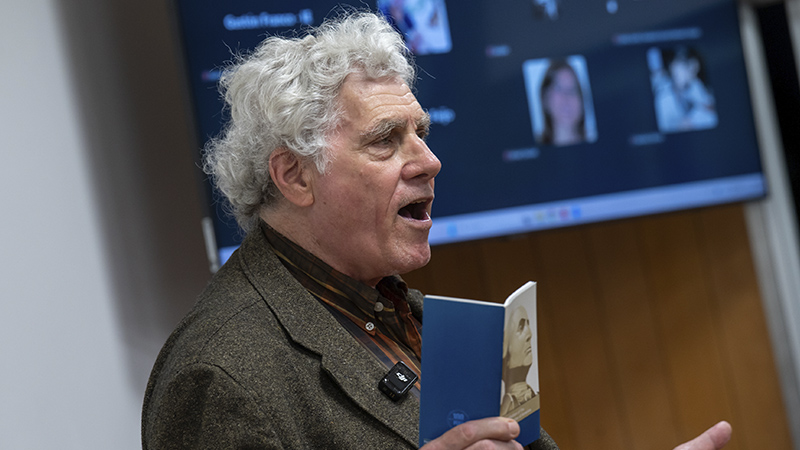
“American culture places a high priority on personal autonomy, self-reliance, and the freedom to shape one’s own destiny. Now, frankly, it’s not entirely true that we are the masters of our own destiny or the architects of our own fortune; but we like to believe it, ”he said.
The American Dream
At the same time, Deutsch linked the Declaration to one of the most enduring ideas in American culture: the American Dream. “We want to believe that we control our own destiny. And the idea of the American Dream implies that, no matter how poor a person may be, they can become president of the United States or run one of the world’s largest companies, ”he asserted.
“That is the dream. And it remains a very, very powerful dream in the United States —one that, moreover, attracts people from all over the world.” For the scholar, one of the country’s greatest strengths is precisely this ability to attract “motivated, intelligent, and capable people” who seek to advance and, in the process, also contribute to the development of the United States.

Finally, Deutsch emphasized that one of the Declaration’s most significant consequences was its role as a catalyst for civil rights. Although not everyone enjoyed equality in 1776, the document laid the groundwork for a promise that would be taken up by successive generations.
“Abraham Lincoln, Elizabeth Cady Stanton, and Martin Luther King Jr. drew on the ideas of the Declaration to fight for the abolition of slavery, women’s suffrage, and the modern civil rights movement, ”he concluded.
An opportunity for academic and cultural exchange
Dylan Vest, Deputy Counselor for Public Diplomacy at the U.S. Embassy in Uruguay, thanked Universidad ORT Uruguay its collaboration in making Deutsch’s visit possible. “His expertise offers a unique opportunity to deepen our understanding of U.S. history and culture, ”he emphasized, adding that he hopes the lecture will allow attendees to “explore the historical and contemporary dimensions of American societyin greater depth.”
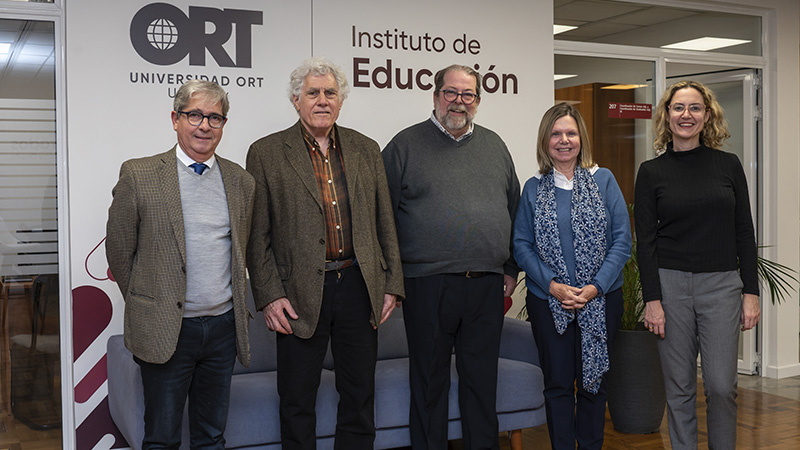
For her part, Dr. Denise Vaillant, dean of the Institute of Education at Universidad ORT Uruguay, noted that the event is part of an initiative aimed at opening the doors of the Institute of Education to the community, as well as at initiating new dialogues and exchanges. “Without a doubt, the history of the United States and its independence is a topic that is currently on the regional and international agenda and has sparked a great deal of interest,” she said.
In the same vein, Dr. Gabriel Díaz Maggioli, a professor at the Institute of Education, expressed special gratitude to the U.S. Embassy for its support in making the visit possible and emphasized the significance of welcoming Deutsch to Uruguay. He also recalled the academic relationship he has maintained with the speaker for decades and noted that his“talent, knowledge, and inspiration”have been a source of admiration over the years.
Díaz Maggioli emphasized that this career path was, in fact, one of the reasons why he felt it was important to create an opportunity to share Deutsch’s work with the university community.
Image Gallery

During his stay in Uruguay—in June 2026— Dr. James Deutsch carried out a program of academic exchange with various stakeholders and institutions in the field of education. The visit was part of the English Language Specialist program of the U.S. Department of State’s Bureau of Educational and Cultural Affairs, coordinated locally through the U.S. Embassy in Uruguay and the Regional English Language Office.
In this context, Deutsch developed Universidad ORT Uruguay project *The United States at 250: An Interdisciplinary View Through the Lens of American Studies* at Universidad ORT Uruguay , with the aim of strengthening academic exchange, promoting an interdisciplinary understanding of the United States, and exploring future collaborations with Uruguayan institutions of higher education and teacher training.