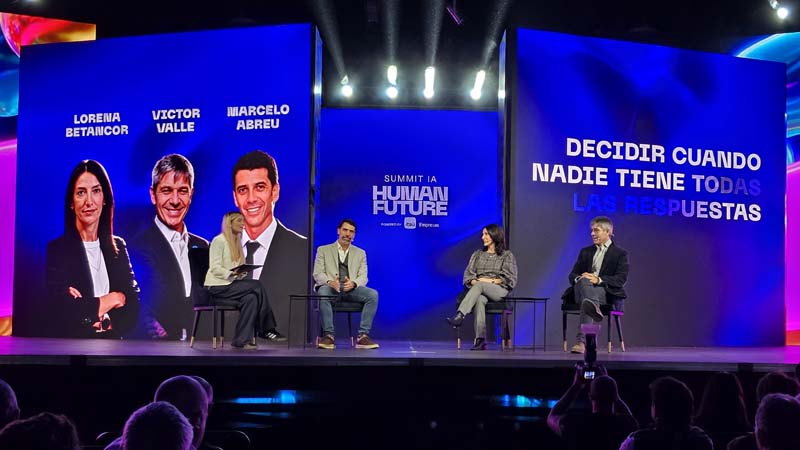
During the discussion, he shared the stage with Víctor Valle, CEO of Google Argentina, and Marcelo Abreu, Antel’s Innovation Manager. The discussion focused on how individuals, organizations, and academia are coping with rapidly changing and uncertain environments.
Betancor emphasized that living with uncertainty is an essential part of scientific work and the innovation process.
“It is what allows us to ask new questions, advance research, and push the boundaries of knowledge.”
He also explained that the scientific process is marked by hypotheses, mistakes, and constant revisions.
Failure as part of the process
In that regard, he noted that research involves constantly dealing with mistakes and mentioned that he often tells his students that “out of the five days in a week, four and a half are going to be failures.”
As he explained, a large part of scientific work consists precisely of going through attempts that do not lead to the expected result, but it is that accumulation of errors, validations, and reformulations that allows us to advance our understanding and develop new solutions.
The professor also pointed out that scientific research teaches humility, because evidence often shows that initial ideas were incorrect.
In his view, accepting uncertainty is essential not only for basic research but alsofor innovation and the development of transformative technologies—such as new drugs, therapies, or medical devices—where there are long periods of uncertainty before a concrete result is achieved.
Biotechnology and Artificial Intelligence
Betancor also discussed the impact that the integration of biotechnology and artificial intelligence will have in areas such as healthcare, agriculture, and the environment.
As he explained, there are current trends related to the co-development of therapies and the use of artificial intelligence to integrate large volumes of biomedical data.
He also noted that these tools are transforming the way scientific research is conducted, as they make it possible to optimize experiments, speed up processes, and significantly reduce the time between the conception of an idea and its scientific validation.
In that regard, he explained that in the past, a researcher might have had to conduct thousands of experiments to validate a hypothesis, whereas today, artificial intelligence makes it possible to identify the most promising avenues and reduce the number of tests needed to reach a conclusion.
This does not stifle scientific creativity; rather, it frees up time to focus on new questions, interpretations, and developments.
He emphasized that the School of Engineering is actively working to integrate artificial intelligence into its academic curriculum and specifically mentioned the development of initiatives related to bioinformatics.
He explained that artificial intelligence makes it possible to speed up scientific processes, optimize experiments, and generate predictive models capable of analyzing large volumes of biomedical data.
The Role of Teachers in the Face of AI
Another topic discussed was how education is changing with the rise of generative artificial intelligence.
Betancor noted that, since February 2023, Universidad ORT Uruguay conducting workshops aimed at updating teachers on new teaching methods and improving the learning experience for students.
“Teachers should teach students to identify important information, ask the right questions, and understand artificial intelligence as a tool that fosters creativity.”
It also highlights that teachers from previous generations can make a valuable contribution by drawing on the strengths of traditional learning formats and combining them with new tools to enhance the training of future professionals.