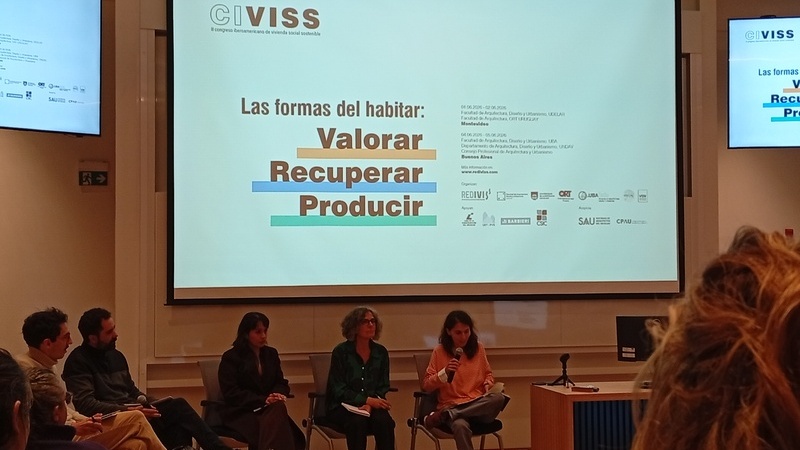
The 2nd Ibero-American Congress on Sustainable Social Housing —CIVISS II— brought together researchers, educators, students, and professionals in the fields of architecture, urban planning, social housing, and sustainability in Montevideo and Buenos Aires. Under the theme “The Forms of Living: Valuing, Recovering, Producing,” the conference aimed to discuss the rehabilitation, recovery, and production of sustainable social housing from different scales of living.
This article focuses on Panel 4 of the general program for CIVISS II, the first session held at ORT on Tuesday, June 2.
2nd Ibero-American Congress on Sustainable Social Housing
In Montevideo, the conference featured events at the School of Architecture, Design, and Urban Planning at the University of the Republic (Uruguay) and at the School of Architecture at Universidad ORT Uruguay. The session held at ORT took place in Room 107 of the Business School within ORT’s Faculty of Administration and Social Sciences and was part of a broader program, which continued that same day at FADU-Udelar and later in Buenos Aires, at FADU-UBA and UNDAV.
View this post on Instagram
ORT’s participation in the conference was also reflected in the academic and institutional work of Dr. Guillermo Lockhart, architect, research professor, and chair of the History and Theory of Architecture at the School of Architecture, who served on the REDIVISS Organizing Committee and was one of the faculty members responsible for the event at ORT.
At the same time, during the opening of the conference, the Architect Gastón Boero, dean of the ORT School of Architecture, put forward an idea that resonated throughout the conference: “Talking about sustainable social housing is not just about buildings”. In his remarks, he linked the topic to the city, the region, the economy, finance, innovation, the future, and the place that decent housing occupies among collective priorities.
View this post on Instagram
Within this framework, Panel 4 of the CIVISS II general program—the first panel held at ORT—launched a discussion on urban regulation, conflict, and densification. Moderated by Guiomar Martín Domínguez, assistant professor of History of Architecture and Urban Planning at ETSA Madrid (UPM), the session featured four presentations related to Barcelona, Lima, and Brazil, with an emphasis on the existing city, social networks, territorial permanence, and everyday ways of living.
- You might also be interested in reading: “Madrid Nuevo Norte Project, lecture by architect José Luis Infanzón”
What topics were discussed at Table 4 of CIVISS II?
Panel 4 provided an opportunity to consider sustainable social housing from the perspective of territories that already have a history, conflicts, population densities, infrastructure, forms of organization, and networks of daily life.
The presentations all emphasized the importance of understanding the material, social, economic, and political conditions that underpin current forms of living. This perspective is key to intervening in the existing city without erasing the capacities accumulated by neighborhoods, communities, and their everyday practices.
The cases presented were not comparable to one another. Each reflected a different reality: densely populated outlying neighborhoods in Barcelona, a self-built informal market in Lima, Brazilian port areas undergoing investment and financialization, and a housing complex linked to the Movimento dos Trabalhadores Sem-Teto in São Paulo.
That diversity made it possible to broaden the discussion on sustainable social housing: what does it mean to restore what already exists, how is the value of community networks recognized, what role does care play in urban life, how are territories under economic pressure governed, and in what ways can architecture enable—or restrict—forms of collective life.
Urban densification and neighborhood cohesion in Barcelona
The first presentation, given by Maribel Rosselló Nicolau, presented the case of densifying neighborhoods on the urban outskirts of Barcelona. The presentation focused on Roquetes and Prosperitat, two residential areas marked by growth, building transformation, and high urban density.
Rosselló described the shift from old, low-rise houses to taller buildings and densely developed lots. That transformation was summed up in a single, clear phrase: “The shift from a horizontal city to a vertical city”.
This change brought with it problems related to accessibility, energy efficiency, narrow staircases, a lack of elevators, cramped courtyards, and homes with complex lighting, ventilation, and connections to the outdoors. Along with this physical assessment, the exhibition also highlighted the value of local networks, neighborhood commerce, continuity, community roots, and forms of social cohesion.
During the pandemic, Rosselló noted, those neighborhoods demonstrated a capacity for daily resilience that proved crucial for their residents. That experience allowed us to view densification both as an urban problem and, at the same time, as an opportunity for intervention when we recognize the social and spatial conditions that sustain neighborhood life.
From that perspective, the presentation argued for the need to develop strategies at the block or neighborhood levelthat could improve accessibility, energy efficiency, shared spaces, and services, without undermining the networks that sustain daily life.
From this perspective, densification can become an opportunity if the complexity of the existing fabric is recognized and if the transformations build on what already works: the street, proximity, and the neighborhood as a support network.
- You might also find it interesting to read: “An urban diagnosis in Ecuador proposes interpreting a neighborhood as a human body”
Street markets, housing, and care in Lima
The second presentation, given by Zarita Gianni Polo Roncal, an urban architect from the Pontifical Catholic University of Peru, shifted the discussion to Lima, based on the case of the Lima Norte Farmers’ Marketin the district of Los Olivos.
The exhibition proposed a look at popular markets as complex urban infrastructures. In addition to their commercial function, they organize food supply, employment, housing, care, social interaction, and neighborhood life. In the words of the presentation, “popular markets are quite complex urban infrastructures that sustain daily life in self-built neighborhoods”.
The case study showed how a market can transform into a vertical neighborhood, with housing built above commercial stalls and a permanent coexistence of economic activity, residence, and caregiving. This situation creates opportunities, but also problems: spatial precariousness, seismic vulnerability, a lack of adequate infrastructure, and difficulties for those who combine commercial work, domestic life, and caregiving tasks within the same environment.
View this post on Instagram
The presentation placed special emphasis on the role of women, who carry out a significant portion of the commercial and caregiving activities in these spaces. The gender perspective helps us understand how commercial work, caregiving, and daily life are distributed within the market.
The proposed project aimed to to integrate commerce, housing, and care without displacing the population or disrupting the daily economy that sustains the community. To that end, it proposed a methodology based on analysis, participation, and planning, with strategies such as safe streets, care networks, new access points, and support structures.
The presentation allows us to appreciate the value of what already exists without confusing it with acceptance of its precarious conditions. Recognizing the practices, networks, and knowledge that sustain a way of living may be the first step toward intervening with greater precision and responsibility.
- You might also be interested in reading: “Building from the Site III: Architect Beccar Varela, Glenn Murcutt, and the Logic of the Landscape”
Brazilian Port Areas: Infrastructure, Financialization, and the Right to Stay
The third presentation, given by João Carlos Cardoso da Silvaof the Federal University of ABC (UFABC, Brazil), broadened the discussion to include Brazilian port areas. His presentation addressed the relationship between global urbanization, financialization, foreign investment, and housing rehabilitation.
The paper proposed interpreting the port as a catalyst for urban reconfigurations, territorial conflicts, and challenges related to the right to remain of communities historically connected to those spaces.
From that perspective, the exhibition highlighted a tension between two rationales. On the one hand, port and financial expansion turns infrastructure into a strategic asset. On the other, decent and sustainable housing requires addressing the needs of the populations living in these areas and who may be exposed to land speculation, rising living costs, gentrification, or indirect displacement.
One of the most powerful quotes from the exhibition summed up that perspective:
“Housing is not merely a side effect; it becomes a strategic dimension of the territorial dispute”.
From this perspective,housing rehabilitation should be part of port governance. The presentation discussed public regulatory instruments, social participation, compensation, community partnerships, and urban design that takes into account noise, traffic, and environmental risks.
The purpose of this presentation was to situate sustainable social housing within a complex territorial framework. Housing is linked to land, infrastructure, the state, investment, and global logistics. From this perspective, it becomes a criterion for evaluating the legitimacy of urban and port projects.
- You might also be interested in reading: “Lina Bo Bardi and the Other Modernity: Architecture, Popular Culture, and Sustainability”
MTST in São Paulo: Community Life After Securing Housing
The fourth presentation, given by Rafael Migliattiof the University of São Paulo (USP, Brazil), focused on the Homeless Workers’ Movement (MTST) in São Paulo and analyzed the relationship between the struggle for housing, architectural form, and everyday life.
The case made it possible to observe a central contradiction: processes of social organization can foster solidarity, care, activism, and community life; however, in the phase following the housing occupation, the architectural and urban form of the complex can strain or undermine these practices.
The exhibition described a housing complex on the outskirts of São Paulo, linked to a protest campaign by the movement. According to Migliatti, the problem lay not only in securing housing, but in how the built space organized life thereafter: the relationship between private units, common spaces, work routines, care, social interaction, and participation.
In that regard, the presentation noted that architecture can manage daily life, fragment time and uses, reinforce the separation between the individual and the collective, or limit the spatial conditions that allow a community to thrive.
One of the most accurate statements in the presentation on this subject was:
“The physical quality of a space and the process of its social production influence the possibilities for building a daily life based on solidarity and community”.
This reading raised a question that is particularly relevant to the field of architecture:What happens after moving into a home? Social sustainability requires addressing, in addition to the housing unit itself, the spatial conditions of communal life, spaces for gathering, care networks, and the urban forms that can support collective processes.
- You might also find it helpful to read: “Architecture and Mental Health: How the Design of Spaces Impacts Our Psychology”
Valuing, restoring, and producing within existing territories
The CIVISS II Table 4 at ORT brought together four different approaches to thinking about sustainable social housing within existing territories.
In Barcelona, the discussion focused on densely populated neighborhoods that require physical improvements but also contain valuable neighborhood networks. In Lima, the focus was on a popular market where commerce, housing, and care form the fabric of daily life. In Brazilian port areas, housing emerged as part of a struggle over permanence, governance, and territorial justice. In São Paulo, the discussion centered on the relationship between housing gains, architecture, and community life.
Taken together, the papers help us understand, appreciate, recover, and produce as interconnected operations. To value implies recognizing what already exists: networks, practices, memories, economies, and forms of organization. Reclaiming requires intervening on material, urban, and social problems without erasing those capacities. Producing involves imagining new design, regulatory, and institutional strategies to support more dignified, inclusive, and sustainable ways of living.
That was one of the most notable contributions of the event held at ORT: bringing together diverse cases to explore a common question. How to plan, regulate, and transform the existing city without losing sight of those who live there.
The topic is primarily linked to Sustainable Development Goal (SDG) 11: Sustainable Cities and Communities, part of the agenda adopted by the United Nations in 2015 to address global challenges by 2030.
This article addresses this SDG by examining sustainable social housing through the lens of urban planning, densification, the revitalization of existing neighborhoods, the right to remain, accessibility, energy efficiency, and the recognition of community networks that support daily life.
In this context, the discussion presented at Panel 4 of CIVISS II explores how to transform the existing city without displacing its residents and how to design more dignified, inclusive, and sustainable ways of living.
- You might also be interested in reading: “Summit IA Human Future 2026: Artificial Intelligence and New Questions for Space Sciences”