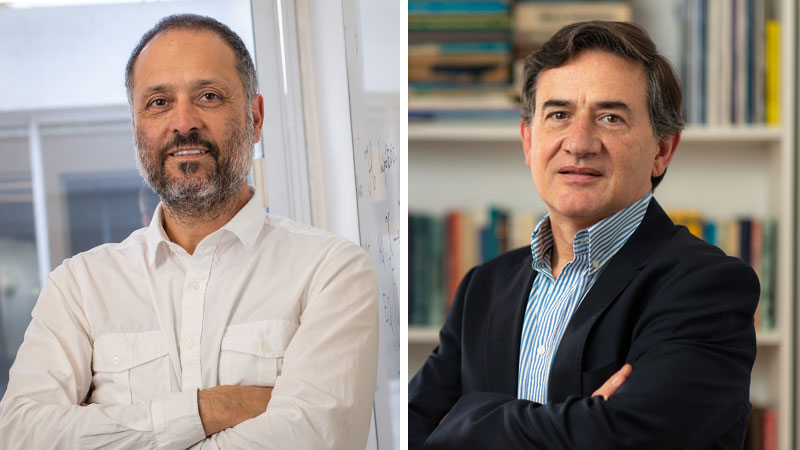
The 2026 update of the international database Updated science-wide author databases of standardized citation indicators, published on October 7 in the Elsevier repository, once again included Drs. Sergio Yovine and Fernando Paganini.
The study, conducted by John P. A. Ioannidis, a researcher at Stanford University (United States), analyzes the impact of scientific output using data from Scopus, an international database that compiles information on academic publications and the citations they receive.
The ranking in which both researchers appear takes into account the cumulative impact of their scientific careers. A separate list is also published that considers only citations received in 2025, including those for works published in previous years.
Research in Artificial Intelligence
Sergio Yovine holds a Ph.D. in Computer Science; he is a professor and academic coordinator of Artificial Intelligence and Big Data in the School of Engineering. He is also a Level 5 researcher in the Computer Science division of the Program for the Development of Basic Sciences ( Programme ,PEDECIBA).
His research career has focused on developing methods to verify the operation of computer systems and, more recently, on analyzing artificial intelligence models, particularly neural networks.
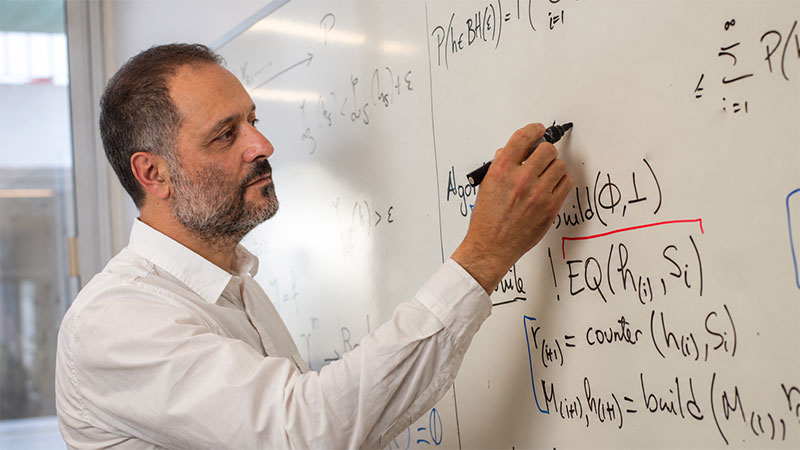
Among his publications is“KRONOS: a Verification Tool for Real-Time Systems,”published in 1997 in the *International Journal on Software Tools for Technology Transfer*. The article, which has been cited 440 times according to Scopus, presents a software tool developed to verify that real-time systems meet certain operational requirements.
More recently, in 2023, he co-authored the paper“A Congruence-based Approach to Active Automata Learning from Neural Language Models”with other researchers, which was published in the *Proceedings of Machine Learning Research*. The paper proposes a method for deriving mathematical representations of the behavior of neural network-based language models, with the aim of facilitating their analysis.
Optimization of Energy Networks and Systems
Fernando Paganini holds a Ph.D. in Electrical Engineering; he is the associate dean for research and a professor of Telecommunications Theory in the School of Engineering. He is also a Level III researcher in the National System of Researchers (SNI).
His scientific career spans the fields of automatic control, optimization, and dynamic systems, with applications in telecommunications networks, computing, and electrical systems.
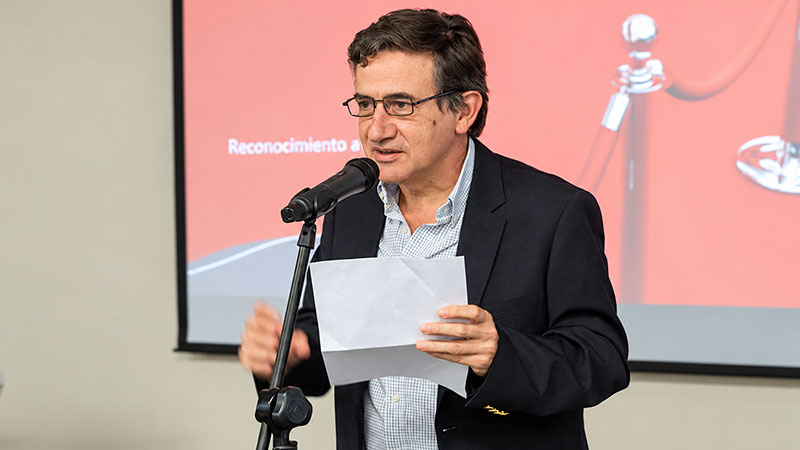
Among his publications is“Internet Congestion Control,”co-authored with Steven H. Low and John C. Doyle and published in 2002 in the IEEE Control Systems Magazine. The article, which has been cited 662 times according to Scopus, analyzes the mechanisms used to control data traffic congestion on the Internet and proposes solutions to improve the stability and performance of networks.
In 2025, he co-authored, with Dr. Andrés Ferragut,“Dynamics and Optimization in Spatially Distributed Electric Vehicle Charging,”published in the journal *IEEE Transactions on Control of Network Systems*. The research develops a mathematical model to analyze how demand is distributed among electric vehicle charging stations, taking into account factors such as travel times, wait times, and user decisions.
How the ranking is determined
The international pool includes the top 100,000 researchers worldwide, as determined by a composite citation metric, as well as those who rank in the top 2% of their respective scientific subfields.
The ranking is based on the so-called c-score, an indicator that combines various metrics, including the number of citations received, the h-index, and the researchers' standing among the authors of the publications.
The database administrators caution that citation metrics have limitations and do not, on their own, constitute a comprehensive assessment of the quality of scientific research.